
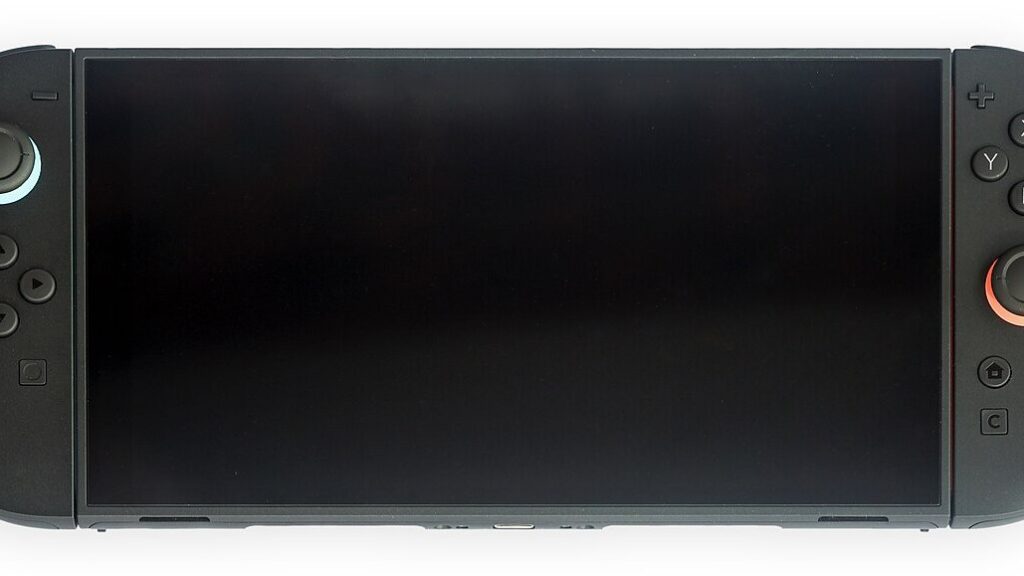
- There is no Switch 2 OLED yet. It is a rumor, not a product. Nintendo has confirmed nothing, and reports point to a possible 2028 launch at the earliest.
- An OLED screen mainly upgrades one thing: how the picture looks in your hands. It gives deeper blacks and richer color in handheld mode, and changes almost nothing else.
- It would not make your games run faster, look sharper on your TV, or play anything the regular Switch 2 can’t. Docked on a TV, an OLED model would look identical.
- The last OLED jump added a modest premium. This time an OLED panel costs more and Nintendo has already raised the Switch 2’s price, so any OLED premium would likely be steeper.
- If you mostly play on a TV, already own a Switch 2, or don’t want to wait years on a maybe, buying now is the smart move. Only patient handheld-first players have a real case for waiting.
Here’s the tricky part: you can’t buy a Switch 2 OLED today. It doesn’t exist yet. Nintendo has not announced one. But the internet is already buzzing about it, and the loudest part of that buzz is money. Would it be worth the extra cost, and how much extra would that even be?
That’s the honest heart of the switch 2 oled price question. An OLED screen is genuinely nicer to look at. It is also more expensive to build. And Nintendo just raised the price of the regular Switch 2 because parts got pricey. So a shinier screen at an even higher price is a real tension, not a small one. Even industry folks discussing the rumor keep landing on the same worry, and IGN summed it up neatly in a recent video: the biggest hurdle for a Switch 2 OLED might be its price tag.
So let’s do the thing nobody selling you a console will do. Let’s separate what an OLED screen actually changes from what it doesn’t, look at what Nintendo’s last OLED upgrade really cost, and figure out whether waiting makes sense for you, or whether you’d just be paying a premium for a prettier black.
The Switch 2 OLED Question Nobody Can Answer Yet
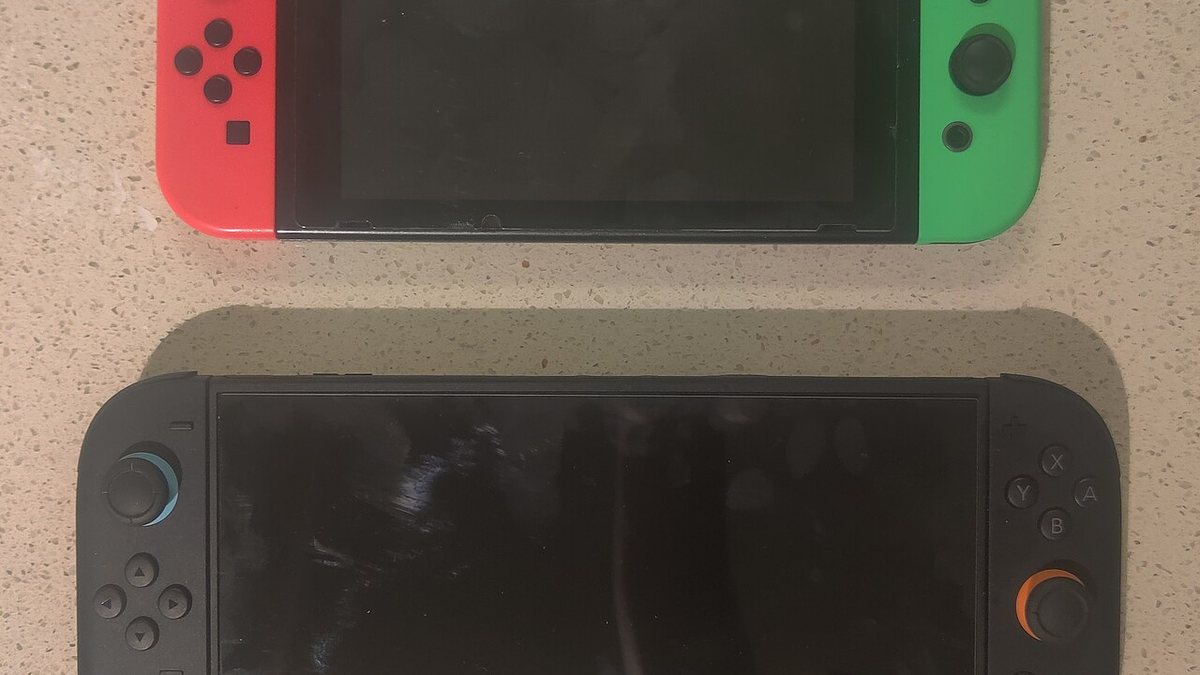
Let’s start with the most important sentence in this whole article: as of today, the Switch 2 OLED is a rumor. That’s it. It is not delayed, it is not sold out, it is not coming next month. Nintendo has said nothing official about it. Everything you’ve read about a “Switch 2 OLED” is reporting and educated guessing, not a product you can add to a cart.
Why does the guessing feel so confident, then? Because Nintendo has done this exact dance before. The original Switch launched on a plain LCD screen, and years later an OLED version arrived. So when a supply-chain report hints Nintendo is “considering” an OLED Switch 2, it fits the pattern people already expect. A pattern is a good reason to pay attention. It is not the same as a promise.
This matters for your wallet in a very direct way. You can’t compare a real price to an imaginary one. So when we talk about the switch 2 oled price, we’re really asking two questions at once: what would it probably cost if it happens, and is that likely cost worth waiting years for? Keep those two apart in your head and the whole decision gets clearer.
What Nintendo Has Actually Confirmed
Here’s the solid ground. The Nintendo Switch 2 is real, it launched in June 2025, and it uses an LCD screen, not OLED. And this wasn’t an accident or a cost-cut Nintendo is embarrassed about. Nintendo’s own hardware lead, Tetsuya Sasaki, said the team chose LCD on purpose because modern LCD panels got good enough to support HDR, the feature that makes bright and dark parts of an image stand out. In other words, Nintendo looked at OLED, looked at LCD, and picked LCD for the launch model with eyes open.
The confirmed screen itself is no slouch. The Switch 2 has a 7.9-inch LCD at 1080p, with HDR and a smooth refresh rate up to 120Hz. That’s a real upgrade over the older Switch OLED’s 7-inch, 720p screen in terms of size and sharpness. You can read all of this straight from Nintendo’s official Switch 2 tech specs if you want the source. The point: the “basic” Switch 2 screen is already a modern, high-refresh, HDR panel, not the dull LCD people remember from older gadgets.
What Is Only a Rumor Right Now
Now the shaky ground, clearly labeled. The claim that a Switch 2 OLED is coming traces back mostly to a South Korean display-industry report. That report suggests Nintendo is weighing whether an OLED model even makes financial sense, and that if it goes ahead, development might start around the end of 2026, with mass production of panels toward the end of 2027. That timeline points to a possible 2028 release. Samsung Display, which supplied panels for the first Switch OLED, is reportedly in line to supply these too.
Read that paragraph again and notice how many soft words are in it: “weighing,” “if,” “might,” “possible.” That’s not me hedging to be safe. That’s genuinely all we have. A rumored OLED model that a supplier is hoping to build is a very different thing from a console with a release date and a price.
What an OLED Screen Actually Does Differently
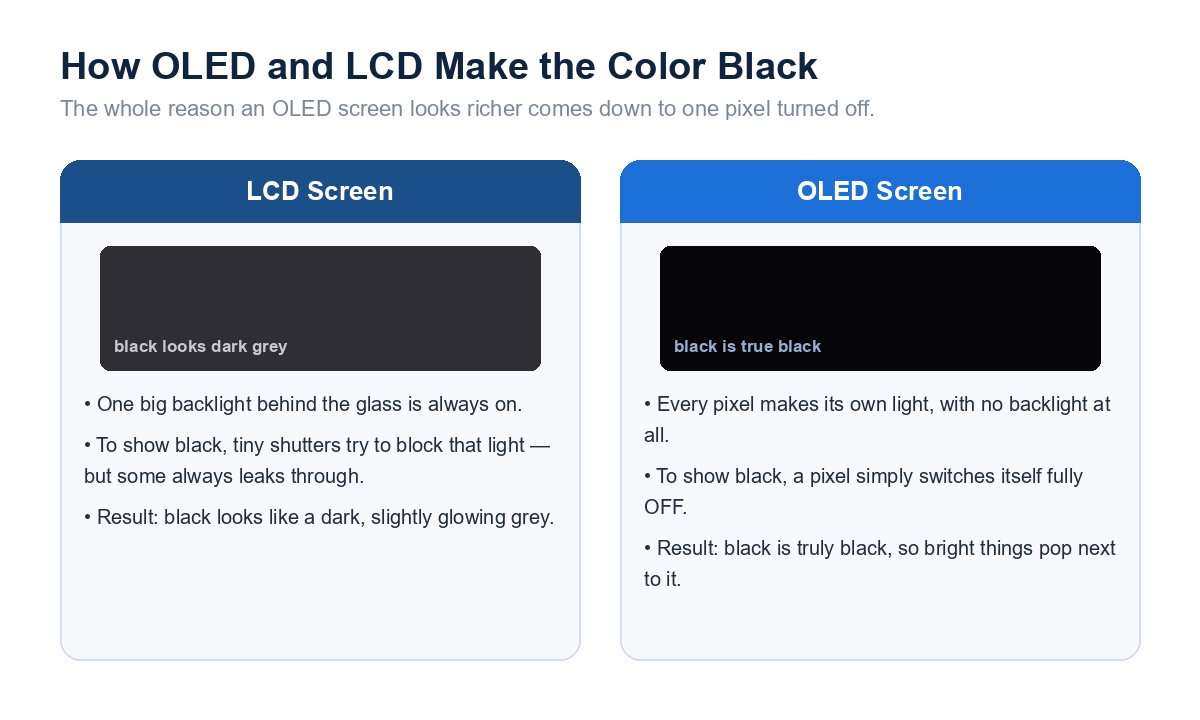
To judge whether a nicer screen is worth paying for, you need to know what a nicer screen actually gives you. So let’s make OLED simple. The magic of OLED comes down to one idea: every tiny pixel makes its own light and can switch itself completely off.
An LCD screen works differently. It has one big backlight behind the glass that’s always shining, and the pixels act like little shutters trying to block that light to make colors. The trouble is, the shutters can’t block all of it. A little light always leaks through. So on an LCD, “black” is really a very dark, faintly glowing grey. On an OLED, a black pixel just turns off, so black is truly black. Next to that true black, bright colors look like they’re glowing.
That difference is most obvious in dark scenes, like a night sky, a spooky cave, or the black bars around a movie. On OLED they look inky and deep. It also helps color feel richer and more punchy. If you play a lot in handheld mode, holding the screen close to your face, this is the upgrade you’d feel every session. It’s a real, visible improvement, not marketing fluff.
What the Original Switch OLED Already Taught Us
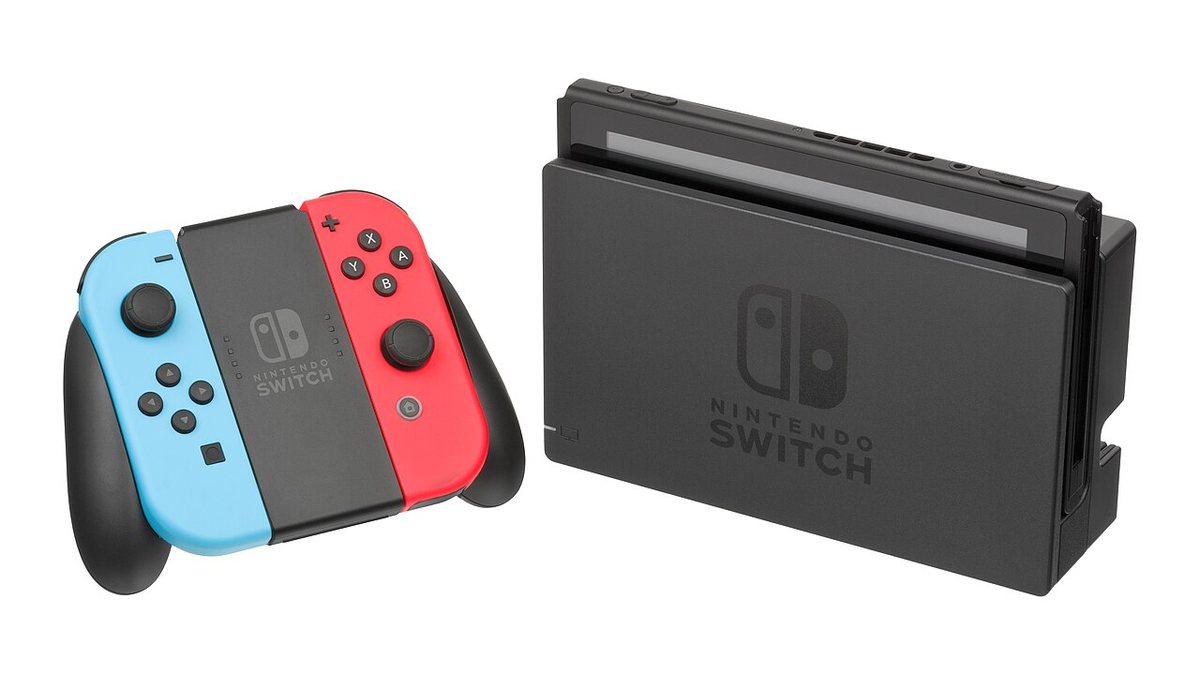
We don’t have to guess what an OLED refresh from Nintendo looks like, because we’ve seen the movie once already. In 2021, Nintendo took the original 2017 Switch and released an OLED version. And the story of that upgrade is the single most useful guide we have to the switch 2 oled price decision.
Here’s what the first Switch OLED actually changed: it added a bigger, gorgeous 7-inch OLED screen, doubled the storage from 32GB to 64GB, added a sturdier adjustable kickstand, put a wired internet port in the dock, and improved the built-in speakers. Nice, thoughtful touches. Owners who played mostly in handheld loved the screen.
And here’s the part everyone forgets: the OLED model did not make the Switch any faster. Same processor. Same memory. Same games, running at the same speed. A slow-loading game still loaded slowly. A game that stuttered still stuttered. Nintendo charged a modest premium for the OLED model over the standard one, and every dollar of that went toward the screen and the small extras, not toward power. That is the template. An OLED refresh is a screen upgrade wearing a new console’s clothes.
What a Switch 2 OLED Would and Would Not Change
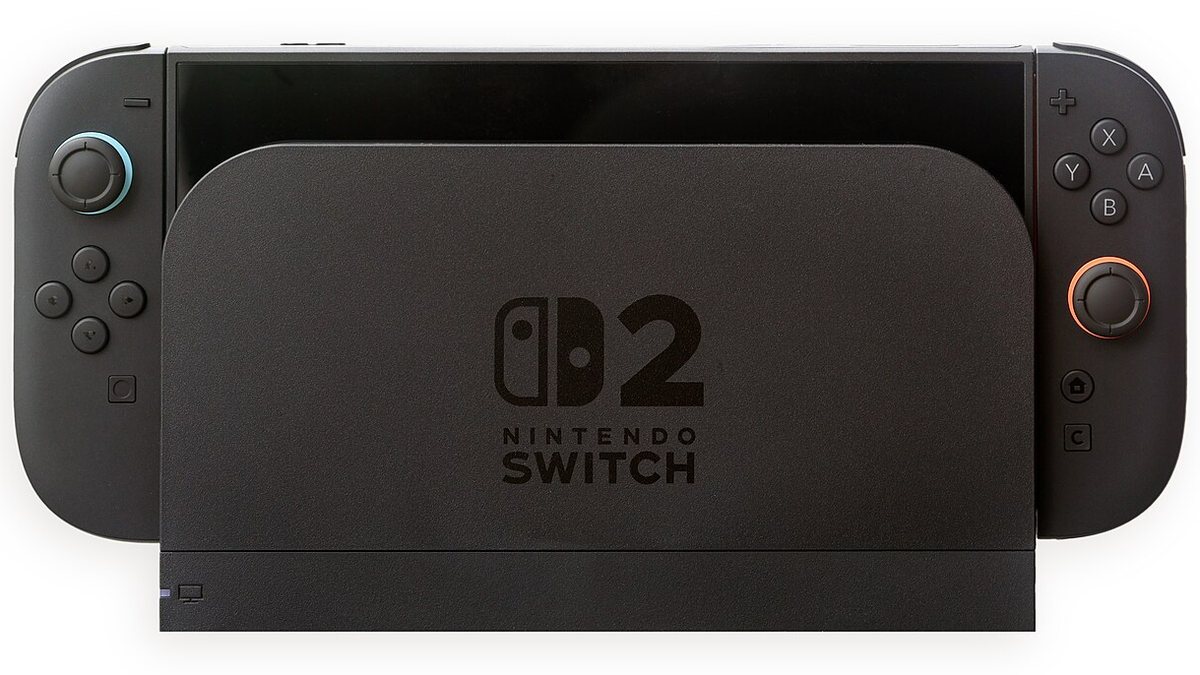
So let’s take that precedent and apply it honestly to a hypothetical Switch 2 OLED. If Nintendo runs the same playbook, we can sort the likely changes into two buckets: the stuff that would genuinely improve, and the stuff that would stay exactly the same. This is where a lot of “should I wait?” confusion clears up fast.
A Richer Screen for Handheld Play
This is the real prize, and it’s a genuine one. A Switch 2 OLED would almost certainly bring deeper blacks, higher contrast, and more vivid color to handheld mode. Reports even suggest the panel would be 1080p OLED, a big step up from the first Switch OLED’s 720p. For someone who plays undocked most of the time, in bed, on the couch, on a train, this is a real, everyday quality-of-life bump.
But be honest with yourself about how big that bump is. The base Switch 2 already has a sharp 1080p HDR screen. You wouldn’t be going from bad to good. You’d be going from good to great, in one specific area: contrast and color richness. That’s worth something. It’s just not the night-and-day jump that the word “OLED” makes people imagine.
Maybe a Size Bump or More Storage
If Nintendo copies the last refresh, an OLED model might also sneak in a few quiet extras, like more built-in storage or slightly better speakers. These aren’t confirmed, and they’re the kind of thing Nintendo decides late, so treat them as bonus possibilities rather than reasons to wait. A little more storage is handy since modern games are large, but you can already solve that with a memory card today for a fraction of a new console’s cost.
The pattern-based guess is that any OLED model would be a “same console, plus a better screen, plus a couple of small perks” package. Useful, but incremental. Nothing here rewrites what the machine can do.
The Same Games, Power, and 4K When Docked
Now the bucket that stays frozen in place. A Switch 2 OLED would play the exact same games as the regular Switch 2, at the exact same speed, because it would almost certainly use the same chip and memory. There is no secret “OLED-only” library. There is no performance mode you’d be missing.
And here’s the one that surprises people most: when you dock the console to play on your TV, the OLED screen isn’t even being used. Docked output comes from the console’s chip sending a picture to your television, up to 4K. That would look identical whether the handheld screen is LCD or OLED. So if your Switch spends most of its life in the dock, an OLED upgrade would improve a screen you rarely look at. That’s the whole game, in one sentence.
The Real Question Is the Price Gap
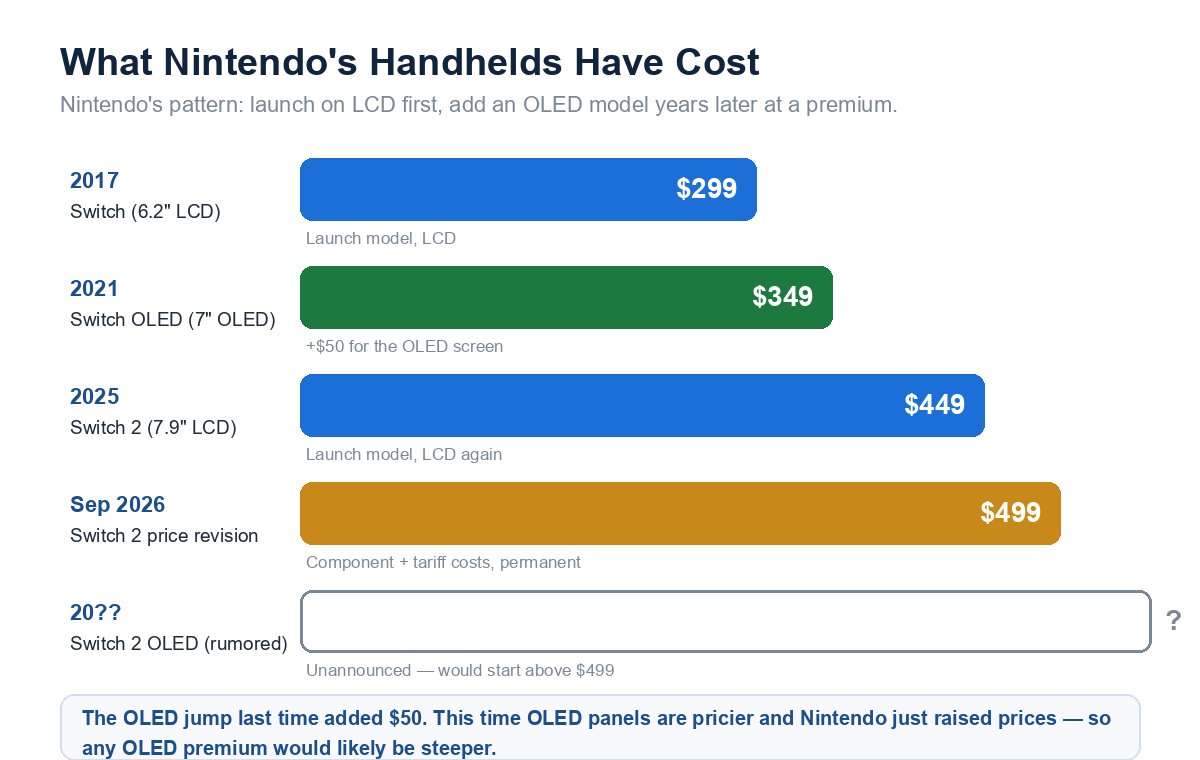
Everything above leads to the number that actually decides this: the gap between what you’d pay for an OLED model and what the base Switch 2 already costs. Because a better screen is easy to want. The real test is whether it’s worth the premium, and that premium is looking less friendly than last time.
Start with history. The first OLED jump was a clean, predictable step of about a sixth of the base price. If Nintendo repeated that exactly, an OLED Switch 2 would sit the same modest step above the base model. Simple. But three things have changed since 2021, and all of them push the likely price up, not down.
First, OLED panels cost more to make than LCD panels, full stop, and this Switch 2 OLED would use a larger, higher-resolution 1080p panel than the small 720p one from before. Bigger, sharper OLED means more cost. Second, the whole industry is dealing with expensive memory chips and other components right now. Third, and this is the big one, Nintendo already raised the Switch 2’s own price because of those exact pressures.
That last fact is the most concrete part of this entire estimate. On September 1, 2026, Nintendo raised the U.S. price of the Switch 2 from $449.99 to $499.99, blaming higher component and tariff costs, and Nintendo’s president has described those cost pressures as medium-to-long-term, not a temporary blip. Those are Nintendo’s own official figures, published in its price revision notice. Stack an OLED premium on top of that raised base and it’s easy to imagine an OLED model landing well north of it, not the tidy step of the old days.
So when people ask about the switch 2 oled price, the honest answer is a range built on reasoning, not a leak: probably more than the raised base price, possibly a good bit more, for a screen upgrade and little else. Whether that’s worth it depends entirely on the kind of player you are, which is exactly where we’re headed next.
Four Types of Players, and the Smart Move for Each
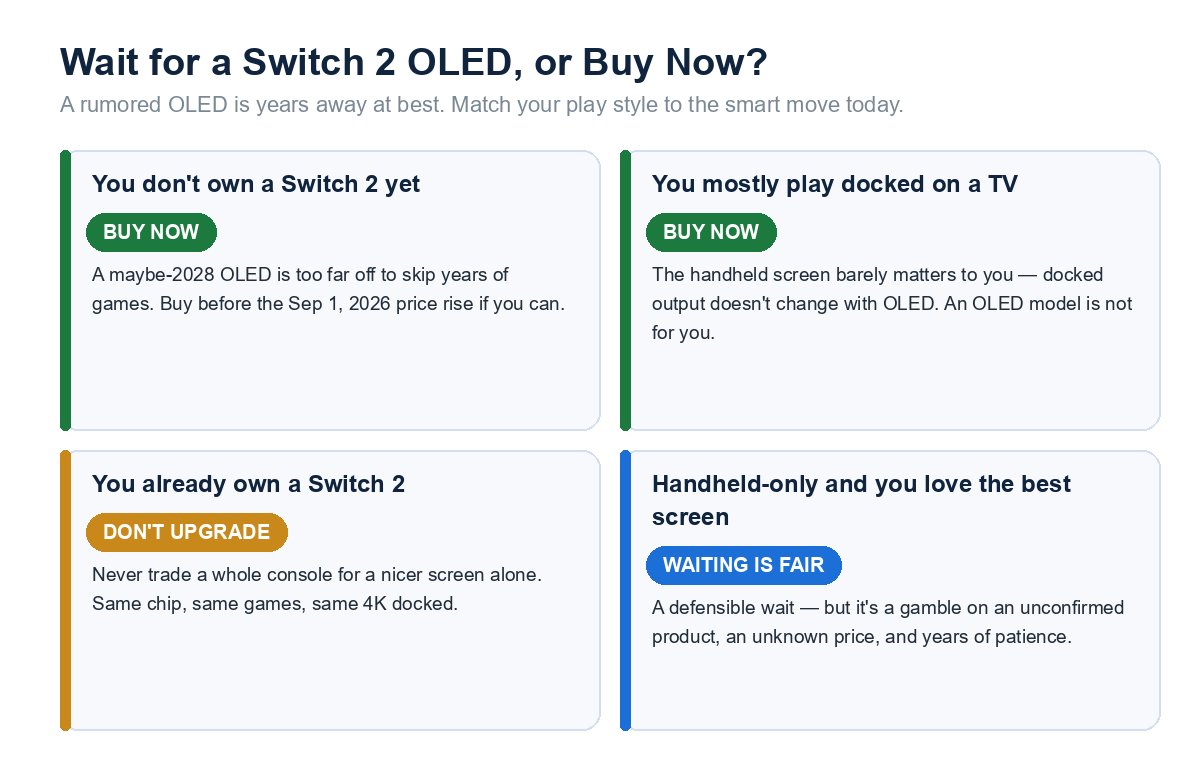
Enough theory. Let’s turn all of this into a plain decision you can actually use. The right move isn’t the same for everyone, because the value of an OLED screen depends completely on how and where you play. There are really only four kinds of buyers here. Find yourself below.
1 If You Do Not Own a Switch 2 Yet
Buy now, and don’t overthink it. A rumored OLED model is, at best, years away, and it may never be announced at all. Waiting means missing years of games to chase a maybe. And the money argument for waiting is weaker than it looks: the base price already went up on September 1, 2026, and Nintendo has framed that increase as lasting, so there is no cheaper window coming back.
The base Switch 2 is not a compromise you’ll regret. It’s a modern, sharp, high-refresh HDR machine that plays everything. You will not be sitting there feeling shortchanged because your blacks are dark grey instead of pure black. Get in, start playing.
2 If You Mostly Play on the TV
Buy now, and skip the OLED conversation entirely. This is the cleanest call on the list. If your console lives in the dock and you play on a television, the handheld screen barely matters to you, and an OLED upgrade would improve a panel you almost never look at. The docked 4K picture on your TV would be identical either way.
Spending extra for an OLED handheld screen when you play on a 55-inch TV is like paying for a nicer car stereo you’ll never turn on. The money buys you a feature your habits don’t use.
3 If You Already Own a Switch 2
Stand pat. You made a good purchase. An OLED model, if it comes, would be a screen upgrade and nothing more, and upgrading a whole console for one component is a terrible trade. The chip is the same, your games are the same, your saves already move with your account, and the docked picture wouldn’t change one pixel.
If a beautiful handheld screen truly matters to you and you’ve got money to burn years from now, nobody can stop you. But go in clear-eyed: you’d be paying a new-console price for a nicer view of the same games you already own.
4 If You Are a Handheld Purist Who Can Wait
This is the one group with a real case for waiting, so let’s respect it. If you play almost entirely in handheld mode, you’re the type who notices screen quality, and you’re genuinely patient, then holding out for a Switch 2 OLED is defensible. You’d get the most benefit from the upgrade and feel it every single time you play.
But call it what it is: a gamble. You’d be betting on an unconfirmed product, arriving on an unknown date, at an unknown and probably higher price, while skipping years of games in the meantime. If you can happily wait and the screen is the thing you care about most, wait. Just know you’re wagering real, playable time today against a rumor. For a related look at Switch 2 hardware quirks worth knowing before you buy, our guide on Switch 2 Joy-Con drift and how to fix it is a useful companion read.
Frequently Asked Questions
Is there a Switch 2 OLED right now?
No. As of now, Nintendo has not announced or released a Switch 2 OLED. It exists only as a rumor built on supply-chain reports. The Switch 2 you can actually buy today uses an LCD screen, which Nintendo chose on purpose because modern LCDs support HDR.
How much would a Switch 2 OLED cost?
Nobody knows, because it isn’t a real product with a real price. Reasoning from history and current conditions, expect it to cost more than the base Switch 2, which itself took a price increase on September 1, 2026. The last OLED model added a modest premium, but a larger 1080p OLED panel plus today’s higher component costs could push any premium higher than that.
When could a Switch 2 OLED come out?
The main rumor points to a possible 2028 launch at the earliest, with panel production reportedly not starting until late 2027. That is a guess based on one industry report, not a Nintendo announcement, so treat the date as loose. It could slip, change, or never happen.
Is the Switch 2 OLED worth waiting for?
For most people, no. An OLED screen mainly improves handheld visuals, and the base Switch 2 already has a sharp 1080p HDR screen. Waiting years and skipping games for a contrast upgrade only makes sense if you play almost entirely in handheld mode and truly value screen quality above playing sooner.
Does a Switch 2 OLED play different games than the Switch 2?
No. If Nintendo follows its usual pattern, an OLED model would use the same chip and memory as the standard Switch 2, so it would play the exact same games at the exact same speed. There would be no OLED-only titles and no performance boost. Only the screen would differ.
Should I buy a Switch 2 now or wait for the OLED?
If you don’t own one, mostly play docked, or already have a Switch 2, buy now or keep what you have. A rumored OLED is years away, may never arrive, and would likely cost more for a screen-only upgrade. Only patient, handheld-first players have a strong reason to wait.
Why did Nintendo use LCD instead of OLED on the Switch 2?
Nintendo’s hardware lead, Tetsuya Sasaki, said the team chose LCD on purpose because modern LCD panels had improved enough to support HDR, the feature that boosts contrast between bright and dark areas. LCD is also cheaper to produce, which helps keep the launch price down. So the LCD choice was deliberate, not a cost-cutting mistake.
About the Author
Elena Brooks
Elena Brooks is the person her group chat texts when something at home stops working or a health trend starts trending. She’s spent years turning that instinct into a job — digging into the research behind everyday questions, calling the experts, and writing up what holds up and what doesn’t. Her beat is wherever curiosity points: kitchens, cars, pets, sleep, money, and the occasional meteor shower.