

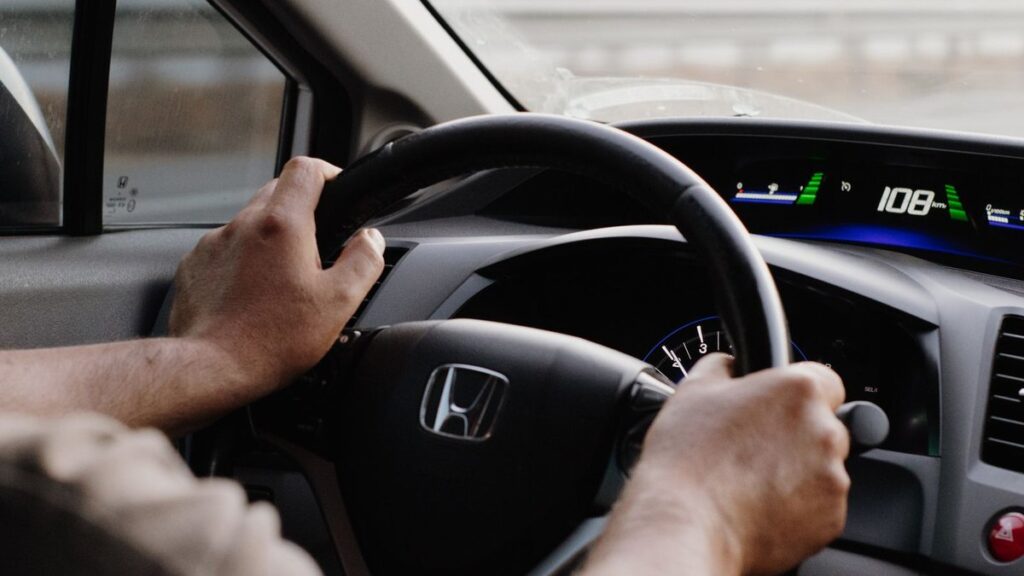
- The timing of the shake is the diagnosis. Shaking only under acceleration points to parts that carry engine torque: CV joints, motor mounts, a misfiring cylinder, or the driveline. Not wheel balance. Not brake rotors.
- A shake that stays the same whether you press the gas or coast is a wheel or tire problem. A shake you only feel while braking is almost always the rotors. These three patterns rarely overlap.
- Repair costs range from about $100 to $250 for spark plugs to roughly $1,100 to $1,400 for a CV axle at a shop. Identifying the trigger condition first protects your wallet.
- You can run the whole load test yourself in five minutes, on a quiet road, with no tools.
- A shake paired with a flashing check engine light is the one version you should not keep driving on. A misfire can destroy the catalytic converter and turn a $150 fix into a $1,000+ repair.
You press the gas and the whole car starts to tremble. You ease off, and it smooths right out. If your car shakes when accelerating, your car just handed you the most useful clue in all of car diagnosis. Most drivers throw it away. Here is the secret mechanics know: WHEN a car shakes matters more than how much it shakes. A shake that only shows up under throttle points at a completely different (and differently priced) list of parts than a shake that follows road speed, or one that appears when you brake. Learn to read that clue and you can walk into a shop already knowing roughly what is wrong and roughly what it should cost.
Why the Timing of the Shake Is the Actual Diagnosis
Think of your car as three separate systems that can each shake you. The wheels and tires spin with road speed. The brakes only touch the wheels when you press the pedal. And the drivetrain, meaning the engine, its mounts, the transmission, and the axles, only strains hard when you ask for power. Each system can only shake you while it is doing its job. That one idea is the entire logic of this article.
Start with the wheels. A wheel that is out of balance has a heavy spot, and every time the wheel spins around, that heavy spot flings outward and tugs on the car. Here is the key part: the tug depends on how fast the wheel is spinning, not on whether your foot is on the gas. So a balance problem shakes you at 65 mph whether you are accelerating, coasting, or cruising. It usually has a sweet spot too, often around 55 to 70 mph. If that is your car, you probably just need wheel balancing, which runs about $15 to $50 per tire. One of the cheapest fixes in this whole story.
Brakes are different again. A warped or unevenly worn rotor is a metal disc with thick and thin spots. You only feel those spots when the brake pads are actually squeezing the disc. So rotor problems shake the car, often through the steering wheel, when you brake from speed, and vanish the instant you let off the pedal. That fix is usually pads and rotors on one axle, commonly $300 to $600 at a shop. It has nothing to do with a shake under throttle.
Now the third pattern, the one this article is about. When your car shakes only while accelerating, the problem lives in the parts that carry torque, the twisting force the engine sends to the wheels. Under throttle, those parts are being wrung like a wet towel. Off throttle, the twisting relaxes to almost nothing. A worn part in that chain can hide perfectly while coasting and scream while loaded. That is why a car that shakes when accelerating but not when coasting is such a gift to a diagnostician. It rules out wheels, tires, and brakes in one sentence.
How to Run the Load Test Yourself in Five Minutes
You do not need tools, a lift, or any mechanical knowledge. You need a quiet road, a parking lot, and five minutes of paying attention. You are separating the three triggers, speed, braking, and load, so you know which system is guilty. Shops effectively bill for this at their hourly rate, which now runs roughly $110 to $175 per hour in much of the United States. Doing it yourself is free.
Step One Is Finding the Speed Where the Shake Appears
Drive at the speed where the shaking is worst and note the number. Then gently accelerate through it and past it. A balance or tire problem is glued to road speed. It always lives at the same mph band, no matter what your right foot does. A load problem follows your foot instead. It appears whenever you push the pedal hard, whether that happens at 20 mph or 60 mph. Write down which one you have. This single observation splits the possible causes, and the possible bills, in half.
Pay attention to where you feel it, too. A shake in the steering wheel tends to come from the front of the car, the front wheels or front axles. A shake in your seat or the floor tends to come from the rear wheels or the driveline under the car. It is not a perfect rule. But shops use it as a starting compass, and it makes your description twice as useful.
Step Two Is the Gas-Off Test at Steady Speed
Here is the money move. Get to the speed where the car shakes, then smoothly lift your foot completely off the gas and coast. Do not brake. Just coast for three or four seconds. If the shake disappears the moment the load comes off, you have confirmed a load-dependent vibration: CV joints, motor mounts, a misfire, or the driveline. If the shake continues exactly as before, load is irrelevant, and you are back to wheels and tires. Repeat it two or three times so you trust the answer.
Step Three Is the Parked Load Test for Motor Mounts
This one feels like a magic trick. Park somewhere safe and open, press the brake pedal down hard and hold it, then shift into Drive and give the engine a small amount of throttle against the brake. You are loading the engine mounts without moving the car. If the engine seems to rise, clunk, or send a strong shudder through the body, a worn mount is letting the engine rock. Repeat gently in Reverse. The engine twists the other way there, so a different mount takes the strain. Keep it brief and gentle. You are looking for a lurch, not stress-testing the transmission.
The Six Load-Dependent Causes Behind a Car That Shakes When Accelerating
So the gas-off test confirmed it. Your car shakes under throttle and calms when you coast. Now we can name suspects. There are six, listed roughly in order of how often they turn out to be the culprit in front-wheel-drive cars, which is what most people drive. Each has a distinct feel, a distinct mechanism, and a distinct price tag. Read them like a police lineup and see which one matches.
1 Worn Inner CV Joints Send a Shudder Through the Floor Under Throttle
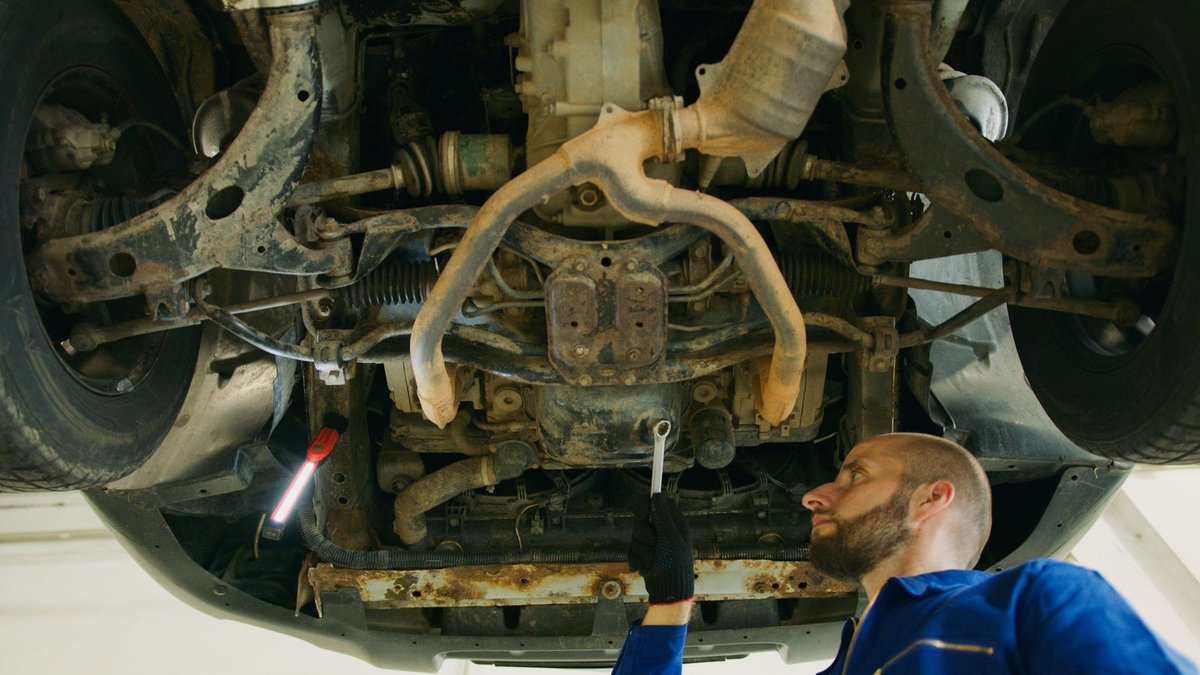
CV stands for constant velocity. CV joints are the flexible couplings at each end of your axles that let power flow to wheels that are busy steering and bouncing. Each front axle has an outer joint at the wheel and an inner joint at the transmission. The inner one is the acceleration suspect. Inside it, three rollers slide in smooth machined tracks. After years of torque, the rollers wear little pockets into those tracks. Under hard load, the rollers catch on the worn spots instead of gliding. The axle then pushes and pulls sideways with every rotation, and you feel a shudder through the floor that appears with throttle and vanishes when you lift.
The tell that separates inner from outer joints is simple. A worn outer joint clicks or pops when you turn sharply, like backing out of a driveway with the wheel cranked. A worn inner joint shudders on straight-line acceleration. And the usual reason either joint dies early is a torn rubber boot, the accordion-shaped cover that keeps grease in and grit out. Once the boot splits, the grease slings out and dirt grinds the joint like sandpaper. A greasy spray on the inside of a wheel is this failure announcing itself early.
The cost spread here is the sharpest lesson in this article. Caught early, a torn boot can be cleaned and re-booted for roughly $150 to $400. Caught late, the whole axle needs replacing. RepairPal’s national estimate for a CV axle replacement currently lands around $1,100 to $1,400 at a shop before taxes and fees. Same root problem, nearly ten times the bill, decided entirely by when you notice it.
2 Collapsed Motor Mounts Let the Whole Engine Rock Under Load
Your engine does not bolt straight to the car. It rests on three to five mounts, blocks of dense rubber, sometimes filled with fluid like tiny shock absorbers. Mounts matter most during acceleration because of a rule you know from playground swings: every push has a push-back. When the engine twists the axles one way, the engine’s own body tries to twist the opposite way. The mounts stop it. When a mount’s rubber cracks or leaks its fluid, the engine physically rocks in the engine bay every time you get on the gas, and that rocking pours vibration straight into the body.
The signature is a shake or clunk right at the moment of load change. Pulling away from a stop. Shifting from Park to Drive. Flooring it to pass. Between those moments the car can feel almost normal, because at cruise the engine barely twists against its mounts. A bad mount also loves to announce itself at idle in gear at a red light. We will come back to that in the idle section, because the same worn rubber that fails under load also stops filtering the engine’s idle wobble.
On cost, RepairPal’s national average for an engine mount replacement runs roughly $630 to $780, with labor making up about $310 to $460 of that. The spread by model is wide. An Elantra mount can total under $500, while some trucks and V6 layouts run higher because the engine has to be supported while the mount comes out. Cars have several mounts, and shops often find one torn and its neighbors aging. Ask to see the torn one, and get a per-mount price rather than a bundled guess.
3 An Engine Misfire Turns Acceleration Into a Stutter You Can Feel
A misfire means one of your cylinders is skipping its turn. A four-cylinder engine is like four people rowing a boat in rhythm. When one rower keeps missing strokes, the boat surges and stumbles. You feel that stumble as a jerk or shake. And here is the interesting part: it often shows up only under acceleration, for a genuinely satisfying physics reason. Pressing the gas raises the pressure inside each cylinder, and electricity has a harder time jumping the spark plug’s gap through dense, high-pressure air. A tired plug with a worn-wide gap, or a weak coil, can still spark at easy cruise. Under load, the spark gets snuffed out. Load is the stress test that exposes a marginal ignition system.
The suspects run in a chain. Spark plugs wear their gaps wide, which forces the ignition coils to make higher and higher voltage, which overheats and kills coils early. That is why neglected plugs so often take a coil with them, and why the misfire fix list starts cheap and climbs. A set of plugs at an independent shop typically runs about $100 to $250, and often $200 to $400 at a dealer. A single ignition coil usually lands around $150 to $400 installed, depending on how buried it is. Injector and fuel-delivery work climbs from there.
The good news: a misfire is the one cause on this list your car will usually diagnose for you. The engine computer counts every skipped combustion and stores a code naming the exact cylinder, like P0303 for cylinder three. A $25 code reader, or the free scan many parts stores offer, turns guessing into knowing before you spend anything. If your shake comes with a check engine light, read the code first. It changes the conversation from “find my vibration” to “fix cylinder three.”
4 A Failing Torque Converter Shudders Like Rumble Strips at Steady Speed
This one is the sneaky exception, because it happens under light load. If your automatic car shivers like it is driving over rumble strips at a steady 25 to 50 mph on gentle throttle, and the feeling passes when you accelerate harder or lift off entirely, you may have torque converter clutch shudder. The torque converter is the fluid coupling between engine and automatic transmission. To save fuel, it contains a small clutch that locks the engine to the transmission at cruising speeds. When that clutch’s friction material or the transmission fluid degrades, the clutch grabs and slips rapidly instead of locking cleanly. You feel a fine, fast shudder at exactly the speeds where the computer engages lock-up.
The reason to know this cause exists is the price gap between its two endings. Caught early, converter shudder is very often cured by fresh transmission fluid, because the friction additives in the fluid are what let the clutch bite smoothly. A fluid service commonly runs in the low hundreds of dollars. Ignored, the slipping clutch cooks the fluid, glazes itself, and sheds material into the transmission. Now you are pricing a torque converter replacement, a job that means removing the transmission and typically costs well over $1,000, with many estimates between $1,500 and $3,000. Few car problems reward early action this lopsidedly.
Be honest about the pattern, though. Converter shudder is rhythmic, lives in a specific speed band, and needs gentle steady throttle. If your shake is strongest under hard acceleration from a stop, look back at CV joints, mounts, and misfires first.
5 A Bent Driveshaft or Worn U-Joints Punish Trucks and Rear-Wheel-Drive Cars
If you drive a pickup, a truck-based SUV, or a rear-wheel-drive car, a long spinning steel tube under the floor called the driveshaft carries power from the transmission to the rear axle. It connects through universal joints, small cross-shaped couplings with needle bearings that let the shaft flex as the suspension moves. The driveshaft spins several times faster than the wheels, so tiny problems make big vibrations. A worn or rust-bound U-joint forces the shaft to speed up and slow down slightly twice per revolution. Under load, that becomes a buzz or drone through the floor that climbs with speed and gets distinctly worse on acceleration.
The extra clues help you spot it. A classic dying U-joint gives a single metallic clunk from under the car when you shift from Park to Drive, which is the slack in the joint snapping tight. A bent driveshaft or a lost balancing weight, often from a rock strike or careless tow, makes a similar under-floor vibration without the clunk. Either way, this suspect only exists on vehicles with a driveshaft. If you drive a typical front-wheel-drive sedan or crossover, skip it and give its share of suspicion to the inner CV joints.
Cost-wise, this is one of the friendlier fixes in the lineup. RepairPal puts a U-joint replacement at roughly $340 to $410 on average, with the broader range across vehicles around $200 to $600, since trucks with two-piece shafts take more labor. The part is cheap; you are mostly paying for the driveshaft to come down and go back up. Left alone, though, a failed U-joint can drop the driveshaft on the road at speed. This is not a vibration to babysit for six months.
6 Sticking Brake Calipers and Loose Lug Nuts Are the Outliers Worth Ruling Out
Two oddball causes earn a spot because they imitate load-dependent shakes, and both are quick, cheap checks. First, a sticking brake caliper. The caliper is the clamp that squeezes your brake pads, and when its piston or slide pins corrode, it can drag the pad against the rotor all the time. The car shakes and struggles more when you accelerate because you are literally driving with one brake partly on. The giveaways: a burning smell after driving, one wheel radiating far more heat than the others, and a gentle pull to one side. Caliper work typically runs a few hundred dollars a corner, and catching it early spares the rotor and pads on that wheel.
Second, loose lug nuts or a wheel that was not seated flat at the last tire change. This one is rarer but genuinely dangerous, and it can appear within days of a tire rotation or brake job. The wheel wobbles microscopically on its studs. The shake grows with speed, feels worse under power as the wheel loads up, and eventually studs can shear. The check costs nothing: a wrench and five minutes, or a free torque-check at any shop. If your shake started right after wheel work, rule this out before you spend a dollar on anything else.
What a Load-Only Shake Rules Out and Why That Saves You Real Money
Here is where the timing clue turns into cash. If your shake passes the gas-off test, appearing under throttle and vanishing on coast, you have positively ruled out the two repairs shops sell most reflexively for vibration complaints: wheel balancing and brake rotors. Not because those services are scams, but because physics says they cannot be your problem. An out-of-balance wheel shakes according to rotation speed, and your rotation speed during the coast test was identical the moment before and after. Rotors cannot shake a car whose brakes are not applied, because nothing is touching them. When the shake changed with your foot and nothing else, the spinning parts and the clamping parts both walked free.
This matters because a vague “my car vibrates” complaint frequently gets triaged into a balance-and-alignment ticket. That costs real money, roughly $60 to $200 to balance a set and about $75 to $250 for an alignment, and does absolutely nothing for a CV joint, a mount, or a misfire. You drive away lighter in the wallet with the shake fully intact, and the shop starts over. Describing the trigger condition precisely on the first visit skips that whole detour. It is the difference between paying for one diagnosis and paying for two.
Use this cheat sheet to match your trigger condition to the likely suspect and an honest national ballpark. The figures are shop-repair ranges drawn from national estimators like RepairPal and current cost guides. Your car, your city’s labor rate, and parts choice will move any of them, so treat them as sanity-check ranges, not quotes.
| Trigger Condition | Most Likely Cause | Typical Shop Cost Range |
|---|---|---|
| Shakes only under throttle, smooths when coasting | Inner CV joint / axle | ~$150–$400 (boot, early) to ~$1,100–$1,400 (axle) |
| Shakes or clunks at throttle tip-in and gear changes | Engine or transmission mount | ~$450–$800 per mount |
| Stutters under load, check engine light on | Misfire (plugs, coil, injector) | ~$100–$250 (plugs); ~$150–$400 (one coil) |
| Rumble-strip shudder at steady 25–50 mph | Torque converter clutch / fluid | Low hundreds (fluid) to $1,500–$3,000 (converter) |
| Buzz under floor, clunk on gear change (RWD/trucks) | U-joint or driveshaft | ~$200–$600 (U-joint) |
| Shakes at the same speed regardless of throttle | Wheel balance or tire defect | ~$15–$50 per tire to balance |
| Shakes only while braking | Warped or worn rotors | ~$300–$600 per axle (pads and rotors) |
| Shakes while parked and idling | Mounts, misfire, or vacuum leak | ~$50–$200 (simple vacuum fix) and up |
One more payoff from getting the diagnosis right the first time. Load-dependent problems are progressive in a way balance problems are not. A wheel ten grams out of balance will still be ten grams out next year. A dry CV joint, a slipping converter clutch, and a misfiring cylinder are all actively grinding toward the expensive end of their price ranges every week you drive. The cost of misdiagnosis is not just the wasted balance job. It is the weeks the real culprit spends getting worse while you think you fixed it.
When Your Car Shakes When Idle the Same Logic Points Inside the Engine
Now flip the scenario. The car trembles sitting at a red light and smooths out once you are moving. When your car shakes when idle, the load logic still applies. It just points somewhere new. At idle there is no drive load at all: no torque through the axles, no lock-up clutch, no driveshaft strain. The only things left that can shake you are the engine’s own running smoothness and the rubber mounts whose entire job is to hide the engine’s natural wobble. So an idle shake shortlists itself. Either the engine is genuinely running rough, or it is running fine and the mounts have stopped filtering it.
A Rough Idle Usually Means the Engine Is Being Fed Wrong
An engine at idle is balancing on a knife edge, sipping the smallest amount of air and fuel it can while staying alive. Tiny feeding errors that vanish at higher rpm are glaring at idle. The classic culprit is a vacuum leak: a cracked rubber hose or hardened gasket letting unmeasured air sneak in, leaning out the mixture so the engine stumbles. The tell is a shake plus a slightly fast or wandering idle, sometimes with a faint hiss. It is often worse when cold, because cold rubber shrinks and gapes. Simple vacuum leaks are among the cheapest fixes in car repair, commonly $50 to $200, though a leak buried under the intake manifold multiplies the labor.
The second common feeder problem is carbon gunk in the throttle body, the valve that meters idle air. Years of oil vapor and soot build a crusty ring exactly where the throttle plate sits at idle, choking the tiny airflow the engine needs. A cleaning is cheap, often under $120 at a shop when access is easy, and doable at home with a $10 can of cleaner. A weak ignition side shows up here too. A misfire that hides while driving can be an obvious lope at idle, because at 700 rpm each skipped combustion is a full missed beat you feel in the seat. At 3,000 rpm the misses blur together. If the idle shake comes with a check engine light, pull the code before spending anything.
A Smooth Engine That Still Shakes the Car Means the Mounts Quit
Here is the neat diagnostic fork. If the rpm is steady and there are no codes, but the car still trembles at idle, suspicion swings hard toward the motor mounts. Every piston engine vibrates at idle. That is just what pistons do. Healthy rubber mounts absorb it so completely you forget it exists. A collapsed or fluid-empty mount conducts that vibration straight into the body, like a drumstick on a drumhead. The confirming clue is the in-gear test at a stoplight: shift from Drive to Neutral while holding the brake. In Drive at idle, the engine twists gently against its mounts. In Neutral, it relaxes. If the shake noticeably calms in Neutral, worn mounts just raised their hand.
This is also the thread that ties the idle story back to the acceleration story. The same mount that fails to filter idle vibration also fails to hold the engine under throttle. So worn mounts often produce both symptoms at once: a trembling red-light idle and a clunk or shudder on takeoff. If you have both, say both to the shop. The pair together is close to a slam-dunk mounts diagnosis and can save a diagnostic hour. While you sit at that light, glance at the temperature gauge too. A needle climbing at idle is a different problem wearing a similar mask, and our guide on why your car is overheating walks through that one the same trigger-condition way.
How to Talk to Your Mechanic So You Pay for the Right Fix Once
Everything you have done so far turns into savings at the service counter, but only if you deliver it well. The magic is specificity. “It vibrates” buys you an open-ended diagnostic ticket. “It shudders through the floor under hard acceleration from a stop, disappears completely when I lift off the gas, no warning lights, and it clicks when I turn left out of my street” is a near-complete diagnosis in one sentence. Any good tech reading that is already reaching for a flashlight and heading for the outer CV boot. Write your observations down before you call: when it shakes, where you feel it, what makes it stop, any sounds, any lights, and when it started.
Then manage the work the way smart owners do. Ask for the diagnosis and the estimate as separate steps, and ask what the shop found, not just what they recommend. A good answer names a specific failed part and how they confirmed it: a torn boot they can show you, a mount they levered apart, a misfire code on a named cylinder, burnt fluid from the transmission. Be politely wary of the parts-cannon approach, where a shop replaces plugs, coils, and mounts all at once and hopes. Every cause in this article has a cheap confirming test, and you are allowed to ask for it by name: the coil swap test, the in-gear mount test, the lug torque-check. Independent estimator sites like RepairPal’s cost guides let you sanity-check any quote against a national range for your exact model in two minutes.
Finally, calibrate urgency honestly, because these causes do not carry equal risk. A mild mount clunk can wait for payday. A flashing check engine light, a driveline clunk on a truck that tows, or any shake that arrived right after wheel work should be looked at within days. Those three failure modes end in a poisoned converter, a dropped driveshaft, and a loose wheel. The load test tells you what is wrong. The failure mode tells you how fast to move. Knowing both turns you into the customer shops quote carefully, because it is obvious you would catch a padded bill.
Frequently Asked Questions
Why does my car shake when accelerating but not when coasting?
Because the shake needs engine torque to happen. When you accelerate, twisting force flows through the axles, CV joints, engine mounts, and driveline, and a worn part in that chain flexes or catches under the strain. When you coast, that torque drops to nearly zero and the worn part relaxes, so the shake stops. This pattern effectively rules out wheel balance and brake rotors, which do not care what your right foot is doing, and points at the drivetrain: most often an inner CV joint, a motor mount, or an engine misfire.
Is it safe to keep driving a car that shakes when accelerating?
It depends on the cause, which is why the five-minute self-test matters. A tired motor mount is uncomfortable but rarely dangerous in the short term. A shake paired with a flashing check engine light is not safe to drive on, because the misfire can destroy the catalytic converter within days. A badly worn CV joint or U-joint can eventually fail completely and leave you without drive. And a shake that started right after tire work could be loose lug nuts, which needs checking immediately. When in doubt, get it inspected within the week, not the month.
Why does my car shake when idle but smooth out while driving?
At idle the engine runs at its slowest, most delicate state, so small problems stand out. The usual causes are a vacuum leak letting in unmeasured air, carbon buildup in the throttle body, a subtle misfire, or worn motor mounts that have stopped absorbing the engine’s natural vibration. Once you drive, higher rpm smooths the power pulses and the mounts matter less, so the shake fades. Quick test: if the idle shake calms when you shift into Neutral at a stoplight, worn mounts are the prime suspect.
How much does it cost to fix a car that shakes when accelerating?
Anywhere from about $100 to over $1,400, because different causes cost wildly different amounts. Spark plugs run roughly $100 to $250 at an independent shop. A single ignition coil is about $150 to $400 installed. An engine mount runs roughly $450 to $800. A U-joint is about $200 to $600. A full CV axle replacement lands around $1,100 to $1,400 per national estimates. That huge spread is exactly why identifying the trigger condition first matters. It tells you which end of the range you are facing before a shop does.
Can bad spark plugs cause shaking only during acceleration?
Yes, and the reason is real physics. Pressing the gas raises the pressure inside each cylinder, and high-pressure air is harder for electricity to spark across. A worn plug with an eroded, widened gap can still fire at gentle cruise but fails under load, so the misfire and the shake appear mainly during acceleration. Worn plugs also force the ignition coils to work harder, which is why old plugs so often kill a coil too. If your engine has never had plugs at its scheduled interval, they are the first and cheapest suspect.
How do I know if the shaking is my tires or my CV axle?
Run the gas-off test. Get to the speed where the shake is worst, then lift your foot completely off the accelerator and coast for a few seconds without braking. Tire and wheel-balance shakes continue unchanged while coasting, because they depend only on rotation speed. A CV axle shake fades or disappears the moment the torque comes off. Two bonus clues: balance problems usually live in a specific band around 55 to 70 mph, and a worn outer CV joint adds a clicking sound during sharp turns.
What does torque converter shudder feel like?
Like driving over rumble strips or a rough patch of road that is not actually there, usually at steady, light throttle between about 25 and 50 mph, right when the transmission’s lock-up clutch engages. It typically stops if you accelerate harder or lift off. Caught early, it is often cured by a transmission fluid service, sometimes with a manufacturer-updated friction-modified fluid, for a few hundred dollars. Ignored, the slipping clutch damages itself and contaminates the transmission, and a torque converter replacement commonly runs $1,500 to $3,000.
Should I pay for wheel balancing if my car only shakes under throttle?
No, and this is the cheapest money-saving rule in this guide. Wheel imbalance produces force based on rotation speed, so it shakes the car identically whether you are accelerating or coasting at a given speed. If your shake passes the gas-off test, appearing with throttle and vanishing on coast, balancing physically cannot fix it. The $60 to $200 you would spend balancing a set is better put toward diagnosing the drivetrain. Describe the trigger condition precisely and you will skip that detour entirely.
About the Author
Elena Brooks
Elena Brooks is the person her group chat texts when something at home stops working or a health trend starts trending. She’s spent years turning that instinct into a job — digging into the research behind everyday questions, calling the experts, and writing up what holds up and what doesn’t. Her beat is wherever curiosity points: kitchens, cars, pets, sleep, money, and the occasional meteor shower.