

- The most common reason is low or leaking refrigerant (the special liquid that makes the air cold). But a stuck mixing flap, a dead cooling fan, or a clogged front grille part can blow warm too.
- How it fails is your biggest clue. Hot on just one side points to the mixing flap. Cold while driving but warm at a stoplight points to the cooling fan or a low charge.
- You can check plenty yourself: the cabin filter, the fuses, and grime in the grille. But leaks and newer R-1234yf systems need a pro.
It’s a hot day, you turn on the AC, and warm air pours out of the vents. So why is my car ac blowing hot air? Most of the time the answer is low or leaking refrigerant, the liquid that makes the air cold. But that is not the only cause. A stuck mixing flap, a worn-out pump, a clogged front grille part, a dead fan, a blown fuse, a hot engine, or even a dirty filter can all make your air turn warm.
The good news? Each cause leaves its own fingerprint. The way your AC acts up tells you a lot about what’s wrong. This guide walks you through every common cause, how to tell them apart, what you can safely check yourself, and roughly what each fix costs.
How Your Car’s AC System Actually Makes Cold Air
Here’s a simple thing that makes every problem below easier to spot: your AC does not make cold. It moves heat out of the car.
A pump called the compressor squeezes the refrigerant into a hot, high-pressure gas. The gas flows to the condenser, a thin grid at the very front of your car, where outside air and a fan cool it down into a liquid. The liquid then passes through a small part that pulls out water, then squeezes through a tiny opening. That sudden drop in pressure is what makes it turn cold.
Next, the cold liquid reaches the evaporator behind your dashboard. A blower fan pushes your cabin air across those icy coils, and that’s the cold air you feel. Last, a flap called the blend door decides how much cold air, versus warm air from the heater, actually reaches your vents.
See how many parts have to work, one after another? Warm air at the vents just means one link in that chain has broken. The clue is which one. For a fuller walkthrough, AAA has a clear explainer on how a car’s air conditioning system works.
The Eight Top Causes of a Car AC Blowing Hot Air
These are the usual suspects, roughly from most common to least. Each one leaves its own clues.
1 Low or Leaking Refrigerant, the Number-One Cause
This is the top cause by far. The refrigerant lives in a sealed loop, so it never gets “used up.” If it’s low, that means it leaked out somewhere, often slowly over years, through a tired hose, a worn seal, or the evaporator.
When the charge gets low, the air just gets weaker and warmer. Drop low enough and the car shuts the pump off to protect it, so you get plain outside air. Watch for these signs: air that is cool but not cold, cold that fades over a few weeks, or an oily, dye-stained smudge near the AC fittings. The refrigerant carries oil, and that oil marks the spot where it’s leaking.
2 A Failing Compressor or Compressor Clutch
The compressor is the pump that drives the whole loop. On most gas cars, a magnetic clutch grabs a pulley and spins the pump only when you ask for AC. If that clutch won’t grab, or the pump itself seizes up or wears out inside, the refrigerant stops moving and your air goes warm.
Clues to watch for: a loud grinding or screeching when you switch the AC on, a clutch you can see is not spinning at the front of the pump while the engine runs, or AC that worked fine one day and was stone dead the next.
3 A Stuck Blend-Door Actuator Feeding Heater Air
The blend door is the flap that mixes cold air and heater-warm air to hit the temperature you set. A small motor, called the actuator, moves that flap.
When that little motor strips its gears or quits, the flap can get stuck on the heat side. So you get warm heater air even though your AC is full and working fine. The classic sign is a repeated clicking or knocking behind the dashboard when you change the temperature. Often you’ll feel hot air on just one side if your car sets each side separately.
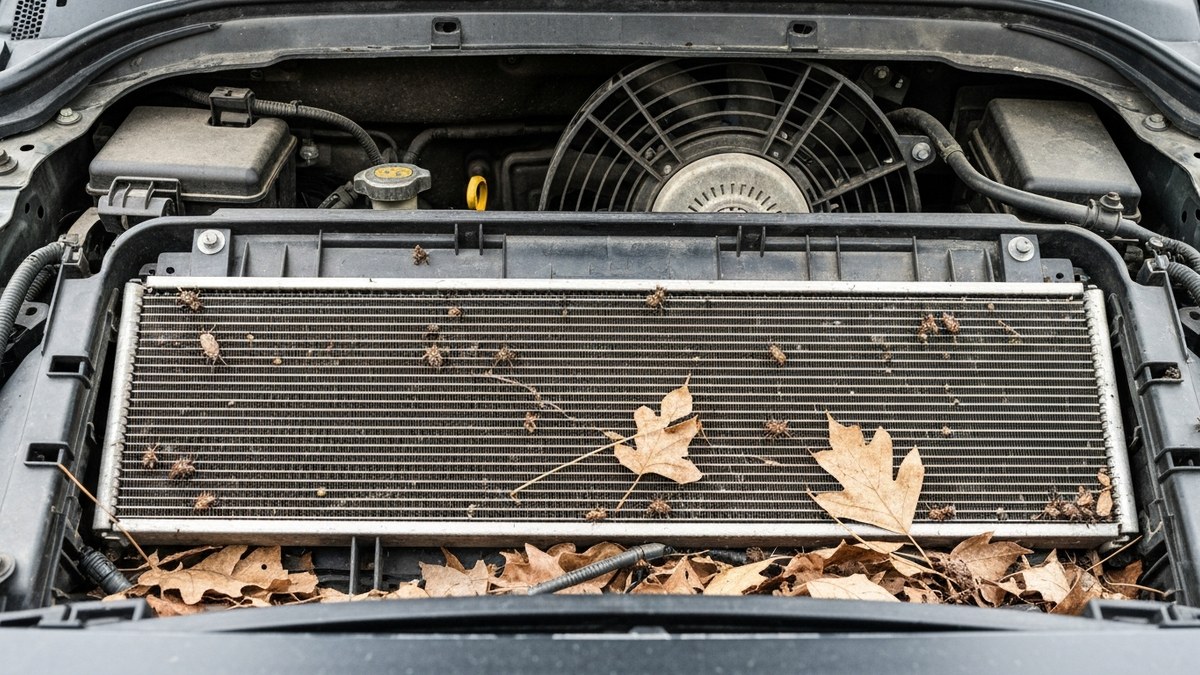
4 A Clogged or Dirty Condenser That Traps Heat
The condenser sits right at the front of your car, so it catches leaves, bugs, road grime, and bent fins. When it gets clogged, it can’t dump heat out of the refrigerant. So the refrigerant reaches the next part still too warm to cool you well.
This usually feels worst in stop-and-go traffic and on the hottest days, when your AC is working hardest. AAA points out that you should check and keep the condenser clear, because debris quietly chokes your cooling.
5 Electrical Faults: Fuse, Relay, or Pressure Switch
Your AC needs several electrical helpers to turn on. A blown fuse or a failed relay (a switch that sends power) can cut the power, so the clutch never grabs. Pressure switches act as safety guards. If one fails or reads wrong, the system may refuse to turn the pump on at all, because it thinks something is unsafe.
These faults tend to be all-or-nothing, and they can pop up out of nowhere. Sometimes the clutch just never clicks on when you press the AC button.
6 A Faulty Condenser Cooling Fan at Idle
One or more electric fans pull air through the condenser when your car isn’t moving fast enough to do it on its own. If a fan motor dies or runs weakly, the condenser can’t dump its heat at low speed.
This gives you the classic “cold on the highway, warm at the light” pattern you’ll read about below. In bad cases it can even make your engine run hot.
7 An Overheating Engine That Cuts the Compressor
The AC condenser and the engine’s radiator share airflow up front, and often the same fans. When the engine runs hot, many cars turn the AC pump off on purpose to ease the load and protect the engine. So your air goes warm right as the temperature gauge climbs.
Treat this one as urgent. A rising temperature gauge is a reason to stop, not just a comfort gripe. Pull over safely, shut the engine off, and get the cooling system checked before you drive any further — warm AC is the least of your worries at that point.
8 A Dirty Cabin Air Filter Starving Airflow
This one fools people, because the air isn’t really hot. There just isn’t enough of it. A cabin air filter packed with dirt starves the blower, so the little bit that reaches the vents feels warm and weak, even though the AC is cooling fine. It’s the cheapest possible fix, so it’s worth ruling out first.
Here’s the mechanism, in plain terms. The cold air is being made just fine on those icy evaporator coils, but if the blower can barely pull air through a clogged filter, very little of that cold reaches your face. The trickle that does get through has more time to warm back up on the way, so it lands lukewarm. A telltale sign is that turning the fan to its highest setting barely changes how much air you feel, and the airflow may carry a musty smell from the trapped grime.
Reading the Symptom Pattern to Pinpoint the Cause
The exact way your AC misbehaves narrows things down fast. Here are the three most common patterns.
Cold on One Side, Hot on the Other
If your car sets each side’s temperature on its own, each side has its own blend door and little motor. When one side blows cold and the other blows hot, the refrigerant is almost surely fine. After all, half the car is cold. The real cause is a failed blend-door motor on the warm side, stuck on heater air.
Listen for that clicking behind the dash when you sweep the temperature dial. This is an electrical or mechanical fix, not a refrigerant problem.
Cold While Driving but Warm at Idle
This is one of the most telling patterns there is. At speed, air rushes through the condenser on its own, so it dumps heat easily. At a stoplight, that airflow disappears and the electric fan has to do the whole job alone.
If cooling falls apart only when you stop, suspect these, in order: a weak or dead cooling fan, a low refrigerant charge (which has the least to spare right when the system is stressed at idle), or a dirty condenser that highway air can push through but the idle fan can’t. If you can see the fan spinning hard at idle, that rules out the most common version of this complaint.
AC That Randomly Switches to Hot Air
Warm spells that come and go usually point to something electrical or heat-related cycling on and off. A weak pressure switch, a failing relay, a clutch that grabs only sometimes, or the engine briefly running warm and cutting the pump can all make the air swing hot and then recover. A charge that’s just barely low can act this way too, cooling fine until the pressure dips too far, then coming back.
Because it comes and goes, this is the pattern most worth taking to a shop to scan for trouble codes.
| Symptom | Most likely cause | Refrigerant involved? |
|---|---|---|
| Air cool but never truly cold; fades over weeks | Low / leaking refrigerant | Yes |
| Grinding or screech when AC turns on, then warm air | Failing compressor or clutch | Sometimes |
| Clicking behind dash; hot on one side only | Stuck blend-door actuator | No |
| Cold on highway, warm at idle | Cooling fan, low charge, or dirty condenser | Maybe |
| Compressor never clicks on at all | Blown fuse, relay, or pressure switch | No |
| Weak airflow, faint smell, air not actually hot | Clogged cabin air filter | No |
| Warm air plus rising temperature gauge | Engine overheating (stop driving) | No |
DIY AC Checks Versus Repairs That Need a Mechanic
You can check several of these right in your driveway, with no special tools.
AC Checks That Are Safe to Do Yourself
- Cabin air filter: It’s usually behind the glovebox. Pull it out and look. A dirty one is a quick, cheap swap.
- Fuses and the compressor clutch: Start the engine, turn the AC on, and look at the front of the pump. The center hub should be spinning. Check the AC fuse against the diagram in your owner’s manual.
- Condenser cleanliness: Peek through the front grille for leaves and bugs. A gentle rinse from the engine side can wash loose junk away.
- Cooling fan at idle: Park the car, turn the AC on, and check that the fan kicks on.
- A basic recharge: A store-bought kit can top up a slightly low R-134a system. AAA’s step-by-step on recharging a car AC is a good guide. It also warns that if the air goes warm again soon after, you have a leak that needs a pro.
Repairs Best Left to a Professional
- Finding or sealing refrigerant leaks (this needs gauges, special dye or detectors, and recovery gear).
- Recharging R-1234yf systems, which use special fittings and pricey refrigerant, and by law need proper handling.
- Replacing the compressor, condenser, evaporator, or that tiny cold-making valve.
- Replacing the blend-door motor, which is buried deep in the dash.
- Tracking down electrical faults in pressure switches and relays, which usually needs a scan tool.
Roughly What Each Car AC Repair Costs
Treat these as rough ballpark numbers, not quotes. Your make, model, parts, and local labor rates can move them a lot. Always pay for a diagnosis first, so you fix the real problem.
| Repair | Typical range | Notes |
|---|---|---|
| DIY recharge kit | ~$40–$60 | Only a stopgap if there’s a leak |
| Professional recharge | often ~$100–$300 | Includes leak check at many shops |
| Cabin air filter | often modest, low double digits in parts | Frequently a DIY job |
| Blend-door actuator | frequently a few hundred dollars | Labor varies hugely by dash access |
| Condenser replacement | often ~$800–$1,200 | Higher on some vehicles |
| Compressor replacement | commonly ~$500–$1,700+ | Among the priciest AC repairs |
Is It Safe to Keep Driving With the AC Blowing Hot?
Most of the time, warm AC is a comfort problem, not a safety one. You can keep driving while you sort out a fix. But there are two big exceptions.
First, if the warm air comes with a rising temperature gauge, the engine itself may be overheating. Pull over safely and shut it off rather than push on, because driving on can cause serious engine damage.
Second, don’t keep forcing the AC on when it clearly isn’t cooling. Running a pump that’s nearly out of refrigerant (and so nearly out of the oil that refrigerant carries) can wear it out or seize it, turning a cheap recharge into a costly pump job. And on very hot days, remember that losing AC is a heat-safety issue for kids, older folks, and pets, so don’t ignore it forever.
One more thing while you’re paying attention to what your car is telling you: notice any smells. A sweet, syrupy odor from the vents can mean a coolant leak, while a musty smell usually points to mildew on the evaporator. And if you catch a whiff of fuel, that’s a separate warning worth chasing down — our guide to why your car smells like gas walks through the causes, some of which are genuinely urgent. Your nose is one of the cheapest diagnostic tools you own.
Know Your Refrigerant: R-134a Versus R-1234yf by Year
Which refrigerant your car uses matters for both DIY recharging and shop costs, and the two are not interchangeable. Over about a decade, the industry switched from R-134a to R-1234yf, which is gentler on the planet.
The 2013 Cadillac XTS was the first US-built car on R-1234yf. From 2014 to 2020 it was a real mix, brand by brand. And under EPA rules, basically all new cars from the 2021 model year on use R-1234yf. The sure answer is on a label under your hood, near the pump or the front frame.
| Model year | Likely refrigerant | What it means for you |
|---|---|---|
| 2013 and older | Almost always R-134a | Inexpensive, DIY recharge kits widely sold |
| 2014–2020 | Either, varies by brand/model | Check the under-hood label before buying anything |
| 2021 and newer | R-1234yf | Pricier refrigerant; usually best left to a shop |
Frequently Asked Questions
Can I just add refrigerant to fix my car AC blowing hot air?
Sometimes, if the system is just a little low and there’s no real leak. But refrigerant doesn’t get used up in a sealed loop, so a low charge means it leaked. A recharge may bring back cold air for weeks or months, then drain out again. Use a DIY recharge as a first test. If the problem keeps coming back, you need a proper leak check.
Why does my AC blow cold while driving but hot when I stop?
At highway speed, air rushes through the condenser on its own. At a stoplight, the electric fan has to do that job alone, so a weak or dead fan lets the air warm up when you stop. A charge that’s a bit low, or a dirty, clogged condenser, can cause the same stop-only pattern.
Is it bad to drive with the AC blowing hot air?
Usually it’s harmless to the car, as long as the engine isn’t overheating. The big exception is a rising temperature gauge, which means a cooling problem you shouldn’t drive on. Also, don’t keep forcing on a pump that clearly isn’t cooling, since running it nearly dry can damage it.
Why is my AC cold on one side and hot on the other?
If your car sets each side’s temperature on its own, that almost always means a failed blend-door motor on the warm side. The little motor that mixes hot and cold air is stuck, feeding heater air to one side. A repeated clicking behind the dash when you change the temperature is the giveaway.
How do I know if my car uses R-134a or R-1234yf?
Open the hood and find the refrigerant label near the pump or the front frame. It lists the exact type and the amount. As a quick guide: 2013 and older almost always use R-134a, 2021 and newer use R-1234yf, and 2014 to 2020 cars can be either, depending on the brand.
How much does it cost to fix car AC blowing hot air?
It depends on the cause. A professional recharge often runs in the low hundreds, a blend-door motor is frequently a few hundred dollars, and a compressor or condenser swap can top a thousand. Pay for a diagnosis first, so you spend money on the real problem, not a guess.
About the Author
Elena Brooks
Elena Brooks is the person her group chat texts when something at home stops working or a health trend starts trending. She’s spent years turning that instinct into a job — digging into the research behind everyday questions, calling the experts, and writing up what holds up and what doesn’t. Her beat is wherever curiosity points: kitchens, cars, pets, sleep, money, and the occasional meteor shower.