
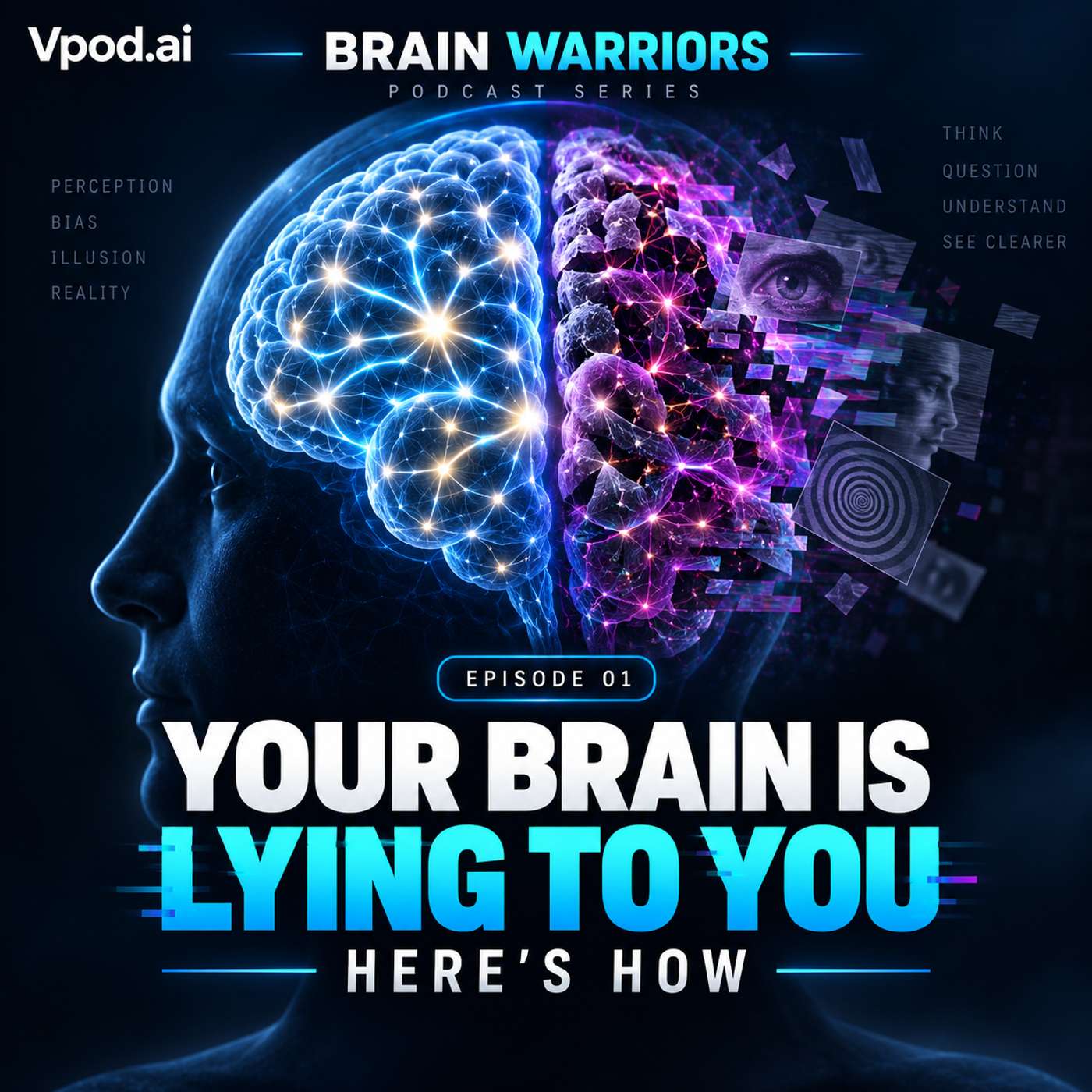




You probably trust your eyes, your memories, and your instincts more than you realize. But your brain is constantly filtering information, filling in gaps, protecting your ego, and taking shortcuts designed to conserve mental energy.
In this episode of Brain Warriors, Mike and Susan explore the psychology behind cognitive biases, false assumptions, memory errors, and the mental shortcuts that influence everyday decision-making.
From the invisible gorilla experiment and confirmation bias to hindsight bias, anchoring, emotional reasoning, and the availability heuristic, this conversation reveals how easily the brain can distort what you see, remember, and believe.
You’ll discover:
• Why System 1 favors fast, automatic decisions while System 2 avoids unnecessary mental effort
• How “what you see is all there is” can create dangerous blind spots
• Why people can completely miss obvious information when their attention is focused elsewhere
• How confirmation bias pushes us to search for evidence that supports what we already believe
• Why hindsight bias can rewrite your memory and make past events seem predictable
• How self-serving bias protects your ego after success and failure
• Why completely arbitrary numbers can influence your estimates through anchoring
• How vivid memories can distort your perception of risk
• Why some cognitive shortcuts may actually be evolutionary adaptations rather than flaws
• How natural frequencies can make complicated statistical information easier for the brain to process
The episode also introduces a practical four-step approach for reducing bias in high-stakes situations: acknowledge your blind spots, seek outside perspectives, practice self-critique with self-compassion, and create cognitive forcing strategies that slow down automatic decisions.
Your Brain Warriors challenge is simple: the next time you feel completely certain about a decision, spend 10 seconds looking for one piece of evidence that could prove you wrong.
The episode closes with an even bigger question: if artificial intelligence learns from human-generated data filled with our own biases, could we unintentionally hardwire those same blind spots into the technology shaping our future?
Subscribe to Brain Warriors, share this episode with someone who enjoys psychology and decision-making, and keep questioning the assumptions your brain wants you to accept automatically.