
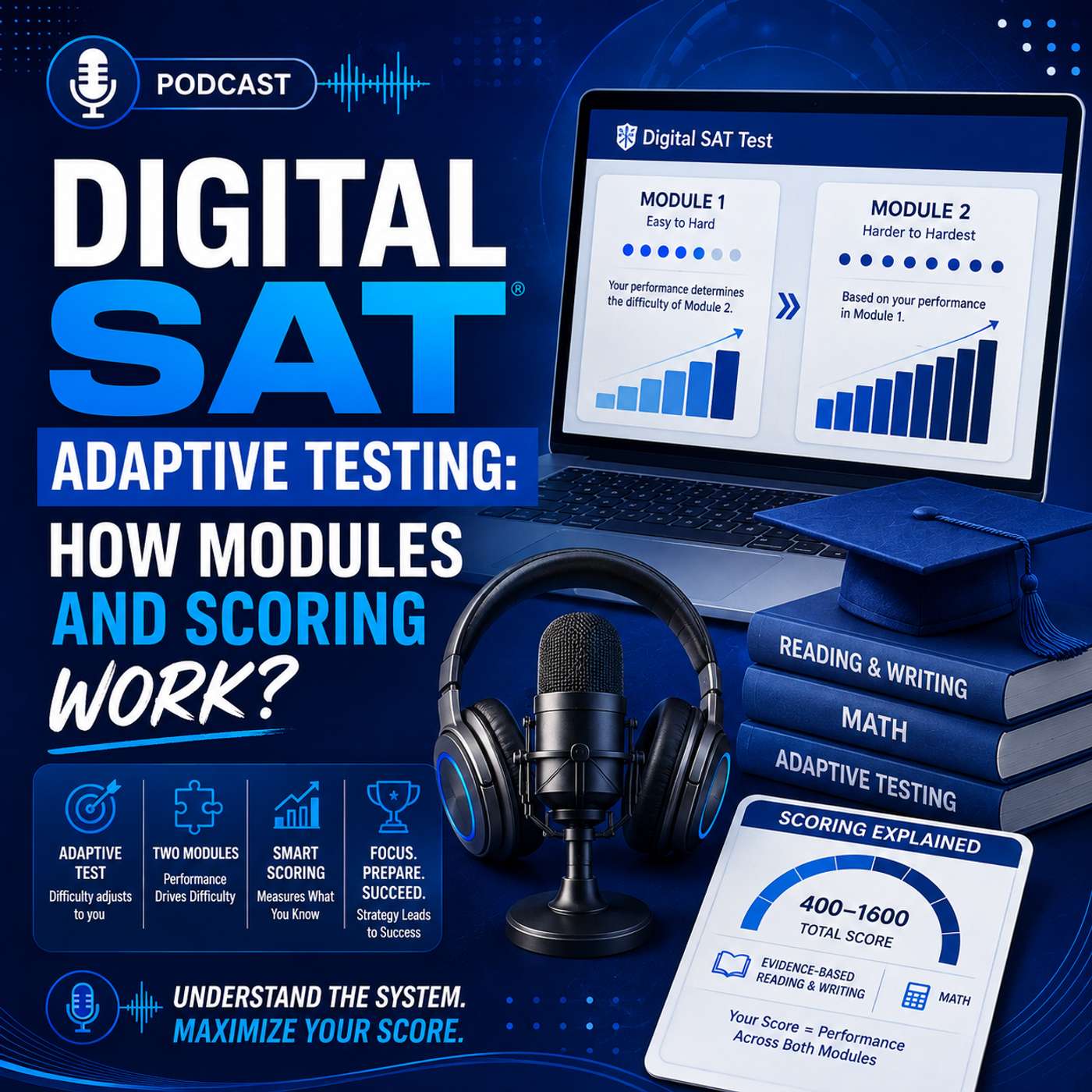





The Digital SAT is not just the old paper test moved onto a computer. It reacts to how you perform—and knowing how that adaptive system works can completely change the way you approach test day.
In this episode of VPOD.AI SAT Mastery, host Mike and testing expert Susan take you inside the mechanics of the digital SAT, breaking down the multi-stage adaptive testing model, Module 1 and Module 2, item response theory, scoring, pacing, and the psychology of facing a test that changes based on your performance.
You’ll learn why the first module plays such an important diagnostic role, how your performance determines the difficulty level of your second module, and why encountering harder questions does not automatically mean your score is falling.
The episode also tackles one of the biggest fears surrounding the digital SAT: the idea that getting routed into a harder second module somehow puts you at a disadvantage. Using clear analogies—from video games to Olympic diving and the high jump—Mike and Susan explain why question difficulty matters and why simply counting correct answers does not tell the whole scoring story.
You’ll also hear practical strategies for staying focused when the test begins to feel more difficult.
Key takeaways include:
- How the 2-hour-and-14-minute digital SAT is structured
- Why Reading and Writing and Math are each divided into two modules
- How Module 1 helps estimate your overall proficiency
- How Module 2 adapts based on your first-module performance
- What item response theory means for digital SAT scoring
- Why missing an early question does not automatically ruin your result
- Why intentionally aiming for an easier second module is a bad strategy
- How to handle difficult questions without second-guessing the algorithm
- Why pacing matters throughout the 64-minute Reading and Writing section and 70-minute Math section
- How contextual math questions add a reading-comprehension challenge
- Why you should bring full focus from the very first question
The central message is simple: don’t waste valuable test-day energy trying to determine whether you received the “easy” or “hard” module. Focus on the question in front of you, manage your time, trust your preparation, and keep moving.
The episode also looks beyond the SAT, exploring how adaptive evaluation could become increasingly common in other environments where performance is assessed in real time.
If you want to approach the digital SAT with a clearer picture of what is happening behind the screen, this episode gives you the framework to do it.
Listen through to the end, then continue with the next deep dive in the series: Create Your Complete SAT Study Plan, where the concepts covered here become a concrete roadmap for preparation.
Subscribe, share the episode with another SAT student, and keep climbing.