
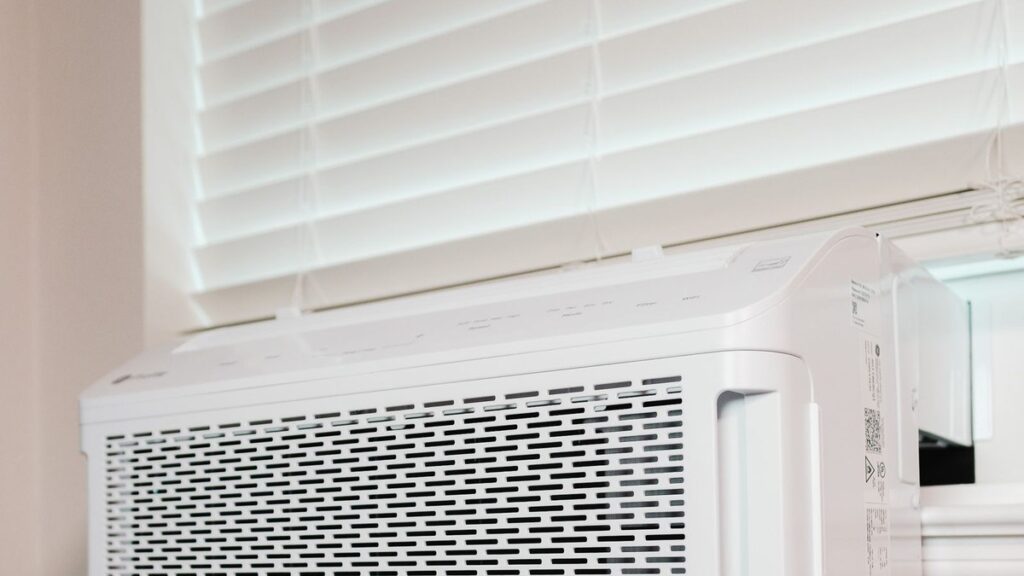
- Most of the time, a window AC not cooling like it used to is choking on airflow, not running low on refrigerant. A dirty filter or dirty coils starve the unit of air, the evaporator ices over, and cooling collapses.
- “Window ac not cooling but fan is running” is the classic sign of this exact problem. The fan motor and the cooling system are separate, so the fan spins happily while the cold part quietly freezes solid.
- The freeze-thaw test settles it fast: run the fan only (no cooling) for a few hours, and if cold air comes back, you had an ice-up caused by blocked airflow, not a refrigerant leak.
- A healthy window AC drops the air by about 14 to 20 degrees Fahrenheit between the air going in and the air coming out. Less than that means something is wrong.
- Bigger is not better. An oversized AC cools the air fast but shuts off before it pulls out humidity, leaving the room cold and clammy and the unit worn out from short-cycling.
- Window units are sealed systems with no refill port. A pro recharge often costs more than a brand-new unit, so on an older AC, replacing usually beats repairing.
It is the hottest afternoon of the week. Your window AC is not cooling the room the way it should, even though you can hear it humming and feel air moving from the vents. The fan works. The unit is clearly on. So why does the room feel like a warm bathtub? Here is the honest answer most people never hear: when your window AC is blowing air but not cold air, the problem is almost never “it ran out of Freon.” Nine times out of ten, it is an airflow problem you can fix yourself with a screwdriver, a vacuum, and an hour of patience.
This guide walks you through why that happens, the simple test that tells you what is really wrong, and when it is finally time to stop repairing and just buy a new unit. We will keep it plain, we will keep it useful, and we will show you the numbers behind every claim so you are never guessing.
Why “Not Cooling but Fan Is Running” Points Straight at Airflow
Let us start with the single most useful idea in this whole guide, because it changes how you think about the problem. Your window air conditioner has two jobs happening at the same time, and they are handled by two different parts. One part is the fan, which just moves air around the room. The other part is the cooling system: a compressor, refrigerant, and two sets of coils that actually pull heat out of the air. These two systems can run completely independently of each other.
That is exactly why “window ac not cooling but fan is running” is such a common complaint. The fan is the easy, tough part. It is a simple motor spinning a blade, and it will keep spinning long after the cooling side has given up. So when you feel air moving but the air is not cold, your unit is basically telling you the fan is fine and the cooling side is in trouble. That is good news, honestly, because the most common cooling-side failure is not a broken compressor or a dead refrigerant charge. It is airflow being choked off somewhere it should not be.
Here is the mechanism, and it is worth understanding because it explains almost everything that follows. The cold part of your AC is the evaporator coil, the metal fins on the room-facing side. Warm room air is supposed to rush across those cold fins, dump its heat, and blow back into the room cooler. But that only works if enough air actually reaches the coil. When something blocks that air, a dirty filter, matted dust on the fins, a fan running too slow, the coil gets colder and colder with no warm air to balance it. Moisture in the air condenses on it, then freezes. Now you have a block of ice sitting where cold air should be coming out, and the fan is just blowing room-temperature air over an ice cube. According to Carrier’s HVAC guidance, restricted airflow from a dirty filter is one of the top reasons any AC stops blowing cold air. It is a snowball that starts with one clogged filter.
The Freeze-Thaw Test That Reveals What Is Really Wrong
Before you spend a dollar or call anyone, run this test. It is the fastest, cheapest way to separate an airflow problem (which you can fix) from a sealed-system problem (which usually means replacement). It takes a few hours of doing nothing, which is the best kind of repair. Follow the steps in order, because each one is solving a specific piece of the puzzle.
Step 1: Switch the Unit to Fan-Only and Turn Cooling Off
Set your window AC so the compressor stops but the fan keeps running. On most units that means turning the temperature all the way up or choosing a “Fan” mode. What you are doing is letting warm room air blow across the coil with no cooling happening, so any ice sitting on the evaporator can melt off. The fan speeds the melt along by pushing warmer air over the frozen fins.
Give it time. Real thawing is slow. Manufacturer troubleshooting notes and repair guides put a full thaw at roughly one to four hours depending on how much ice built up. If you just unplug the unit and walk away, the ice still melts, but slower, and you will not get the fan’s help. Resist the urge to chip at the ice with a knife or screwdriver, because the aluminum fins bend and tear easily and a bent coil becomes a permanent airflow blockage of its own.
Step 2: Turn Cooling Back On and Watch What Happens
Once the coil is fully thawed and dry, switch cooling back on and pay attention for the next 20 to 30 minutes. If cold air comes roaring back and stays cold, congratulations: you had an airflow-caused freeze-up, and you have just confirmed the fix is cleaning, not refrigerant. Move straight to the filter and coil cleaning steps below so it does not freeze right back up.
If the air is cold at first and then slowly weakens and the coil starts frosting again within an hour, that is still almost always airflow. You thawed the ice but did not remove the cause, so it rebuilt. Clean everything thoroughly before you conclude anything else. Only if the unit thaws, gets cleaned, and still refuses to make cold air should you start thinking about the sealed system.
Step 3: Feel the Two Air Streams With Your Hand
While you wait and test, do a rough gut-check you do not need any tools for. Hold one hand near the air blowing into the room and, if you can safely reach it, feel the exhaust air venting out the back of the unit. On a healthy AC, the indoor air should feel distinctly cold and the outdoor exhaust should feel warm to hot, because the machine is literally moving heat from inside to outside.
If the indoor air is barely cool and the outdoor exhaust is also weak or lukewarm, the whole cooling cycle is struggling, which again usually traces back to airflow or dirty coils choking the heat exchange. If the indoor air is only slightly cool but the outdoor exhaust is blasting hot, the unit is trying hard but cannot move enough air across the indoor coil. Both fingerprints point back to the same airflow story. For a precise version of this same idea, use the temperature split test in the next section.
How to Measure Your AC’s Temperature Split (the Number That Does Not Lie)
If you want to move from “feels warmish” to an actual number, measure the temperature split. This is the single most honest diagnostic a homeowner can run, and all you need is a cheap thermometer. The temperature split is simply the difference between the warm air going into the unit and the cool air coming out.
Here is how to do it. Let the AC run for at least 15 minutes so it settles into a steady state, because a unit that just kicked on has not reached its real performance yet. Then measure the temperature of the room air being pulled into the front grille, and measure the temperature of the air blowing out of the vents. Subtract the outgoing temperature from the incoming temperature. That difference is your split.
A properly working air conditioner produces a temperature split of roughly 14 to 20 degrees Fahrenheit, a range confirmed across HVAC references and echoed by the pros at HVAC School. So if your room air is 80 degrees going in and 63 degrees coming out, your 17-degree split is healthy and your AC is doing its job; your problem may be an undersized unit for the space, not a broken one. But if the air only drops 5 or 8 degrees, the cooling system is genuinely underperforming, and now you have a real number to act on instead of a vague feeling. This test also saves you money, because it can prove the unit is fine and the room is just too big, which no amount of refrigerant will fix.
The Real Culprits Behind a Window AC That Won’t Cool
Now for the actual causes, ranked roughly by how common they are. Notice how many of them come back to airflow, the thesis of this whole guide. Work down this list in order, because the top items are cheap and easy and account for the vast majority of cases, while the bottom items are rare and expensive.
1 A Clogged Air Filter Is the Number One Cause by Far
If you fix only one thing, fix this. The filter is a thin mesh or foam screen behind the front grille, and its whole job is to catch dust before it reaches the coil. Over a season of running, it packs solid with dust, pet hair, and pollen. Once it clogs, it strangles the airflow the cooling system depends on, and you are back to the freeze-up snowball from the top of this guide: too little air, coil gets too cold, ice forms, cooling dies.
The fix is almost insultingly simple, which is why it is so satisfying. Pop off the front grille, slide out the filter, and look at it against a light. If you cannot see light through it, it is the problem. Most window-unit filters are washable: rinse it under the tap with a little mild dish soap, let it dry completely, and slide it back in. A wet filter reinstalled damp just grows mold and clogs faster, so dry it fully. This one clogged screen quietly causes more “dead” ACs than every other failure combined, and a matted filter also blows dust deeper into your home, which is worth caring about if anyone in the house deals with asthma triggers and breathing issues.
2 Iced-Over Evaporator Coils Are the Symptom, Not the Cause
The evaporator coil is the cold indoor coil, and when you see ice on it, that ice is the visible result of the airflow problem, not a separate fault to fix on its own. People see the ice and panic, thinking the machine is broken in some deep way. It is not. The ice is just frozen condensation that piled up because warm air stopped flowing across the coil to keep it above freezing.
The trap here is treating the ice as the disease instead of the fever. If you thaw the coil (using the freeze-thaw test above) but never clean the filter or the coil fins that caused the airflow blockage, it will simply freeze again in a day. So the real repair is two parts: thaw it now, then remove the airflow restriction so it stays thawed. Gently clean the exposed coil fins with a soft brush or a coil-cleaning spray, and straighten any bent fins with a cheap fin comb if you have crushed a section, because bent fins block air just like dust does.
There is a second, less common cause of a frozen coil worth knowing: low refrigerant can also cause icing, because it drops the coil’s pressure and temperature abnormally low. But here is the tell that separates the two. Airflow-caused ice usually forms as a solid sheet across the whole coil after the filter clogs. Refrigerant-caused ice tends to form near the point where the refrigerant enters the coil and spread from there. If your coil freezes again right after a thorough cleaning and a fresh filter, the odds tip toward refrigerant, which on a sealed window unit means it is replacement time.
3 A Dirty Condenser Coil Traps Heat Outside the Unit
Flip the logic to the back of the unit. The condenser coil is the outdoor coil, and its job is to dump the heat your AC just pulled out of the room into the outside air. If that coil is caked in dust, grass clippings, cottonwood fluff, or grime, it cannot release heat efficiently. The heat has nowhere to go, so it backs up into the system, and the whole cooling cycle loses power, even with a spotless filter up front.
This is the cause people forget because it lives out of sight and out of mind on the exterior half of the unit. The symptom is often a unit that cools a little but never really keeps up on hot days, and an outdoor exhaust that feels weaker than it should. The fix is to gently vacuum and brush the condenser fins, and if the unit is easy to remove and you are comfortable doing it, a careful rinse from the inside out with a gentle hose stream (never a pressure washer, which flattens fins) clears it beautifully. A clean condenser can restore a surprising amount of lost cooling on an older unit that everyone assumed was dying.
4 A Failing Thermostat or Temperature Sensor Fools the Whole Unit
Some window ACs stop cooling not because the cooling parts failed but because the brain misreads the room. Most units have a small thermostat sensor, a thin metal probe or bulb, positioned near the intake to read the incoming air temperature and tell the compressor when to run. If that sensor drifts out of position, gets bumped, or fails, it can wrongly think the room is already cold enough and simply never fire the compressor. The fan keeps running (there is your “fan is running” again), but the cold never comes.
The tell here is a unit that blows room-temperature air with no ice on the coil and a compressor that never seems to kick on (no low hum, no change in the sound when you lower the temperature). On many units the sensor is a wire-mounted probe you can see near the coil; if it has fallen out of its clip and is dangling in the airflow, gently reseating it near, but not touching, the coil sometimes fixes the problem instantly. If the sensor or the control board is genuinely dead, the repair cost usually pushes an older unit into replace-it territory.
5 Low or Leaked Refrigerant Is Real but Far Rarer Than You Think
Here is the cause everyone jumps to first and should actually check nearly last. Refrigerant is not fuel. It does not get “used up” like gas in a car. It circulates in a sealed loop, over and over, forever, unless there is a physical leak. So if your unit is genuinely low on refrigerant, it does not mean the AC “ran out.” It means there is a hole somewhere that let the refrigerant escape, and that hole must be found and sealed before any refill would even hold.
The symptoms overlap with airflow problems, which is exactly why people misdiagnose it: weak cooling, and sometimes a frozen coil. The difference is that a refrigerant-starved unit will keep underperforming even after a spotless filter, a clean coil, and a full thaw. As covered above, refrigerant-caused ice also tends to start where the refrigerant enters the coil rather than as an even sheet. If you have ruled out every airflow cause and the unit still will not cool, low refrigerant or a tired compressor is the likely answer, and that is where the money math below becomes the real decision.
6 An Oversized Unit That Short-Cycles Cools the Air but Never the Room
This one surprises people the most, because it is the opposite of what common sense suggests. An AC that is too powerful for the room actually cools worse, not better. A too-big unit blasts the air down to the target temperature in just a few minutes, hits the thermostat’s number, and shuts off. That rapid on-off-on-off pattern is called short-cycling, and it creates two real problems.
First, cooling and dehumidifying are not the same job, and short-cycling only does the first one. Pulling moisture out of the air is slow work that requires the AC to run for a sustained stretch so water keeps condensing on the coil and draining away. A unit that runs for four minutes and quits never runs long enough to wring the humidity out, so the room ends up cold but damp and clammy, that “why does it feel muggy in here even though it is cold” feeling. Second, constant starting and stopping is brutal on the compressor, the single most expensive part, so an oversized unit literally wears itself out faster while doing a worse job. This is why the humidity in your home can stay stubbornly high even with the AC blasting; if that is your fight, our guide on what actually drives indoor air quality and comfort is a useful companion read. The cure is not a repair at all. It is matching the unit’s size to the room, which the sizing section below spells out in numbers.
The Oversizing Trap and How to Size a Window AC Correctly
Since a wrong-sized unit is a cooling problem no repair can fix, let us get the sizing right. Air conditioners are rated in BTUs, which is just a measure of how much heat they can move per hour. The goal is to match the BTUs to the room. Too few and it never keeps up; too many and it short-cycles and leaves you clammy, as we just covered.
The rule of thumb from ENERGY STAR and the Department of Energy is about 20 BTU per square foot of living space. Measure the room’s length times its width to get square footage, multiply by 20, and that is your starting number. Then adjust: add roughly 10 percent for a very sunny room, subtract about 10 percent for a heavily shaded one, add 600 BTU for each person who is regularly in the room beyond two, and add about 4,000 BTU if the unit is going in a kitchen where the stove throws off heat. The table below turns the base rule into quick targets, following the ENERGY STAR chart. (Small rooms still start at 5,000 BTU because that is simply the smallest window unit sold.)
| Room Size (Square Feet) | Room Example | Recommended BTU Rating |
|---|---|---|
| 100–150 | Small bedroom or office | 5,000 |
| 150–250 | Standard bedroom | 6,000 |
| 250–350 | Large bedroom or small living room | 7,000–8,000 |
| 350–450 | Living room or studio | 9,000–10,000 |
| 450–550 | Large living room | 12,000 |
| 550–700 | Open-plan main floor | 14,000 |
This matters for your wallet too, not just your comfort. An oversized unit that short-cycles switches its compressor on and off constantly, and that startup surge is the most power-hungry moment in an AC’s cycle. So the wrong-size unit quietly runs up your electricity cost while cooling worse. Right-sizing is one of the rare home decisions that improves comfort and lowers the bill at the same time.
Repair vs. Replace: The Honest Money Math on Sealed Systems
Say you have done everything: cleaned the filter, cleared both coils, run the freeze-thaw test, checked the sensor, and the unit still will not cool. Now you are staring at a sealed-system problem, refrigerant or compressor, and the question becomes purely financial. Here is the honest answer the repair industry does not always volunteer.
Window air conditioners are built as sealed, largely disposable systems. Unlike a big central AC, most window units have no service port, so a technician cannot simply hook up and top off the refrigerant. To recharge one, they have to install a piercing valve into the sealed loop, find and seal the leak, evacuate the system, and refill it. According to 2026 repair-cost data from Angi and related industry figures, a professional recharge on a window unit runs roughly $100 to $300, and if there is a leak to find and seal, that adds another $200 or more on top. Meanwhile a brand-new, correctly sized window AC often costs $150 to $400. See the problem? The repair frequently costs as much as or more than the replacement, on a machine that is already old.
So the decision rule is refreshingly simple. If your window unit is more than a few years old and the failure is inside the sealed system (refrigerant or compressor), replace it. You get a new warranty, a more energy-efficient unit, and no risk of the same leak reopening next month. Save the repair effort for the cheap, high-value stuff, the filter, the coils, the sensor, which is genuinely most cases. Reserve replacement for the rare sealed-system failure, and when you do replace, use the sizing table above so your new unit does not inherit a clammy-room problem the old one never had.
Frequently Asked Questions
Why is my window AC running but not cooling?
Almost always because airflow to the cold coil is blocked, usually by a clogged filter or dirty coils. The fan and the cooling system are separate, so the fan keeps blowing air while the cooling side quietly ices over and stops working. Start with the filter, clean both coils, and run the freeze-thaw test before you ever think about refrigerant.
What does “window AC not cooling but fan is running” actually mean?
It means the easy part of your AC (the fan) is fine and the cooling part is in trouble, which is actually good news because the most common cause is cheap to fix. It usually points to restricted airflow that has let the evaporator coil freeze over, so the fan is just blowing room-temperature air across a block of ice. Thaw the coil with fan-only mode, then clean the filter and coils.
How do I know if my AC is frozen?
Turn it off and look at the coils behind the front grille; visible frost or ice confirms a freeze-up. Other clues are very weak airflow, water pooling under the unit as it thaws, and air that starts cold then fades. A frozen coil is nearly always an airflow problem, not a refrigerant one, so the fix is thawing and cleaning, not a recharge.
Can I recharge the refrigerant in a window air conditioner myself?
No, and you should not try. Most window units are sealed systems with no service port, so a DIY recharge kit has nothing to attach to, and piercing the sealed loop wrong vents refrigerant (which is illegal to release) and can destroy the compressor. On top of that, low refrigerant always means a leak that must be found and sealed first, which is a professional job that usually costs more than a new unit.
What is a normal temperature split for a window AC?
A healthy window AC drops the air by about 14 to 20 degrees Fahrenheit between the warm air going in and the cool air coming out. Measure it by running the unit 15 minutes, then subtracting the vent temperature from the intake temperature. A much smaller drop means underperformance to diagnose; a much larger drop with weak airflow usually means the coil is starting to freeze.
Should I repair or replace a window AC that won’t cool?
If the fix is a cleaning, a filter, or a reseated sensor, repair it, that is most cases and nearly free. If the failure is inside the sealed system (refrigerant leak or compressor) on an older unit, replace it, because a professional recharge often costs $100 to $300 plus leak repair, which rivals or exceeds the $150 to $400 price of a new, more efficient, correctly sized unit.
Why does my room feel cold but still humid when the AC runs?
That is the signature of an oversized unit that short-cycles. It cools the air fast, hits the target temperature, and shuts off before it runs long enough to pull moisture out of the air, leaving the room cold but damp. The fix is not a repair but right-sizing: use roughly 20 BTU per square foot so the unit runs longer, gentler cycles that actually dehumidify.
About the Author
Elena Brooks
Elena Brooks is the person her group chat texts when something at home stops working or a health trend starts trending. She’s spent years turning that instinct into a job — digging into the research behind everyday questions, calling the experts, and writing up what holds up and what doesn’t. Her beat is wherever curiosity points: kitchens, cars, pets, sleep, money, and the occasional meteor shower.