
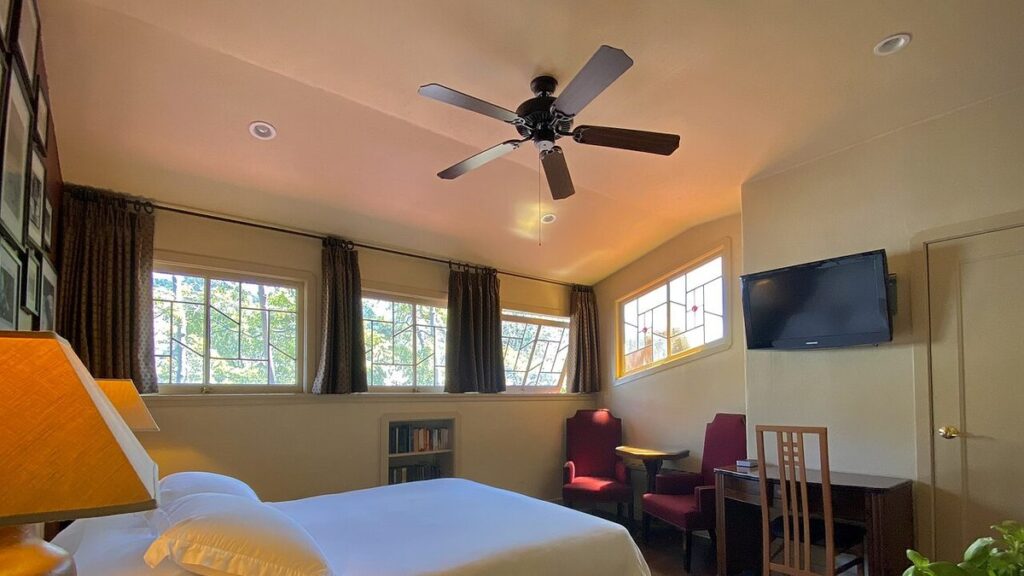
- In summer, set your ceiling fan to spin counterclockwise (viewed from below) so it pushes air straight down and makes a breeze you can feel.
- The fastest check is standing under the running fan. A real breeze means summer mode. Barely any air means it’s backward.
- Flip the direction with the small slider on the motor housing — but always turn the fan off and let the blades stop first.
- A fan’s breeze cools your skin, not the room, so running a fan in an empty room just burns electricity for nobody.
- Pair the fan with your AC and you can raise the thermostat about 4 degrees F without feeling any warmer — that’s where the real savings live.
- In winter, reverse to clockwise on low speed so the fan pulls air up and pushes the warm ceiling air back down to you.
Here’s the answer, right up front: in summer, your ceiling fan should spin counterclockwise when you look up at it from below. That direction pushes air down on top of you, and that little breeze can make you feel several degrees cooler without changing the room’s temperature at all. And here’s the check: stand directly under the fan while it runs. If you feel air washing over you, you’re set. If the fan is spinning but you feel almost nothing, it’s running backward. That’s the whole test — no stool, no manual, no squinting at tiny switches. Everything else in this guide — the right ceiling fan direction in summer versus winter, how to flip the switch, and the thermostat trick that actually saves money — builds on one simple idea: fans cool people, not rooms. Once that clicks, every fan decision you’ll ever make becomes obvious.
Counterclockwise Is the Answer for Summer
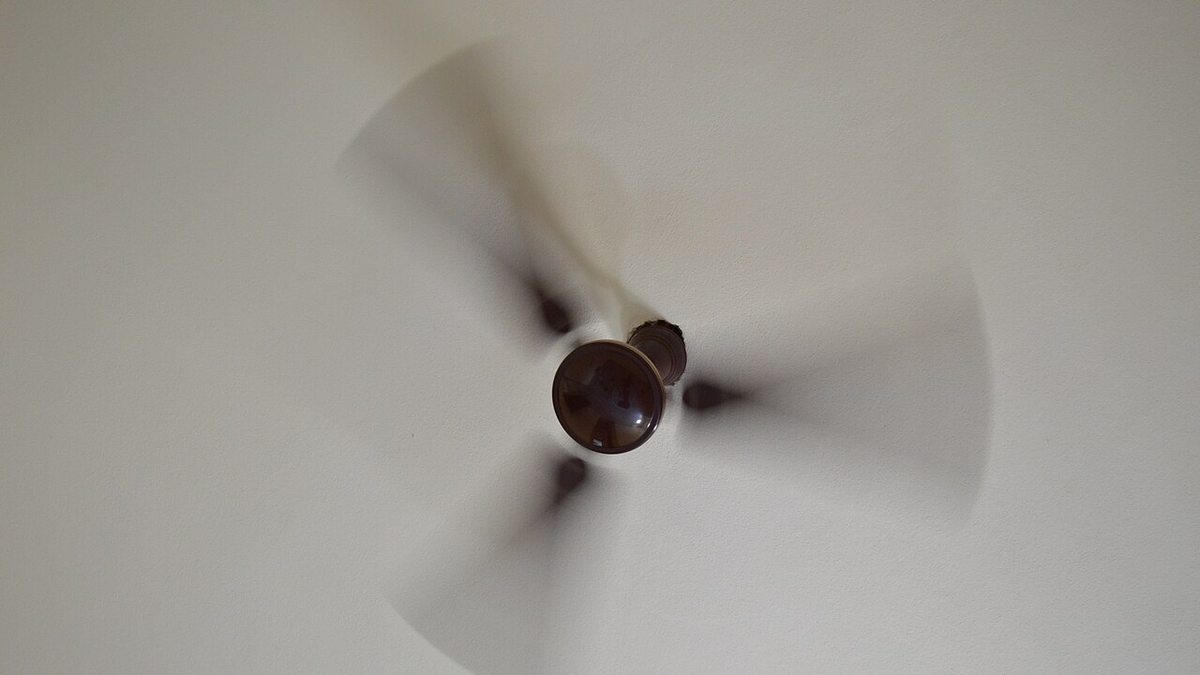
Look up at your fan from underneath. In summer, you want the blades sweeping counterclockwise — the opposite way a clock’s hands move. Fan blades aren’t flat. Each one is tilted at an angle, like a propeller. When the fan spins counterclockwise, that tilt scoops air from above and shoves it straight down at you. People in the business call this a downdraft, but you don’t need the word. You just need the feeling: a steady, gentle wind falling from the ceiling onto your skin.
So why is this simple answer so hard to find? Search for fan direction and you’ll land on page after page from fan brands that walk through motors, seasons, blade pitch, and energy theory before they ever tell you which way to set the thing. The answer gets buried in the middle of a dual summer-and-winter guide, usually under a heading you have to scroll to find. Even worse, half the sources talk in terms of “forward” and “reverse,” which means nothing when you’re standing in your living room staring at the ceiling. Major HVAC brands like American Standard do confirm the rule — counterclockwise for summer, clockwise for winter — but you shouldn’t need to read a heating company’s blog to cool your bedroom.
Here’s the reframe that makes it stick forever: stop thinking in clock directions and start thinking up or down. Summer means air blows DOWN on you. Winter means air gets pulled UP away from you. Down when you’re hot, up when you’re cold. A ten-year-old can remember that, and it works on every fan ever made, no matter what the manual calls the modes.
Three Easy Ways to Check Fan Direction From the Floor
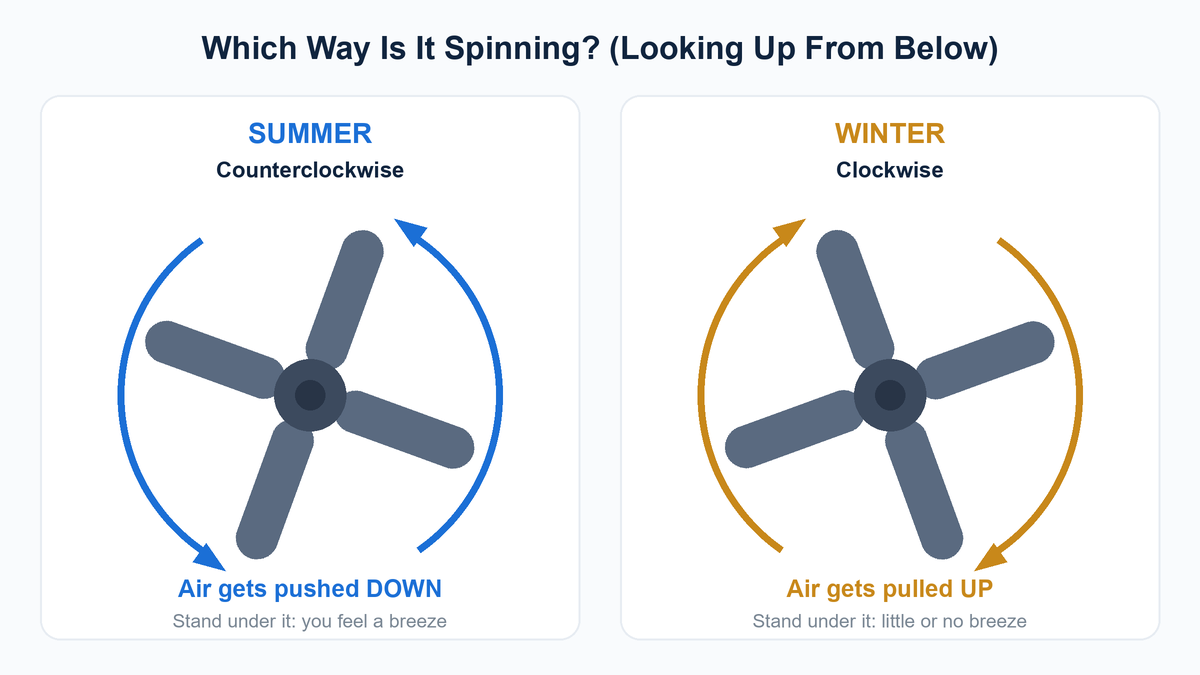
You never need a ladder to check your fan. You don’t even need to see the blades clearly. Your skin is a better instrument than your eyes here, and it works from six feet below. There are three checks, in order from easiest to most useful, and all of them happen with your feet on the floor.
1 Stand Under the Fan and Feel for Air
Turn the fan on, walk directly underneath it, and just stand there for a few seconds. In summer mode you’ll feel an obvious breeze pressing down — on your face, your arms, the top of your head. In winter mode the same fan at the same speed feels strangely still underneath, because the air is being pulled up past you toward the ceiling instead of pushed down onto you. The difference isn’t subtle. If you’re standing under a running fan asking yourself “do I feel something?”, the answer is no, and your fan is in winter mode.
2 Watch the Blades Like a Clock Face
Want to confirm what your skin told you? Set the fan to its lowest speed so the blades are slow enough to follow, stand directly below, and picture a clock face on the ceiling. If the blades sweep from 12 toward 9 — against the clock — that’s counterclockwise, your summer setting. If they sweep from 12 toward 3, that’s clockwise, the winter setting. One important catch: the direction depends on where you’re standing. Viewed from below it’s counterclockwise; if you could look down on the same fan from above, it would look clockwise. Every rule in this article uses the view from below, because that’s the only view you’ll ever actually have.
3 Read the Blade Tilt While the Fan Is Off
There’s even a check for a fan that’s switched off, and it makes you feel a little like a detective. Look at any one blade. You’ll see it’s tilted — one long edge sits slightly higher than the other. For the fan to push air down, the higher edge has to lead the way as the blade spins, like a paddle angled to scoop air downward. So note which edge is raised, then flick the fan on for a moment: if the raised edge is the one cutting through the air first, you’re in summer mode. If the lower edge leads, the fan is lifting air instead. This one takes a bit of squinting, so treat it as a party trick — the breeze test is still king.
How to Switch Your Fan Into Summer Mode
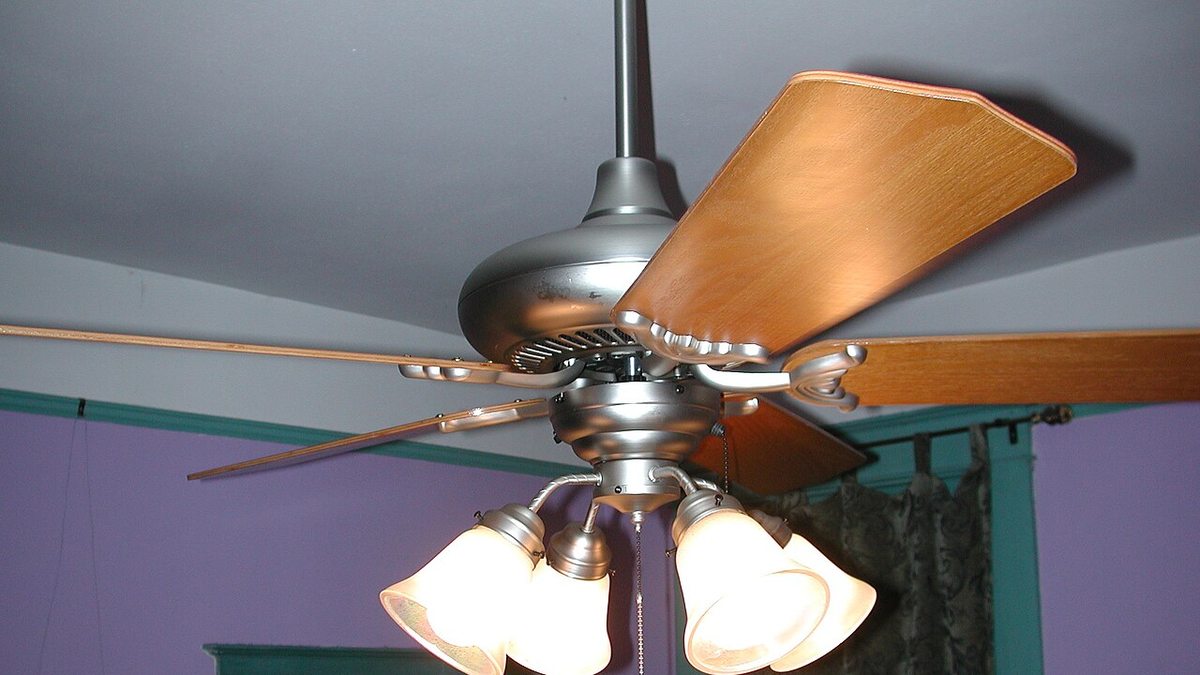
Found out your fan is backward? The fix takes under a minute on almost every fan sold in the last few decades. Where the control lives depends on the age and style of your fan, but it’s always one of three places: a physical switch on the fan itself, a button on a remote, or a toggle in an app.
Turn the Fan Off and Let the Blades Stop Fully
Before you touch anything, turn the fan off and wait for the blades to coast to a complete stop. This isn’t fussy safety theater. The direction switch physically reverses how the motor is driven, and flipping it while the motor is still spinning one way asks the fan to fight its own momentum — a genuinely bad deal for the motor’s windings and a good way to shorten the fan’s life. Some newer fans refuse the command until they’ve stopped anyway, but the classic slider switch will happily let you hurt an older motor. Off first, full stop, then flip.
Find the Small Slider on the Motor Housing
On most fans, the direction control is a small plastic slider on the motor housing — the chunky body of the fan above or below the blades, where the pull chains hang. It slides either horizontally or vertically, and it’s usually unlabeled, which is exactly why the up-or-down confusion exists in the first place. On many fans with a vertical slider, down means summer and up means winter — a decent memory hook, since down-for-downdraft matches the air pushing down. But conventions genuinely vary between brands, so don’t trust the slider’s position. Flip it, run the fan, and let the breeze test give you the verdict. If you can’t spot a slider at all on a chain-operated fan, check the top side of the housing near the downrod — a few manufacturers tuck it up there.
Use the Remote or App on Newer Fans
If your fan came with a remote, look for a button labeled with two curved arrows, or the word “reverse” — some remotes hide it behind a long-press of the regular fan button. Smart fans move the setting into their phone app, usually under the fan’s settings screen rather than the main controls. And this is worth knowing before you buy: many remote-controlled fans have no wall-reachable slider at all, so if the remote dies, you’ve lost the direction control with it. Wherever the control lives, the routine never changes: fan off, blades stopped, flip, then stand underneath and feel for the breeze.
Why the Breeze Cools Your Skin and Not the Room
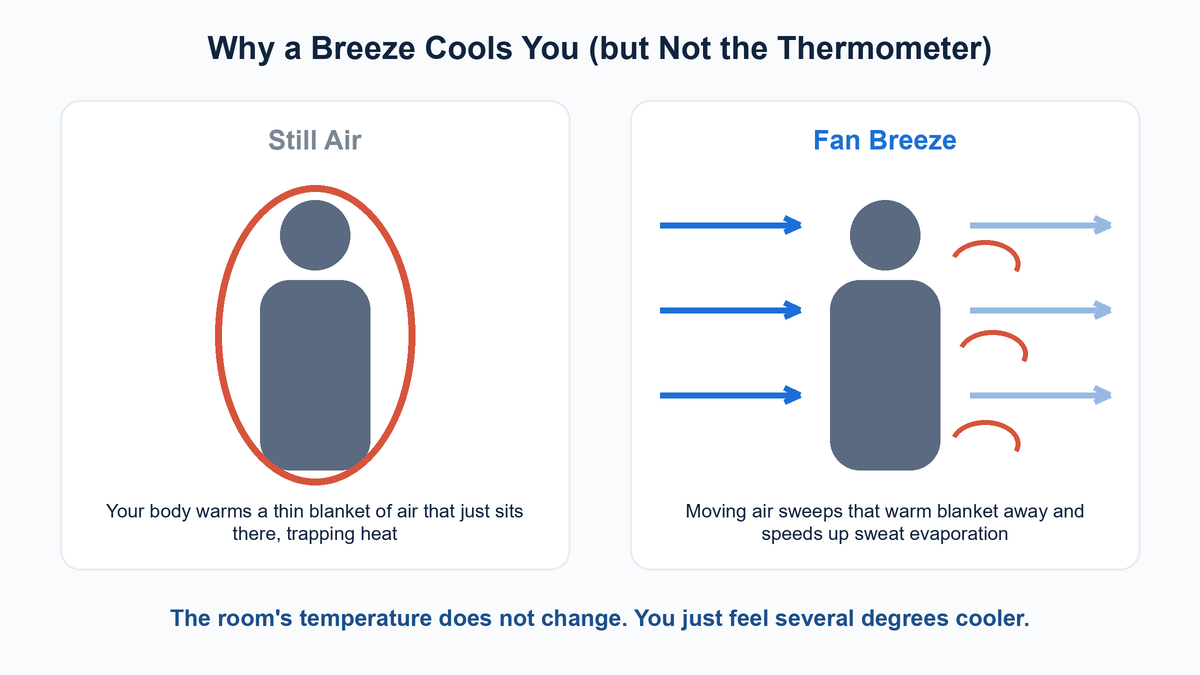
Now for the part most guides skip, which happens to be the part that saves you money. A ceiling fan does not cool air. Not even slightly. Run a fan all afternoon in a closed room and the thermometer will read exactly what it read at lunch — actually a hair higher, because the motor itself gives off a little heat. So what’s the breeze doing? It’s working on you, in two ways.
First, your body constantly warms a thin, invisible blanket of air that clings to your skin. In still air, that warm layer just sits there, insulating you like a light jacket you can’t take off. Moving air strips that blanket away and replaces it with room-temperature air over and over, so your body sheds heat much faster. Second, moving air speeds up evaporation. Every bit of sweat that evaporates carries real heat away with it — it’s the body’s built-in air conditioning — and a breeze makes that happen dramatically faster. Stack the two effects and a fan’s airflow can make a room feel several degrees cooler than it actually is, which is why American Standard’s guidance treats a fan as a comfort machine rather than a cooling machine.
This single fact quietly answers almost every fan question people argue about. Should you leave the fan on for the dog? No — the wind-chill trick works on sweating human skin, and dogs barely sweat, so they get far less from it. Does a fan help an empty room stay cool for later? Not at all — the room was never being cooled. Fans make people comfortable while they’re under them, full stop. One thing the breeze won’t do is make the air any cleaner or fresher — that’s a different project entirely, and if it’s the one you actually care about, it turns out cleaner indoor air has some surprising benefits beyond comfort.
The Thermostat Trick That Turns a Breeze Into Real Savings
Here’s the money paragraph. On its own, a ceiling fan barely registers on your electric bill: most use somewhere in the range of 50 to 100 watts, while a central air conditioner draws a few thousand. Hunter Fan’s own comparison puts a fan run eight hours a day at about $1 to $3 a month, versus roughly $100 to $150 a month for central AC on the same schedule. But that cheap fan can’t replace the AC, because it can’t actually cool anything. The real play is teamwork.
Because the fan’s breeze makes you feel about 4 degrees cooler than the room really is, you can raise the AC’s thermostat by about 4 degrees F and feel exactly as comfortable as before. The fan buys the comfort; the higher setpoint means the air conditioner — the expensive machine — runs noticeably less. That thermostat bump is the entire financial case for summer fan mode, and it’s why the counterclockwise setting matters: a backward fan gives you no breeze, no wind-chill discount, and no reason to touch the thermostat. If you want maximum effect for minimum wattage, newer certified fans help too — ENERGY STAR rates its certified ceiling fans as up to 44% more efficient than conventional models.
The flip side of “fans cool people” is just as valuable: turn the fan off when you leave the room. A fan spinning over an empty couch is doing exactly nothing except spending electricity and adding a trickle of motor heat to the room your AC is fighting. One fan left on isn’t a disaster — but three fans running around the clock all summer quietly multiplies that “couple of dollars a month” math, the same way all the other little always-on devices in your house add up to real money over a year.
What Forward and Reverse Actually Mean on a Fan
If you’ve ever read a fan manual, you’ve met the words “forward” and “reverse” — and probably closed the manual more confused than you opened it. Here’s the translation: on most brands, forward is the summer setting. Forward means the blades turn counterclockwise viewed from below and push air down. Reverse is the winter setting — clockwise, pulling air up. The manufacturers aren’t being difficult on purpose; from the motor’s point of view, one rotation really is its normal drive direction and the other is its reversed one. But nobody lives at the motor’s point of view. You live under the fan.
The confusion gets worse because “counterclockwise” itself flips depending on where you imagine yourself standing, and because a handful of manuals describe rotation as seen from above — a view that exists only in diagrams. This is why the up-or-down framing beats every other way of talking about fan direction. “Forward” requires you to know the brand’s convention. “Counterclockwise” requires you to agree on a viewpoint. “Air pushes down on me in summer” requires nothing but your own skin, and it can’t be misread. When in doubt, ignore every label and ask the only question that matters: can I feel the breeze from below? In summer, the answer should be yes.
Flip It to Clockwise When Winter Rolls Around
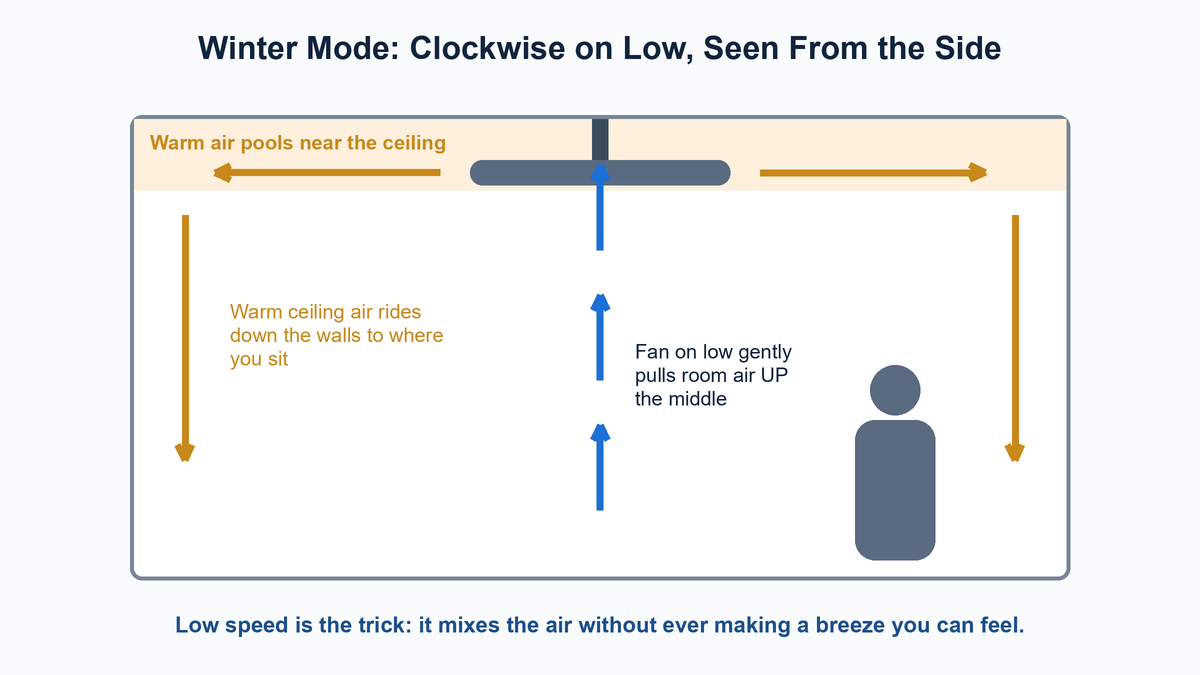
Come winter, the fan earns its keep a completely different way — and this is the setting the “or winter” half of the question is really about. Warm air rises. Every hour your heater runs, the warmest air in the room floats up and pools against the ceiling, which is a spectacular waste, because you live at sofa height. In a room with tall ceilings the air near the ceiling can sit several degrees warmer than the air at your feet. You paid to heat that air, and it’s hovering eight feet above where you can feel it.
Winter mode fixes the layering problem. Flip the fan to clockwise (viewed from below, as always) and run it on its lowest speed. Now the blades pull room air gently upward through the middle of the room. That rising column pushes the warm ceiling air outward, and it slides across the ceiling and rolls down the walls, arriving back at floor level where you actually are. The room’s heat gets stirred back into one even temperature instead of sitting in layers, so the space feels warmer at the same thermostat setting.
Low speed is not a suggestion — it’s the whole trick. On high, the fan makes a real breeze, and a breeze in January does exactly what it does in July: wind-chills your skin and makes you feel colder, canceling the benefit. Winter mode done right is a fan you can’t feel at all, quietly folding the warm air back down to you. It pays off most in rooms with high or vaulted ceilings, stairwells, and any room where your feet are freezing while the thermostat swears it’s 70.
Get the Fan Size Right or the Direction Will Not Matter
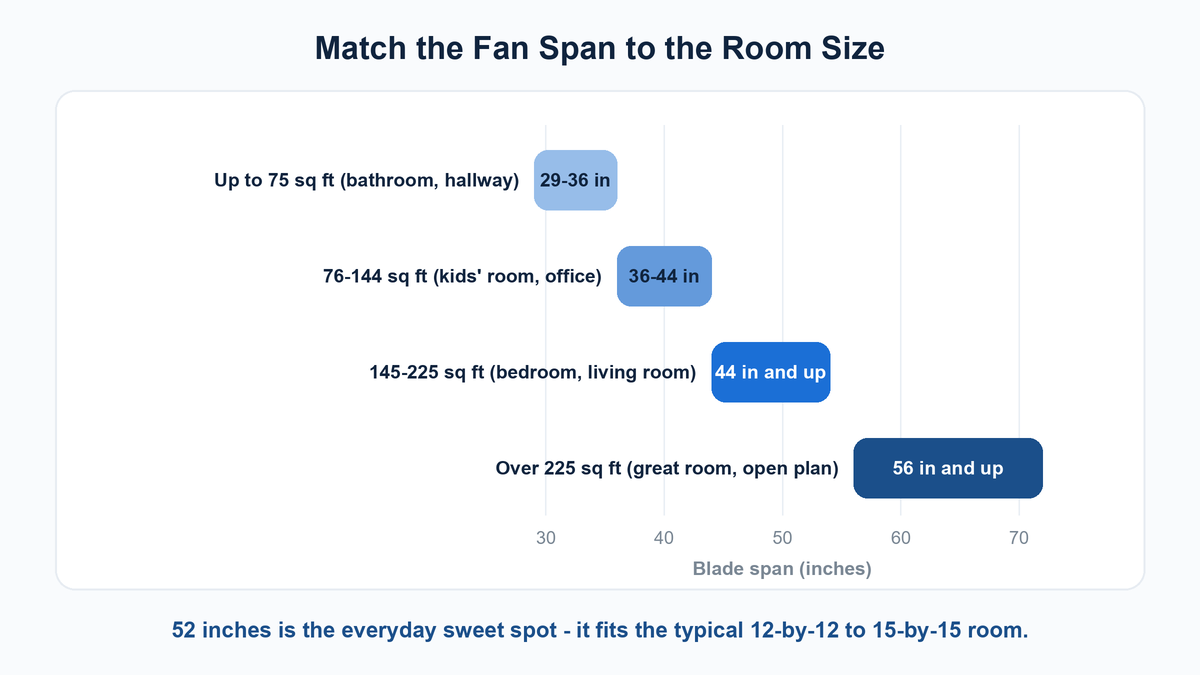
A quick reality check before you blame the direction switch: if your fan is too small for the room, no setting will save it. The breeze effect depends on how much air the fan can actually move, and a tiny fan in a big room stirs the air like a teaspoon in a bathtub. Fan-industry sizing guides run remarkably consistent on this — Hunter’s own sizing guide is a good example: small rooms up to about 75 square feet suit a 29-to-36-inch fan, mid-size rooms up to about 144 square feet want 36 to 44 inches, typical bedrooms and living rooms up to about 225 square feet call for 44 inches or more, and big open rooms past that deserve 56 inches or more. The most common all-around size in American homes is 52 inches, which fits the typical 12-by-12 to 15-by-15 room.
If you’re shopping, the number that actually describes performance is CFM — cubic feet per minute, literally how much air the fan moves. Two 52-inch fans can move very different amounts of air depending on blade pitch and motor, so compare CFM instead of trusting blade span alone; more CFM means a stronger breeze, and higher CFM-per-watt means that breeze costs less to run. Mounting height matters too: blades hanging around 8 to 9 feet above the floor put the breeze where people are, which is why downrods exist for vaulted ceilings. A correctly sized, correctly hung, counterclockwise fan is what all the energy math in this article assumes — get those right and the direction switch finally gets to do its job.
Outdoor Fans Follow the Same Rule With One Extra Step

Porch and patio fans obey exactly the same physics: counterclockwise from below, air pushed down, wind-chill on your skin. If anything, the effect is more valuable outside, where nobody’s air conditioner is coming to save you, and where the breeze has a bonus job — a steady downdraft makes it genuinely harder for mosquitoes and flies to hover and land on you. The breeze test works exactly the same on a porch: stand under the fan, feel for the push.
The extra step is the rating, and it’s not optional. Outdoor fans come in two flavors: damp-rated fans, built for covered spaces that see humidity but not direct rain — a roofed porch, a covered patio, a sunroom — and wet-rated fans, sealed to shrug off actual rain and hose-downs, for pergolas and anywhere weather reaches. An ordinary indoor fan hung outside will rust, its blades will warp in the humidity, and the wobble will get worse until the fan fails — the ceiling fan in a breezy porch photo may look identical to the one in your bedroom, but the materials are doing very different work. Open-air spaces also swallow airflow, so size up: a breeze that felt strong in a sealed bedroom disperses fast with no walls to contain it, which is why large-blade, high-CFM fans dominate the outdoor section of every fan aisle.
The Bottom Line on Summer Fan Direction
Counterclockwise from below, air pushing down, breeze on your skin — that’s summer. Clockwise on low, air pulled up, no breeze at all — that’s winter. You can verify either one in ten seconds by standing under the fan, and you can flip between them in under a minute with the slider on the housing, the remote, or the app — fan off and stopped first. Behind the whole ritual sits one idea worth keeping: fans cool people, not rooms. That’s why the direction matters, why the fan should be off in empty rooms, and why the smartest cooling move in your house is a fan breeze plus a thermostat nudged about 4 degrees higher. It’s the rare home tip that costs nothing, takes a minute, and shows up on the next bill.
Frequently Asked Questions
Which direction should a ceiling fan spin in the summer?
Counterclockwise, as seen when you stand under the fan and look up. The angled blades push air straight down, creating a breeze that makes you feel several degrees cooler than the room’s actual temperature. If you’d rather skip the direction words entirely, remember it this way: in summer, the fan should blow air down onto you, and you should be able to feel it.
Is counterclockwise up or down on a ceiling fan?
Counterclockwise is the down direction — it pushes air down toward the floor, and it’s the setting you want in summer. Clockwise is the up direction, pulling air toward the ceiling for winter. The clock terms confuse people because they flip depending on your viewpoint, so every guide (including this one) means the view from below, standing in the room.
How can I tell if my ceiling fan is set correctly without climbing up?
Stand directly under the running fan. A clear breeze on your face and arms means it’s in summer mode. Almost no airflow means it’s backward. For a second opinion, run the fan on low and watch the blades from below against an imaginary clock face — sweeping from 12 toward 9 is counterclockwise, which is correct for summer. Neither check requires a stool or touching the fan.
Should the direction switch be up or down for summer?
On many fans with a vertical slider, down is summer and up is winter — down matches the downdraft. But brands genuinely differ, and horizontal sliders have no standard at all, so never trust the slider position alone. Flip it, turn the fan on, and stand underneath: the breeze tells you the truth in seconds. Always turn the fan off and let the blades stop before moving the switch.
Does reversing the fan direction really lower my energy bill?
The direction switch alone doesn’t — the fan draws the same 50 to 100 watts either way. The savings come from what the correct direction lets you do: with a real breeze making you feel about 4 degrees cooler, you can raise the AC thermostat about 4 degrees F with no comfort loss, and the AC runs less. Skip the thermostat change and the fan is only comfort; make the change and it’s money.
Should I leave the ceiling fan on all day in summer?
Only in rooms with people in them. A fan cools skin through wind-chill and evaporation — it doesn’t lower the room’s temperature even slightly, so a fan in an empty room accomplishes nothing but spending electricity and adding a bit of motor heat. Turn it off when you leave, the same way you’d treat a light. The exception is coming back soon to the same room, where the restart hassle outweighs pennies of runtime.
What direction and speed should I use in winter?
Clockwise (viewed from below) on the lowest speed. Warm air pools at the ceiling in heated rooms; the slow updraft pushes that warm layer across the ceiling and down the walls back to where you sit, evening out the room without creating a breeze. Speed matters more than people expect — on high, the fan makes a wind-chill breeze that makes you feel colder, undoing the benefit entirely.
About the Author
Elena Brooks
Elena Brooks is the person her group chat texts when something at home stops working or a health trend starts trending. She’s spent years turning that instinct into a job — digging into the research behind everyday questions, calling the experts, and writing up what holds up and what doesn’t. Her beat is wherever curiosity points: kitchens, cars, pets, sleep, money, and the occasional meteor shower.