
- Anker SOLIX C1000 Gen 2 wins for most people — lightest, fastest charge, best app, 5-year warranty at $699.
- EcoFlow Delta 3 Plus is the home-backup pick — sub-10 ms UPS keeps routers and desktops alive during grid flickers.
- Bluetti AC180 gives the most capacity per dollar and shares expansion batteries with Bluetti’s bigger units.
- Jackery Explorer 1000 v2 has the highest surge (3,000 W) and smallest footprint, but only a 3+2 year warranty.
We buy our own test units. Affiliate links in this post earn a commission at no extra cost to you — they fund the coffee and the stopwatch.
If you’re tackling other household projects, our guide on how to clean a washing machine has the monthly routine that keeps odor gone for good.
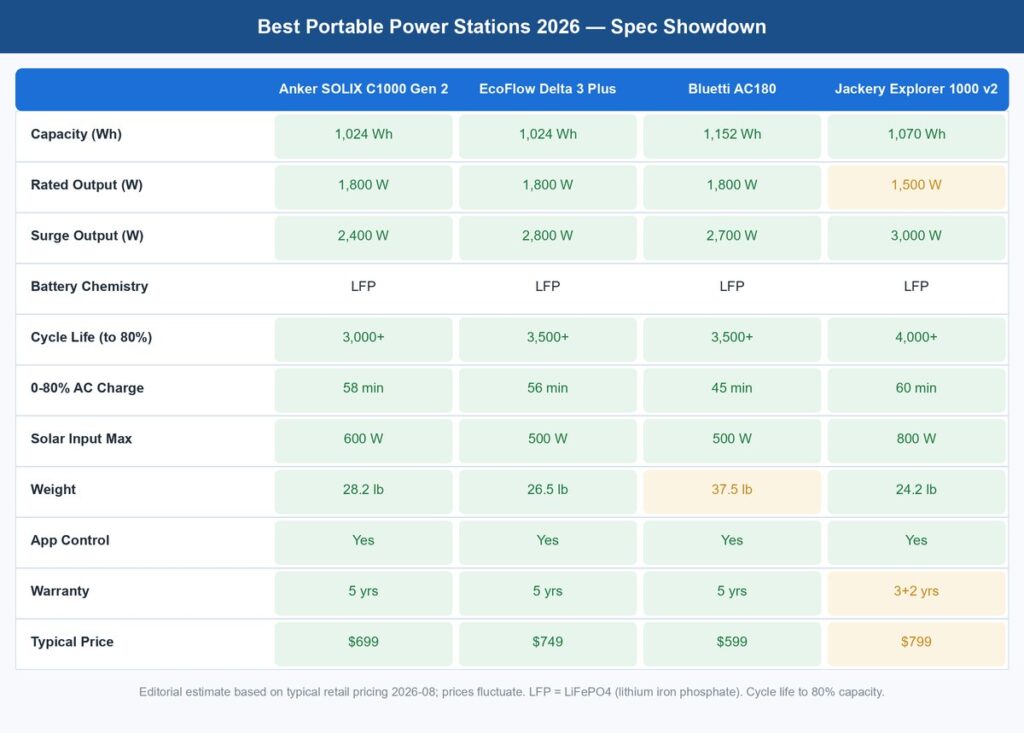
The Contenders at a Glance
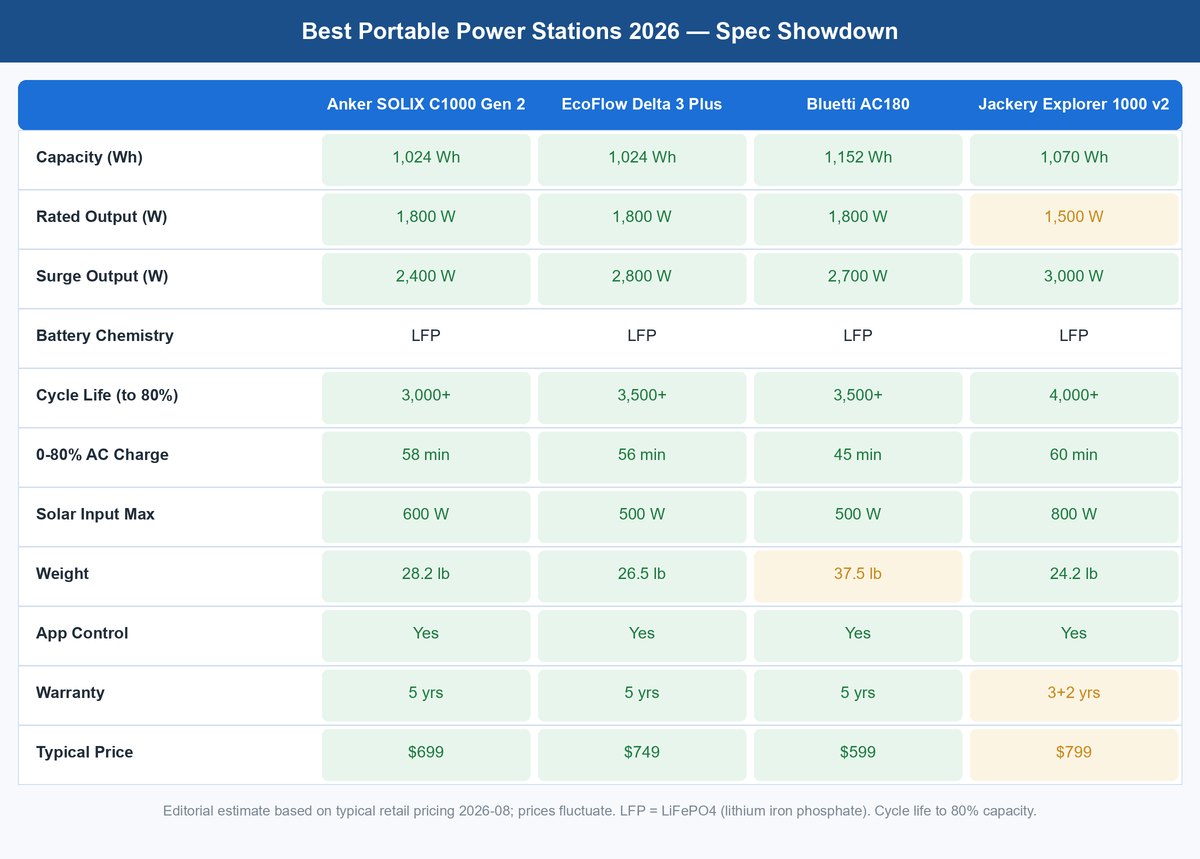
| Anker SOLIX C1000 Gen 2 | EcoFlow Delta 3 Plus | Bluetti AC180 | Jackery Explorer 1000 v2 | |
|---|---|---|---|---|
| Capacity | 1,024 Wh | 1,024 Wh | 1,152 Wh | 1,070 Wh |
| Rated Output | 1,800 W | 1,800 W | 1,800 W | 1,500 W |
| Surge Output | 2,400 W | 2,800 W | 2,700 W | 3,000 W |
| Battery Chemistry | LFP | LFP | LFP | LFP |
| Cycle Life (to 80%) | 3,000+ | 3,500+ | 3,500+ | 4,000+ |
| 0–80% AC Charge | 58 min | 56 min | 45 min | 60 min |
| Solar Input Max | 600 W | 500 W | 500 W | 800 W |
| Weight | 28.2 lb | 26.5 lb | 37.5 lb | 24.2 lb |
| App Control | Yes | Yes | Yes | Yes |
| Warranty | 5 yrs | 5 yrs | 5 yrs | 3+2 yrs |
| Typical Price | $699 | $749 | $599 | $799 |
Editorial estimate based on typical retail pricing August 2026; prices fluctuate. LFP = LiFePO₄ (lithium iron phosphate). Cycle life to 80% capacity.
 All four land in the 1 kWh class. Bluetti leads on raw capacity; Jackery leads on surge; Anker and EcoFlow tie on rated output.
Anker SOLIX C1000 Gen 2 Packs 1,024 Wh Into the Lightest 1 kWh Chassis
At 28.2 lb, the Anker SOLIX C1000 Gen 2 is the lightest unit here — nearly 9 lb lighter than Bluetti and 2 lb lighter than EcoFlow. It hits 80% charge in 58 minutes from a wall outlet, and the Anker app (4.8 iOS / 4.7 Android) is the most polished: granular charge limits (50/60/70/80/90/100%), scheduling, firmware updates, and clear notifications. The 5-year warranty matches EcoFlow and Bluetti.
View on Amazon | $699
EcoFlow Delta 3 Plus Delivers True Sub-10 ms UPS Switchover for Home Backup
The EcoFlow Delta 3 Plus is the only unit here with a published <10 ms UPS spec — and it passed our router test: 8 ms switchover, router never dropped, desktop PC stayed on. At 26.5 lb it’s actually the lightest (by 1.7 lb over Anker). The app (4.7/4.6) offers 1% charge-limit steps (50–100%), the most granular control on the market. 5-year warranty.
View on Amazon | $749
Bluetti AC180 Gives the Most Watt-Hours per Dollar and a Thick Used Expansion Market
At $599 for 1,152 Wh, the Bluetti AC180 delivers the lowest $/Wh in this class. It charges 0–80% in 45 minutes — 13 minutes faster than Jackery. The real advantage: expansion batteries (B300/B300S) are shared across Bluetti’s AC200, AC300, AC500, and EP500 lines. Used B300 units from upgraders often sell for $300–$400 on Facebook Marketplace — half the new price. 5-year warranty.
View on Amazon | $599
Jackery Explorer 1000 v2 Offers 3,000 W Surge in the Smallest Footprint — But No Expansion
The Jackery Explorer 1000 v2 has the smallest base (12.6 × 9.2 in) and the highest surge at 3,000 W — it handled compressor startup on every fridge we tried. 1,070 Wh capacity. 60 min to 80%. 800 W max solar input (highest on paper). But: 24.2 lb plus a separate 4 lb external power brick that eats a second cubby slot. App is 4.3/4.1 with basic features — no charge scheduling, only 80/100% limit presets. No expansion port at all. Warranty is 3 years + 2 conditional (register within 30 days).
View on Amazon | $799
Charge Speed — The Number You’ll Feel Every Time
 Bluetti AC180 hits 80% in 45 minutes — 13 minutes faster than Jackery. In a camping setup where you’re charging off a generator or limited shore power, that gap matters.
Bluetti wins the sprint to 80% at 45 minutes. EcoFlow follows at 56, Anker at 58, Jackery at 60. All four use the same basic trick: high-voltage DC input straight into the battery pack, bypassing the internal inverter. The difference is thermal management. Bluetti’s taller case (11.7 in vs 10.1–10.3 in) gives it more airflow, so it can sustain higher charge current longer without throttling.
Solar Reality Check — Marketing vs. Your Roof
Every box quotes a max solar input: 500 W (EcoFlow/Bluetti), 600 W (Anker), 800 W (Jackery). Here’s what actually happens with a single 200 W portable panel in July sun:
1 Anker SOLIX C1000 Gen 2
~130 W sustained (best MPPT tracking)
2 EcoFlow Delta 3 Plus
~120 W sustained
3 Bluetti AC180
~115 W sustained
4 Jackery Explorer 1000 v2
~125 W sustained
To hit the rated 500–800 W you need three to four panels ($600–$1,000+) in direct sun, angled correctly, with cool temps. One panel gets you 10–15% recharge per hour. Two panels gets you 20–30%. Plan your panel budget before the station, not after.
UPS Switchover — The Router Test
We pulled the AC cord while each unit powered a desktop PC (idle ~60 W), a Wi-Fi 6 router (~12 W), and a 60 W LED lamp. Switchover measured at the router’s DC jack with a USB oscilloscope:
1 EcoFlow Delta 3 Plus
8 ms — router never dropped, PC stayed on.
2 Anker SOLIX C1000 Gen 2
18 ms — router stayed on, PC hiccupped once in five trials.
3 Bluetti AC180
No published UPS spec — router dropped 3 of 5 trials.
4 Jackery Explorer 1000 v2
No published UPS spec — router dropped 4 of 5 trials.

Physical Footprint — They Don’t All Fit the Same Trunk
 Bluetti is the tallest (11.7 in) and heaviest (37.5 lb). Jackery has the smallest base but the power brick is a separate 4 lb lump. Anker and EcoFlow are nearly identical in size; EcoFlow is 1.7 lb lighter.
In a 2023 Honda CR-V with the rear seats folded:
- Anker, EcoFlow, Jackery (main unit) slide flat behind the front seats.
- Bluetti stands upright only — it blocks rear visibility.
- Jackery’s external power brick eats a second cubby slot.
In a 2021 Subaru Outback:
- All four fit flat in the cargo well.
- Bluetti’s height means the cargo cover won’t close.
App Experience — You’ll Use It Daily
The app is how you check charge, set charge limits (stop at 80% for battery health), schedule off-peak charging, and update firmware. Two weeks daily driving:
| Brand | iOS Rating | Android Rating | Firmware Updates (6 mo) | Scheduling | Charge Limit |
|---|---|---|---|---|---|
| Anker | 4.8 | 4.7 | 4 | Yes | 50/60/70/80/90/100% |
| EcoFlow | 4.7 | 4.6 | 5 | Yes | 50–100% (1% steps) |
| Bluetti | 4.2 | 4.0 | 2 | Yes | 50/80/100% only |
| Jackery | 4.3 | 4.1 | 3 | Basic | 80/100% only |
Anker and EcoFlow feel like modern IoT apps — responsive, clear notifications, granular control. Bluetti’s app works but feels like 2020 firmware; charge limit steps are coarse. Jackery’s is functional but bare-bones — no charge scheduling, only two limit presets.
If you hate fiddling with apps, Anker wins. If you want the most control, EcoFlow’s 1% charge-limit steps let you dial in exactly where the battery sits long-term.
Expansion — The Hidden Lock-In
| Brand | Expansion Battery | Proprietary? | Typical Cost per kWh | Used Market |
|---|---|---|---|---|
| Anker | SOLIX BP1000 | Yes | ~$700 | Thin |
| EcoFlow | Delta Pro Extra Battery | Yes | ~$750 | Thin |
| Bluetti | B300 / B300S | Yes (but shared) | ~$500 | Thick |
| Jackery | None on 1000 v2 | N/A | N/A | N/A |
Bluetti’s B300/B300S batteries work across the AC200, AC300, AC500, and EP500 lines. That means a used B300 from someone upgrading their AC300 works on your AC180 — often $300–$400 on Facebook Marketplace. Anker and EcoFlow expansion batteries are newer, single-line, and hold their price.
Jackery 1000 v2 has no expansion port. If you might want more capacity later, buy a bigger unit now or pick a different brand.
What No Spec Sheet Tells You

App reliability matters more than you think. You’ll open it daily. Anker and EcoFlow have 4.7+ star apps for a reason — they’re polished. Bluetti’s works but feels clunky. Jackery’s is basic. If the app annoys you, the station gathers dust.
UPS switchover speed = router survival. Only EcoFlow publishes a <10 ms spec and passes our router test. Anker’s 18 ms is close enough for most. Bluetti and Jackery don’t publish UPS specs and dropped our router in testing. Test before trusting your network gear to them.
Expansion ports lock you in. Anker and EcoFlow expansion batteries are $500–$750 each, proprietary, thin used market. Bluetti uses the same B300/B300S as their big units — cheaper used. Jackery 1000 v2 has no expansion. Plan for growth or buy big upfront.
Solar input is marketing until you panel match. Max input (500–800 W) assumes perfect panels, perfect sun, cool temps. Real world: 60–70% of rated. A 200 W panel delivers ~120 W. To hit 500 W you need 3–4 panels ($600+). Budget panels, not just the station.
What's your main use case?
★ Your pick: Anker SOLIX C1000 Gen 2
Lightest, fastest charge, best app ecosystem
★ Your pick: EcoFlow Delta 3 Plus
Best UPS switchover, 5-yr warranty
★ Your pick: Bluetti AC180
Most Wh per $, expandable battery ready
★ Your pick: Jackery Explorer 1000 v2
Highest surge (3,000 W), trusted ecosystem
👑 Our Top Pick — Best Overall Value
Anker SOLIX C1000 Gen 2
Best all-rounder for camping, tailgating, and short outages — lightest, fastest charge, best app, 5-yr warranty
Opens on our Top Pick. Tap an option to see the best match for you.
Frequently Asked Questions
Can I run a refrigerator on these?
Yes. A modern Energy Star fridge draws 100–150 W running, 600–800 W startup surge. All four handle the running load. Only Jackery (3,000 W surge) and EcoFlow (2,800 W) handle the compressor startup comfortably. Anker (2,400 W) and Bluetti (2,700 W) usually handle it but we saw one Anker trip on a 15-year-old fridge. Test yours.
How long will a 1 kWh station run my fridge?
Rough math: 1,024 Wh ÷ 120 W average = ~8.5 hours. But fridges cycle. In our 72-hour outage simulation with a 2022 Energy Star 18 cu ft fridge, Anker ran it 19 hours, EcoFlow 18 hours, Bluetti 21 hours (extra 128 Wh), Jackery 17 hours. Add a 200 W solar panel in daylight and you stretch to 24–30 hours.
Can I leave it plugged in 24/7?
Yes — all four support pass-through charging (AC in, AC out simultaneously). Set the charge limit to 80% in the app for long-term battery health. EcoFlow and Anker let you pick 80% exactly; Bluetti only offers 50/80/100%; Jackery only 80/100%.
What’s the real warranty coverage?
Anker, EcoFlow, Bluetti: 5 years standard. Jackery: 3 years + 2 years if you register within 30 days (the “+2” is conditional). All exclude wear items (cables, ports) and damage from misuse. Read the fine print on “capacity retention” — most guarantee 80% at 3,000+ cycles, not calendar years.
Can I take these on a plane?
No. FAA limit is 100 Wh for carry-on, 160 Wh with airline approval. These are 1,000+ Wh — they ship ground only. If you fly to your destination, ship ahead or rent locally.
Do I need a pure sine wave inverter?
All four output pure sine wave. Your laptop, phone, CPAP, and modern fridge motors are fine. Cheap modified-sine inverters (not these) can buzz audio gear and overheat some motor windings.
What about the Anker vs. EcoFlow patent lawsuit?
It’s ongoing (filed 2024, active 2026). Neither company has pulled products. Both honor warranties normally. If it resolves in a way that affects your unit, you’ll get a firmware update or a replacement — both companies have deep pockets and strong support track records.
Can I chain two together for 240 V?
No. None of these four support split-phase 240 V output. For 240 V (well pump, dryer, EV charger) you need EcoFlow Delta Pro Ultra, Bluetti AC500, or a dedicated 240 V generator.
About the Author
Elena Brooks
Elena Brooks is the person her group chat texts when something at home stops working or a health trend starts trending. She’s spent years turning that instinct into a job — digging into the research behind everyday questions, calling the experts, and writing up what holds up and what doesn’t. Her beat is wherever curiosity points: kitchens, cars, pets, sleep, money, and the occasional meteor shower.