

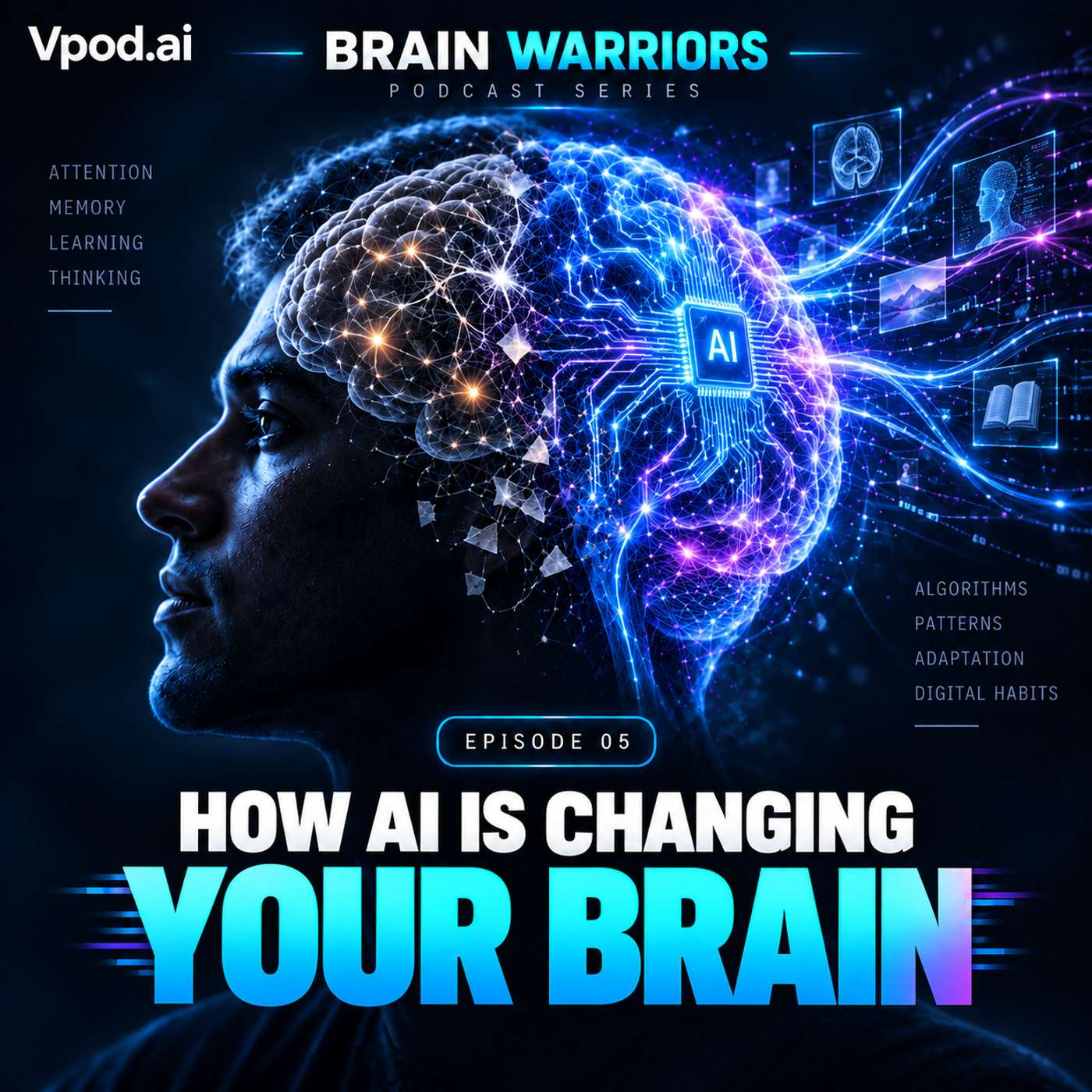





What happens to your brain when AI can remember, create, analyze, and solve problems for you?
In this episode of the Brain Warrior series, we explore how generative AI may be changing the way people use attention, memory, confidence, and critical thinking—and why convenience can become a cognitive liability when humans stop doing the difficult mental work that drives learning.
Drawing on research involving hundreds of knowledge workers and real-world examples of AI-assisted work, the conversation examines a striking pattern: the more confident people become in an AI system, the less critical thinking they may apply to its output. But when people have strong expertise and confidence in their own abilities, they tend to scrutinize AI-generated work much more carefully.
The episode also explores the automation paradox: humans can simultaneously become too passive when AI sounds confident and too stubborn when AI contradicts what they already believe.
You’ll hear how these behaviors affect:
• Critical thinking and cognitive effort when using generative AI
• The relationship between AI confidence and human self-confidence
• Why AI is shifting work from generation toward verification
• Task stewardship and the importance of owning the final outcome
• The automation paradox in human-AI decision-making
• Why expertise can make people better evaluators of AI output
• How excessive automation may weaken individual learning
• The role of “thin public signals” in building shared knowledge
• The potential long-term risk of knowledge collapse
• Why extremely accurate AI could create unexpected societal risks
• How to use AI as a tool for thought instead of an answer machine
• Why friction, struggle, and uncertainty remain essential to neuroplasticity
The discussion introduces the Brain Warrior AI Mindset Framework, built around three principles:
• Task stewardship: Remain the verifier, editor, and final decision-maker.
• Calibrated confidence: Question both your own certainty and the machine’s certainty.
• Seed the ecosystem: Document discoveries, share failures, mentor others, and continue contributing human knowledge.
You’ll also get a practical Brain Challenge: instead of asking AI for the answer to a problem, ask it to generate five difficult questions about your project. Then close the application and answer those questions yourself.
The goal isn’t to reject AI. It’s to use AI in a way that strengthens human cognition instead of quietly replacing the mental effort that keeps our abilities growing.
As AI becomes increasingly capable of handling routine problem-solving and technical execution, the episode closes with an even bigger question: could emotional intelligence, empathy, judgment, and the ability to manage AI systems become some of the most valuable human skills of the future?
Stay curious, keep friction alive in your thinking, and subscribe for the next installment of the Brain Warrior serie