
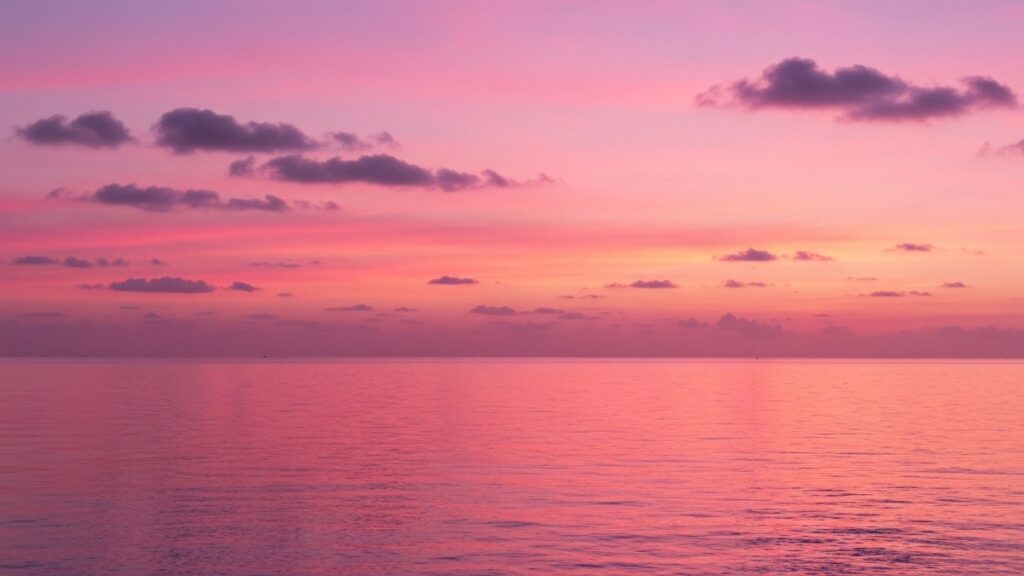
- A pink sky appears when low-angle sunlight travels a long path through the air, loses most of its blue to Rayleigh scattering, and the surviving red and orange light blends with a little leftover scattered blue, then glows against clouds and haze.
- Pink is a recipe, not a separate effect: strong red and orange, a pinch of residual blue (often deep purple-blue from high stratospheric aerosols at twilight), and particles or clouds for that warm light to reflect off.
- Particle size and amount set the shade: a light haze of fine aerosols pushes orange toward pink, while heavy smoke, smog, or fog scatter all colors equally and wash the sky out to gray or muddy brown.
Look up at the right moment and the whole sky turns the color of cotton candy. Soft rose near the horizon, a wash of peach overhead, clouds glowing like they have a light switched on inside them. It’s gorgeous, and it makes you ask a surprisingly deep question: why is the sky pink? The short answer is that pink is what sunlight looks like after it has run an obstacle course through a thick slab of air, lost most of its blue along the way, and bounced its leftover warm colors off clouds and dust. Same sun, same air, same physics that paints the daytime sky blue, just seen from a different angle. Let’s unpack how it works, step by step.
The Quick Science: What Makes the Sky Pink
Here’s the whole idea in one breath. Sunlight is white, which means it’s secretly all the rainbow colors mixed together. As that light pushes through our atmosphere, tiny air molecules knock the short, jittery blue and violet wavelengths sideways far more than the long, lazy red and orange ones. During the day, that scattered blue is splashed across the sky, so it looks blue. But near sunrise and sunset, the sunlight travels through a much longer stretch of air, so by the time it arrives almost all the blue has been scattered out and left behind. So the honest answer to what makes the sky pink is that pink is a recipe, not a separate phenomenon: plenty of red and orange light that survived the long journey, a pinch of leftover blue still scattering through the upper sky, and something physical, clouds or haze or fine particles, for all that light to glow against. Change the proportions and you slide from gold to orange to fiery red, with pink and magenta sitting in the gentle middle. Everything else here is a closer look at how those ingredients get mixed.
How Light and the Atmosphere Work: Rayleigh Scattering Made Simple
To really get pink skies, you need one big idea, and it has a name: Rayleigh scattering. Don’t let the fancy label scare you. It just describes what happens when light bumps into particles much smaller than its own wavelength, like the nitrogen and oxygen molecules that make up most of our air. Get this one concept, and every pink, red, orange, and blue sky runs on the same simple rule.
Light Comes in Different-Sized Waves
Picture sunlight as a parade of waves of every color marching toward you. Blue and violet light travel as short, tightly packed waves; red and orange light travel as longer, more stretched-out ones, with green and yellow in between. That difference in wave size is the secret to everything that follows, because how a wave interacts with a tiny obstacle depends enormously on how its length compares to the obstacle’s size.
The molecules in our air are hundreds of times smaller than even the shortest wavelength of visible light, so they don’t block light the way a wall would. Instead, a passing light wave makes the electrons in a molecule jiggle, and the jiggling molecule re-radiates that energy in new directions. This re-radiation is what we call scattering, and the short, fast-jiggling blue waves provoke it far more strongly than the long, slow red waves. According to NASA Space Place: Why Is the Sky Blue?, blue light is scattered more than other colors precisely because it moves as shorter, smaller waves. One common misconception is that the atmosphere absorbs and destroys blue light; it doesn’t. The air merely redirects it, flinging it off to the sides while red and orange continue straight ahead, so the same blue scattered out of a sunset beam is exactly the blue you see overhead at noon.
An Analogy: Marbles, Beach Balls, and a Crowded Room
Imagine you’re rolling balls across a room crowded with thin pillars. Tiny, fast marbles, standing in for blue light, ricochet off almost every pillar they pass, scattering wildly and rarely crossing the room in a straight line. Big, heavy beach balls, standing in for red light, mostly plow straight through, barely nudged. Air molecules treat light exactly like that: they fling the short blue waves all over the sky while letting the long red waves sail more or less straight ahead.
The math behind the analogy is striking. Rayleigh scattering is inversely proportional to the fourth power of wavelength, which sounds intimidating but just means small changes in color cause big changes in scattering. Because deep red light has roughly twice the wavelength of violet-blue light, and two to the fourth power is sixteen, the shortest visible wavelengths are scattered on the order of sixteen times more than the longest ones. That single factor of sixteen is the engine behind blue skies, red sunsets, and every pink in between. It also explains why scattered colors seem to come from the whole sky at once, while direct, unscattered light arrives only from the sun’s exact spot, the very difference that makes looking up and looking at the horizon give such different colors.
Why the Daytime Sky Looks Blue
Now stand outside at noon. Sunlight is coming almost straight down, so it only passes through a thin layer of atmosphere, but that’s still plenty of air to scatter the easily-scattered blue light in every direction. Everywhere you look, blue is bounced toward your eyes from molecules all across the sky, so the whole dome glows a familiar blue. The red and orange mostly stream past unscattered, which is why the midday sun itself looks pale yellow-white rather than blue.
A natural follow-up is why the sky isn’t violet, since violet scatters even more strongly. Two things conspire against it: the sun emits less violet light to begin with, and our eyes are more sensitive to blue than violet, so the brain reads the mixture as sky blue. The physics technically favors violet, but biology and the sun’s spectrum nudge the result toward blue. This is also the part people find counterintuitive, so it’s worth saying plainly: the color of the daytime sky and the color of a sunset are the same effect viewed from opposite ends. When you look at the blue daytime sky, you’re seeing the blue light that got scattered out of the sunbeam and tossed toward you from all directions. When you look at a pink sunset, you’re staring almost straight down the beam itself, so you see what’s left after the blue has been stripped away and scattered elsewhere. One scene shows you the light that was removed; the other shows you the light that survived. Keep that flip in mind and pink skies stop being mysterious.
Rayleigh Scattering Versus Mie Scattering
So far we’ve talked only about air molecules, which are far smaller than a wavelength of light and give us pure Rayleigh scattering. But the air also carries larger floating particles, and when light meets a particle roughly the same size as its wavelength or bigger, a different rulebook takes over. That rulebook is called Mie scattering, and it differs from its Rayleigh cousin in one crucial way: it does not strongly favor short wavelengths.
Mie scattering treats most colors fairly equally, scattering red almost as readily as blue. That is why a cloud, made of relatively large water droplets, looks white rather than blue, and why a thick, hazy, or foggy sky looks washed-out and gray instead of vividly colored: when big particles dominate, color sorting breaks down and everything blends toward white. Pink skies live in the delicate handoff between these two regimes. Rayleigh scattering from molecules strips out the blue over a long path and hands you a reddened beam. A modest sprinkling of small aerosols then adds gentle, color-preserving scattering that spreads the warm light into broad pastel washes and lets a little blue survive in the mix. Push the particle sizes too large or the amount too high, though, and Mie scattering takes over and grays everything out. The interplay of the two effects is exactly why some evenings glow rose and others just turn dull and flat.
Why Is the Sky Pink at Sunset
Everything changes when the sun sinks low. The question of why is the sky pink at sunset comes down to one word: geometry. The path the light takes through the air gets dramatically longer, and that long path is what trades blue for pink. The sun hasn’t changed and the air hasn’t changed, only the angle has. Let’s break the sunset recipe into its key ingredients.
The Long Path: More Air for Light to Travel Through
When the sun is overhead, its light slices through the atmosphere on a short, near-vertical route. When the sun sits on the horizon, its light comes in at a shallow, grazing angle, so it skims through a far thicker wedge of air. Atmospheric scientists measure this with a quantity called airmass, and at the horizon the light passes through roughly thirty to forty times more atmosphere than at noon. Every extra mile of air is another stretch where blue can be scattered away.
The longer the path, the more thoroughly the blue is filtered out before the light reaches you. By the time low sunlight arrives, its blue has been scattered sideways over hundreds of extra miles of sky, and the surviving beam is dominated by warm reds and oranges. This is also why a low sun looks so much dimmer and redder than the midday sun: the thick slice of air has filtered it enormously. Even so, that dimming is never total, which leads straight to an important safety note.
Which Colors Survive the Long Journey
Think of the atmosphere as a filter that grows stronger the longer light spends inside it. As the path lengthens toward sunset, the colors drop out in order of wavelength: violet goes first, then blue, then green and yellow thin out too. Red and orange are the marathon runners that make it all the way to your eyes, which is why a sky can shift from gold an hour before sunset, to orange, to deep red right at the horizon.
But sunsets aren’t usually pure fire-engine red, and that gap between “should be red” and “looks pink” is the whole puzzle. If the only thing happening were blue getting filtered out, every sunset would simply march toward deeper red, and plenty do. The reason so many skies land on pink instead is that the reddened direct beam never travels alone; it shares the sky with scattered light arriving from other directions, and that companion light is the missing ingredient.
How Pink Specifically Forms From Leftover Blue
Here is the mechanism that turns a red sunset pink, and it’s worth slowing down for because most explanations skip it. The direct beam from the low sun is red and orange, having lost its blue on the long path. But above and around it, the rest of the sky is still doing ordinary Rayleigh scattering on sunlight passing overhead, so a faint blue glow washes across the upper sky. Where the warm direct light overlaps that residual cool blue, your eyes add the two together, and red plus a little blue reads as pink and magenta rather than pure red.
There’s a beautiful high-altitude version too. After the sun sets, its reddened rays skim through the upper atmosphere and illuminate tiny aerosols in the lower stratosphere, roughly ten to twenty kilometers up. That reddish light combines with blue still being scattered overhead to paint the well-known purple and lavender twilight glow. So the pinks and purples high in a clear sky after sunset are literally red-tinted light from below mixing with blue-tinted light from above, the leftover-blue recipe staged at altitude.
The Aerosol Sweet Spot That Tints Skies Pink
The air is never perfectly clean. It carries aerosols, a catch-all word for fine floating particles: dust, sea salt, pollen, soot, and water droplets. A moderate amount of these adds gentle, color-preserving scattering that spreads and softens the warm colors into broad pastel washes. Too few and you get a clean but plain orange; a light sprinkling of small aerosols is often exactly what pushes a sunset from ordinary orange into glowing pink.
There’s a sweet spot, though, and it’s all about particle size. A modest helping of fine particles enhances the color, but a heavy load of large particles does the opposite. When the air gets thick with big droplets, heavy smog, or fog, those large particles scatter all wavelengths roughly equally, which is Mie scattering taking over and washing the color toward dull gray. Size matters as much as quantity: a thin veil of small particles flatters a sunset, while a dense bank of large ones flattens it.
How Clouds Catch and Reflect Reddened Light
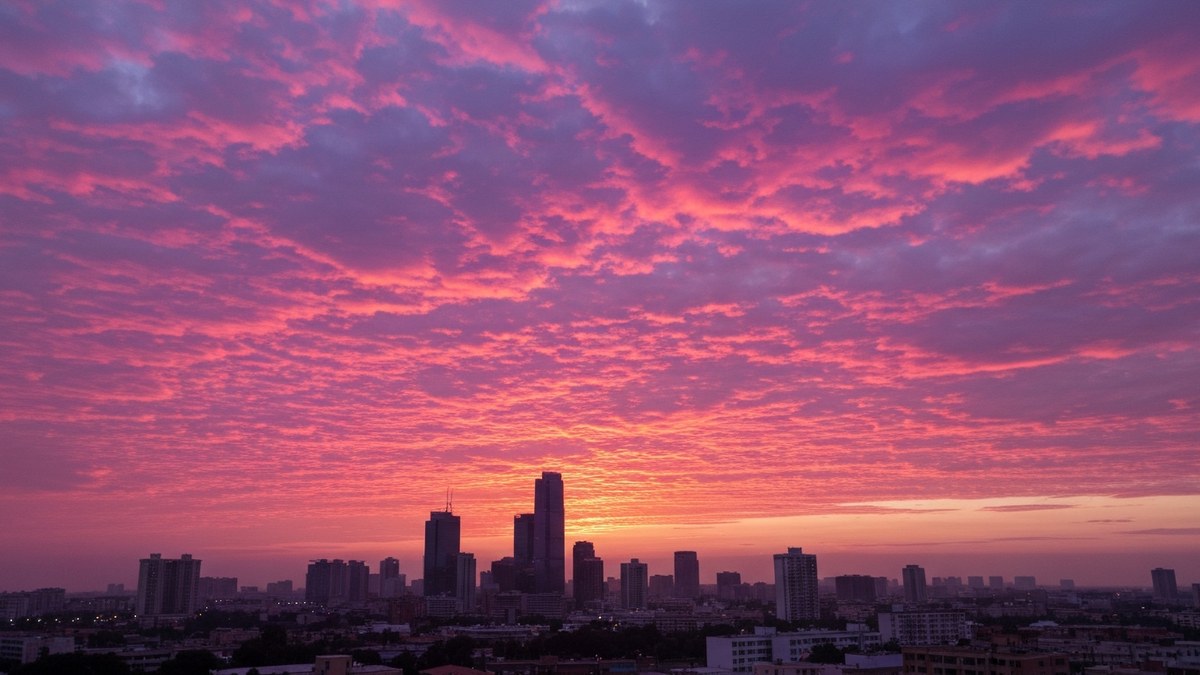
Clouds are the canvas that makes a pink sky pop. After the sun dips below your horizon, its light can still reach clouds floating high above you, lighting them from below and the side. That light has already crossed a huge stretch of atmosphere, so it arrives stripped of blue and full of red and orange, and the clouds, made of water droplets, reflect it back down to you, glowing pink and salmon while the clearer sky behind them fades to deeper rose and violet.
The height and type of cloud make a big difference. High, thin clouds like cirrus catch the last light long after low clouds have fallen into shadow, which is why the most striking pinks often appear in wispy streaks overhead while the horizon has gone dark. A frequent misconception is that the clouds themselves are dyed pink; they aren’t. A pink cloud is just an ordinary white cloud reflecting reddened sunlight, the same way a white wall glows orange under a sunset. Remove the colored light and the cloud is plain white again. No clouds means a quieter sunset; the right clouds in the right place mean a showstopper.
Why Is the Sky Pink Before a Storm (and After)
Ever noticed how some of the most intense pink and lavender skies show up right around stormy weather? Understanding why is the sky pink before a storm ties together everything above: a low sun, extra particles, and a sky full of clouds, all arriving at once. Storms don’t break the physics, they simply stack several pink-making ingredients into one dramatic scene.
Storms Fill the Sky With Clouds at Many Heights
An approaching or departing storm fills the sky with cloud layers at many altitudes at once, from low gray decks to high wispy sheets miles up. When the sun is low and shines in sideways under those layers, it lights their undersides directly, turning each layer into its own reflecting surface. With so much cloud area to catch and bounce reddened sunlight, the entire dome can flush pink, purple, and orange together.
This multi-layer lighting is what makes pre-storm and post-storm skies look so three-dimensional compared to a plain clear-sky sunset. A clear evening gives you a smooth gradient of color; a storm-laden one gives you a textured ceiling of glowing shapes at different heights, each reflecting the warm light at a slightly different angle, the difference between a single wash of watercolor and a richly layered painting.
Extra Moisture and Particles Deepen the Color
The air around storm systems is loaded with water droplets, humidity, and stirred-up aerosols lifted by gusty winds. As you’ve seen, the right amount of fine particles is great at scattering and reflecting the warm light that survives a long path through the atmosphere. That extra material boosts the overall glow and can deepen the pinks toward rich magenta, part of why skies near weather systems often look so saturated.
There’s a balance at play, though, the same Rayleigh-versus-Mie tug-of-war from before. If the storm air holds mostly fine droplets and modest haze, you get enhancement and gorgeous deep color; if it’s choked with very large droplets, heavy rain, or thick low cloud, Mie scattering dominates and the sky goes flat gray. That’s why the showpiece skies tend to come at the leading or trailing edge of a storm, where there’s plenty of cloud and moisture but also clear gaps for the low sun to shine through.
The Low Sun Angle Does the Heavy Lifting
None of this works at noon. The pink only appears when the sun is near the horizon, sending its light on that long, blue-stripping path. A midday storm can fill the sky with clouds and moisture, but with the sun high overhead the light hasn’t lost its blue, so the clouds just look gray and white. The low sun angle is the non-negotiable ingredient that turns a cloudy sky into a colorful one.
Timing is what makes storms such reliable color-makers. Many storm systems, especially summer convection, build through the afternoon and roll through in late afternoon and early evening, which lines up a big cloudy, particle-rich sky with a low sun at exactly the same moment. That coincidence, dramatic clouds plus grazing light, is the perfect setup for a knockout pink and purple display, and it’s why so many memorable skies happen on stormy evenings rather than calm ones. After the rain passes, you often get a bonus: the freshly washed air has shed its heaviest large particles, letting warm light travel far and clean while the breaking-up clouds keep catching it from below, so post-storm skies can be the most vivid pinks you’ll ever see.
Other Reasons Skies Turn Pink and Red
Sunsets and storms are the everyday causes, but the sky can also turn unusually pink, red, or even an eerie deep crimson when something extra fills the air. In each case the same rule applies: more particles in the light’s path mean more blue scattered away and more warm color reaching your eyes. What changes is the source of the particles, and that source shapes the exact shade.
1 Wildfire Smoke and Its Blood-Red Skies
Smoke from wildfires is packed with extremely fine particles that are very good at filtering out shorter wavelengths. When a smoke plume spreads through the atmosphere, it can turn the sun blood-red and bathe the whole sky in a heavy orange-pink, sometimes in the middle of the day when it would normally be bright blue. People downwind of large fires often describe an apocalyptic orange noon, which is simply scattering supercharged by a sky full of soot.
The shade smoke produces leans toward muddy orange and red rather than delicate pink, a clue to the particle size at work. Thick smoke carries a heavy load of particles, many large enough to scatter several colors together, which mutes the clean pinks you’d get from a light haze. The colors can be beautiful, but they’re a visible sign of a lot of particulate matter overhead, the same particulate that makes wildfire air hazardous to breathe.
A common misconception is that a dramatically colored smoke sky means the fire must be close by. It often isn’t. Smoke routinely travels thousands of miles on high-altitude winds, so a vivid red sun and pink-gray haze can appear over a city with clear local air while the fire itself burns on another continent. The color tells you particles are in the air column above you, not how far away they started.
2 Volcanic Ash and Stratospheric Aerosols
Big volcanic eruptions can blast ash and sulfur-rich gases high into the stratosphere, where the sulfur converts into tiny sulfate aerosol droplets. Because these particles sit far above the weather, global winds spread them around the planet, and they can linger for months or even a couple of years. Up there they scatter sunlight in just the right way to produce famously vivid, long-lasting pink and purple twilights.
What makes volcanic twilights so special is their timing and altitude. The aerosols sit so high that they keep catching sunlight long after the lower sky has gone dark, extending the after-sunset glow well into deep twilight. The fine sulfate droplets favor shorter wavelengths and let blue mingle with the reddened light grazing through from below, precisely the mix that reads as pink and purple rather than plain red. The result is an unusually prolonged, glowing lavender-pink that doesn’t fade on schedule, which is why major historical eruptions left written records of strange, spectacular skies thousands of miles from the volcano.
3 Urban Pollution and Haze
Human-made pollution adds its own load of particles to the air and can tint sunsets just as natural aerosols do. A layer of urban haze or smog can intensify the reds and pinks of an evening sky, sometimes giving big cities oddly rich, glowing sunsets. The physics is identical, just with particles from cars, factories, and industry instead of dust and sea salt, so the same Rayleigh-and-Mie balance decides the final color.
But pollution sits right on the edge of that balance, and it cuts both ways. A light layer of fine pollutant haze can enhance color; a thick blanket of heavy smog, full of larger particles, tips into Mie-dominated scattering and dulls the sky to a brownish gray. That’s why some polluted cities get eerily beautiful pink evenings on lighter-haze days and flat, lifeless skies when the smog is dense.
4 Wind-Blown Dust and Desert Sand
Wind-blown dust, including sand carried huge distances from deserts, fills the sky with coarse mineral particles that scatter and color sunlight. Dust storms can turn skies pink, tan, and orange, and even a thin high-altitude dust layer can give an otherwise clear evening a soft rosy tint. Massive dust plumes routinely cross entire oceans, so the dust coloring your sky may have started on the far side of the world.
Because dust particles tend to be relatively large and mineral-rich, they often push the color toward earthy tans, ochres, and dusty rose rather than the clean candy-pink of a light aerosol haze. The exact hue depends on the mineral makeup and size of the dust: fine, high dust can lend a delicate pink wash, while a dense, low dust storm can blot the sun to a pale disk and turn the whole sky a flat sepia. Saharan dust crossing the Atlantic regularly tints sunrises along the Americas, while Asian desert dust does the same across the Pacific, the local air otherwise clean. As always, the dust is just one more way to load the light’s path with particles, scatter away blue, and let warm color glow against whatever the sky is carrying.
Is a Pink Sky a Good or Bad Weather Sign?
You’ve probably heard the old saying: “Red sky at night, sailor’s delight. Red sky in morning, sailors take warning.” A pink sky is really a soft red sky, so does the rhyme hold up? Surprisingly, yes, with some important fine print about where you are and which way you’re looking.
In the mid-latitudes, roughly thirty to sixty degrees north or south where most of North America and Europe sit, weather systems generally travel west to east on the prevailing westerlies, and high pressure usually brings fair, particle-laden air while low pressure brings clouds and storms. According to the NOAA Global Monitoring Laboratory: Red Sky in the Morning, a glowing red or pink sunset, seen looking west toward the setting sun, often means a high-pressure system and good weather are heading your way, hence the sailor’s delight. A red or pink sunrise, seen looking east, can mean that high pressure has already passed east of you, leaving room for a storm to roll in behind it from the west, hence the warning.
The catch is that this folklore only works reliably inside that west-to-east westerly belt; closer to the equator weather can move the other way, so the rhyme falls apart or even reverses. And a single colorful sky is never a guaranteed forecast on its own, it’s a hint, not a promise. Still, it’s a lovely example of people noticing real physics long before anyone could explain it. For more on how low-angle light fools our eyes, see our companion explainer on Why Does the Moon Look Orange?, which runs on the very same scattering science.
Pink-Sky Scenarios at a Glance
Different pink skies have different causes. Here’s a quick cheat sheet to match what you’re seeing with what’s going on in the air.
| Pink-Sky Scenario | Main Cause | Typical Time |
|---|---|---|
| Soft pastel pink sunset | Long light path scatters away blue; mild fine aerosols spread warm light, leftover blue mixes in | Around sunrise and sunset |
| Bright pink glowing clouds | High clouds reflecting reddened sunlight from below after the sun is hidden | Just before sunrise / just after sunset |
| Deep purple-pink twilight glow | Reddened light lighting fine aerosols high in the stratosphere, plus residual scattered blue | Ten to thirty minutes after sunset |
| Dramatic pink-purple pre-storm sky | Many cloud layers plus extra moisture and particles, lit by a low sun | Late afternoon and evening near storms |
| Heavy orange-pink daytime haze | Wildfire smoke or thick pollution scattering out blue light | Any time of day during smoke events |
| Vivid worldwide pink twilights | Volcanic sulfate aerosols high in the stratosphere | Twilight, for weeks or months after a big eruption |
| Rosy or tan dusty sky | Wind-blown dust or desert sand scattering and tinting light | During and after dust storms |
Putting It All Together
So the next time the sky goes pink, you’ll know exactly what you’re looking at. Air molecules scatter short blue waves far more than long red ones, by something like a factor of sixteen, which is Rayleigh scattering and why the daytime sky is blue. When the sun drops low, its light plows through dozens of times more atmosphere, the blue is scattered away over that long path, and the surviving reds and oranges blend with a little leftover scattered blue and bounce off clouds, dust, and haze to glow pink. Every dramatic variation is that one idea in a different costume: a storm stacks cloud layers under a low sun, while wildfire smoke, volcanic aerosols, and desert dust each load the light’s path with their own particles, and the sweet spot between fine Rayleigh-friendly aerosols and color-killing Mie scattering decides whether you get glowing rose or flat gray. It’s the same physics every time, dressed up in a different shade, and now it’s yours to explain to whoever’s standing next to you when the sky lights up.
Frequently Asked Questions
Why is the sky pink instead of just red or orange?
Pink is what you get when warm red and orange light mixes with a bit of leftover blue scattered light, plus pale reflections off clouds and haze. Near sunrise and sunset the air strains out strong blue but never removes all of it, so the blend lands on soft pink and rose rather than deep red.
Is a pink sky rarer than a red or orange sunset?
Not really, it’s just a particular shade on the same dial. The exact color depends on the sun’s angle, how much dust, smoke, or moisture is in the air, and whether clouds are catching the light. Clean, slightly hazy air with high clouds tends to produce the prettiest pinks rather than fiery reds.
Does a pink sky mean bad weather is coming?
Sometimes, but it depends on which way you’re looking and where you live. In mid-latitudes a pink or red sky at sunset often means fair weather is approaching from the west, while a pink sunrise can hint a storm is on the way. The old sailor’s rhyme has real science behind it but plenty of exceptions.
What makes the sky pink after it rains?
After a storm clears, the setting or rising sun shines through air that’s been freshly washed but still holds water droplets and lingering clouds. Those clouds catch low, reddened sunlight from below and glow pink, while the cleaner air lets warm colors travel far, giving especially vivid post-rain skies.
Why are clouds pink at sunset?
Clouds high above you can still be lit by the sun even after it has dropped below your horizon. The light reaching them has already traveled through tons of atmosphere, so its blue has been scattered away and it arrives red and orange. The clouds reflect that warm light back down to you as pink.
Is the pink sky the same thing that makes the moon look orange?
It’s the same family of physics. A low moon shines through a long, thick slice of atmosphere, so its blue light scatters away and it looks orange or red, just like a low sun. The pink sky and the orange moon are both about light losing its blue on a long path through the air.
About the Author
Elena Brooks
Elena Brooks is the person her group chat texts when something at home stops working or a health trend starts trending. She’s spent years turning that instinct into a job — digging into the research behind everyday questions, calling the experts, and writing up what holds up and what doesn’t. Her beat is wherever curiosity points: kitchens, cars, pets, sleep, money, and the occasional meteor shower.