
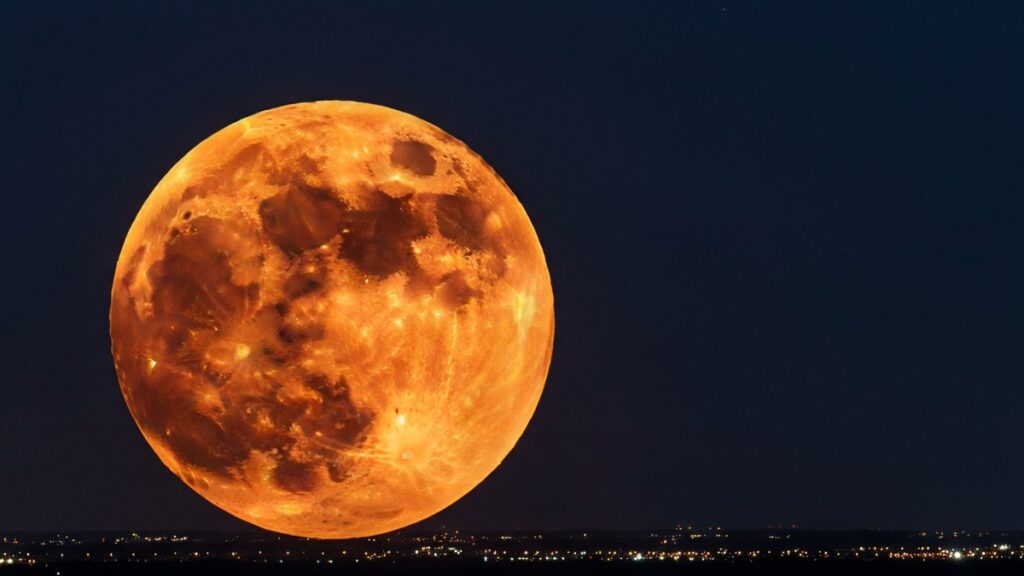
Wondering why does the moon look orange tonight? You’re not imagining it, and nothing is wrong. When the Moon sits low near the horizon, its light has to travel through far more of Earth’s atmosphere to reach your eyes. The air scatters away the shorter, bluer wavelengths and lets the longer, redder ones through — the exact same effect that paints sunrises and sunsets orange. Dust, smoke, and humidity can deepen the color further. As the Moon climbs higher, it passes through less air and fades back to its familiar silvery white. It’s ordinary, beautiful physics — not an omen.
Key Takeaways
- A low Moon looks orange because its light passes through more atmosphere, which scatters blue light away and leaves the red and orange — the same reason sunsets are red.
- Dust, wildfire smoke, pollution, and humidity intensify the color; a high Moon looks white because its light cuts through much less air.
- The Moon looking huge near the horizon is a separate thing — that’s the Moon Illusion, a trick of perception, not a change in color or actual size.
- A deep-red “blood moon” during a total lunar eclipse has a different cause: sunlight bent through Earth’s atmosphere onto the Moon.
It’s a sight that stops people in their tracks: a swollen, glowing, orange Moon hanging just above the rooftops. It looks almost unreal, and it tends to spark a flurry of “is this normal?” texts. The reassuring answer is that an orange Moon is completely normal and entirely predictable — it’s the same physics that turns the sky blue and the sunset red, just played out on the Moon. The Moon makes no light of its own; everything you see is sunlight that bounced off its gray, rocky surface and then ran the gauntlet of Earth’s atmosphere on the way to your eye. By the time that reflected sunlight reaches you, the air has reshaped its color — and how much it reshapes it depends almost entirely on how low the Moon sits. Here’s exactly what’s happening, the physics made plain, and how to tell the everyday orange Moon apart from the rarer “blood moon” of an eclipse.
The Short Answer: It’s the Atmosphere
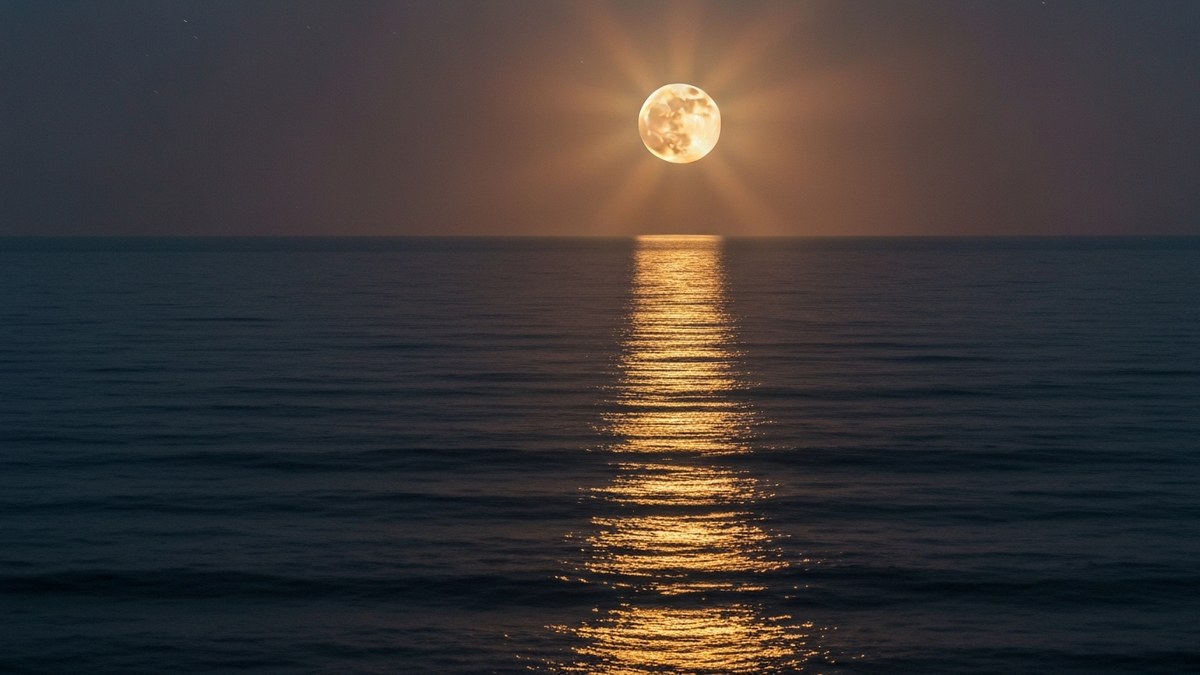
The color of the Moon doesn’t actually change. What changes is the air its light travels through to reach you. When the Moon is high overhead, its light takes a relatively short, straight path down through the atmosphere, so it arrives looking bright and silvery-white. When the Moon is low on the horizon, that same light has to skim through a much thicker, longer slice of atmosphere — and the air filters it along the way. The result is the warm orange glow you notice at moonrise and moonset.
It helps to hold one idea in mind for the whole article: nothing about the Moon itself is changing from minute to minute. The same craters, the same gray rock, the same brightness are up there the entire time. The only variable is the thickness of air sitting between the Moon and your eye, and that thickness shrinks steadily as the Moon climbs. So the “orange Moon” is really a story about Earth’s atmosphere, told on the Moon’s bright face like a screen. Everything that follows is just unpacking how that air does its filtering — and why the effect is strongest right at the horizon.
Why a Low Moon Is Orange and a High Moon Is White
The mechanism is called Rayleigh scattering, and it’s the same one behind a blue daytime sky and a red sunset. Sunlight looks white but is actually a blend of every color, each color a different wavelength — violet and blue are short waves, red and orange are long ones. When that light passes through air, the tiny gas molecules (mostly nitrogen and oxygen) knock the light sideways, but they don’t treat all colors equally. The strength of this scattering rises very steeply as wavelength shortens, so blue and violet light is scattered far, far more strongly than red and orange. Because of that steep wavelength dependence, even a modest amount of air robs a beam of much of its blue while barely touching its red.
That single fact explains both the blue sky and the orange Moon, just viewed from two angles. By day, you see the blue light that air scatters out of the Sun’s beam and sprays across the whole sky — the sky is blue because that’s the color the air throws sideways at you. At sunset, you look straight along the beam through a long, low slice of air, so much blue has been scattered away that what survives the trip is the warm leftover — orange and red. As the BBC Sky at Night Magazine puts it, when the Moon is low its light “must pass through a more substantial thickness of the Earth’s atmosphere,” so more of the blue is scattered out of the path and “the light we observe is largely towards the red end of the spectrum.”
The Moon plays by the identical rules, because moonlight is just recycled sunlight. The long journey through thick air strips the blue out of the Moon’s reflected sunlight before it gets to you, leaving the reds and oranges to dominate — which is why a low Moon and a setting Sun wear the same color. As the Moon rises higher in the sky, its light passes through progressively less atmosphere, less blue is filtered out, and the orange thins back toward a brilliant white. That gradient is the whole effect in a sentence: more air below the Moon means more blue removed means a warmer color. It’s also why the deepest color always sits right at the horizon, and why the very same Moon can look pumpkin-orange at 9 p.m. and cold silver by midnight without anything in space having changed at all.
The Geometry: Why the Horizon Path Is So Much Longer
To really understand the orange Moon you have to picture the shape of the air you’re looking through, because geometry is doing half the work. The atmosphere is a relatively thin shell wrapped around a round planet. When the Moon is straight overhead, you look down through that shell along the shortest possible route — essentially a vertical line punched through the layer. Astronomers call the amount of air along your line of sight the “airmass,” and looking straight up is the thinnest airmass there is, the baseline of one.
Now drop your gaze to the horizon. Instead of punching straight through the shell, your line of sight runs almost along it, slicing through the air at a shallow, glancing angle. That slanted path threads through a far longer column of atmosphere — you’re effectively looking the long way through the shell rather than the short way across it. Because Rayleigh scattering depends on how much air the light crosses, that much longer path scatters out far more blue before the light ever reaches your eye. Same air, same Moon; a dramatically longer route through it. (We won’t quote a precise multiplier, because the exact figure shifts with the Moon’s height, your altitude, and the air itself — the honest statement is simply that a low Moon’s light travels through far more atmosphere than a high one’s.)
This is the lever behind every warm sky color, and it ties the Moon neatly to things you already know. A blue noon sky, a low Sun glowing orange at sunset, and a low Moon glowing orange at moonrise are three views of the exact same geometry: short overhead path keeps the light cool and bright, long slanted horizon path bleeds out the blue and leaves it warm. Watch the Moon for an hour after it rises and you can literally see the geometry change — as it lifts off the horizon and the airmass between you shrinks, the orange drains away and the silver returns. Nothing about the Moon moved; only the length of your atmospheric tunnel did.
When Dust, Smoke, and Pollution Deepen the Color
The basic horizon-orange happens even in perfectly clean air, because air molecules alone are enough to scatter the blue. But extra particles suspended in the atmosphere can make the effect dramatically more intense. Dust kicked up by wind, haze, high humidity, urban air pollution, and especially wildfire smoke all add scattering particles to the mix, and those particles strip out even more of the short wavelengths. The more material the light has to fight through, the further the surviving color slides from orange toward a deep amber, copper, or even blood-red — all while the Moon itself is doing absolutely nothing different.
You can see this as a kind of dial. On a crystal-clear night with dry, clean air, a rising Moon shows a gentle, pale-orange tint that fades quickly as it climbs. On a hazy, humid, or smoky night, that same rising Moon can glow a startling deep orange or red and hold the color even fairly high in the sky, because the particles keep scattering blue long after molecule-only air would have given up. During major events — like the wildfire smoke that blanketed the U.S. West Coast in 2020 — the Sun and Moon have appeared an eerie, near-uniform orange-red even when high overhead, the particle load so heavy that the usual “high equals white” rule broke down. The principle is consistent: as EarthSky notes, particulates in the air enhance the reddening that scattering already produces.
So if the Moon looks unusually fiery one night, the most likely explanation is simply that there’s more dust or smoke in the air than usual, not anything happening at the Moon. Humidity and pollution near a city horizon are common culprits; smoke drifting from a distant wildfire is another. It’s a striking, photogenic sight, but it’s the atmosphere doing the painting — the same gray Moon, seen through dirtier glass.
How Wildfire Smoke Changes the Color
Wildfire smoke deserves its own look, because it has become one of the most common reasons people suddenly notice a deep-red Moon and assume something is wrong. Smoke is not a gas but a dense cloud of tiny solid and liquid particles — soot, ash, and condensed organic droplets — lofted high into the atmosphere and carried hundreds or even thousands of miles by the wind. Those particles are far more numerous and, on average, larger than the air molecules behind ordinary Rayleigh scattering, so they intercept and redirect light much more aggressively. The net effect is the same direction as clean-air scattering — blue is removed, warm colors survive — but turned up sharply.
Because smoke particles can sit at high altitude and spread across an entire region, they break the usual “a high Moon looks white” expectation. On a smoky night the Moon can glow a flat, dim orange-red even when it’s well above the horizon, because the smoke layer filters its light from every angle rather than only along the long horizon path. The same haze that turns the daytime Sun into a dull red disk you can almost look at directly will turn that night’s Moon a matching copper. If you’ve ever seen a sunset go an apocalyptic deep red during a fire season, the Moon hours later is showing you the very same filter.
The practical tell is consistency and dimming. Pure horizon-orange is brightest and most saturated right at the horizon and fades to white as the Moon climbs within an hour or two. A smoke-reddened Moon, by contrast, often stays muted and reddish across a much wider stretch of sky and looks noticeably dimmer overall, because the particles are absorbing and scattering away a chunk of the light entirely, not just shifting its color. If the air also smells faintly of smoke or the daytime sky has been milky and yellowed, you can be fairly confident wildfire particulates are the cause — ordinary, if unsettling, atmospheric optics rather than any omen.
The Giant Moon Near the Horizon Is a Separate Effect
Here’s a distinction worth getting right, because the two are constantly confused. When a low Moon looks not just orange but enormous, the color and the size are caused by completely different things. The orange is real, physical atmosphere at work — a genuine change in the light that a camera records just as your eye does. The giant size is the Moon Illusion, a quirk of human perception — the Moon’s actual angular size in the sky is essentially unchanged whether it’s rising or riding high. Keep these two phenomena firmly apart: one happens in the air, the other happens in your head.
The numbers make the point. The Moon spans only about half a degree of sky — roughly 0.5° — and that figure barely budges over a single night. NASA is blunt about it: “Photographs prove that the Moon is the same width near the horizon as when it’s high in the sky,” and the apparent swelling is “an illusion rooted in the way our brains process visual information.” You can test it yourself in two ways. Hold your arm out straight and your outstretched fingernail will blot out the Moon whether it’s low or high. Or photograph the Moon at moonrise and again overhead with the same lens, and measure: the disk comes out the same size both times. The hugeness, in other words, never shows up on the sensor — only in your impression.
Why does the brain do it? Honestly, science hasn’t fully settled the question, and that’s worth stating plainly rather than papering over. The leading ideas involve apparent distance: the Ponzo illusion, where foreground objects like rooftops and trees near the horizon trick the brain into judging the Moon as farther away and therefore “bigger,” and the related “flattened sky dome” theory, in which we perceive the overhead sky as closer than the horizon. NASA notes that no single explanation is fully satisfying, and the Royal Observatory Greenwich likewise frames the Moon Illusion as a still-debated puzzle of perception rather than a solved one. The honest takeaway: the orange is physics we can fully explain, the bigness is your brain doing something we can’t yet fully explain — two unrelated effects that happen to share a stage at the horizon.
The Blood Moon: A Different Kind of Orange
Not every red Moon is the same. The deep, coppery “blood moon” that appears during a total lunar eclipse looks superficially similar to a low orange Moon, but its cause is genuinely different — and confusing the two is one of the most common mistakes about the Moon’s color. The everyday orange is about your viewing angle through nearby air. The eclipse red is about Earth’s entire atmosphere acting on the sunlight before it even reaches the Moon.
1 Everyday Horizon-Orange From Nearby Air
Your line of sight to a low Moon runs sideways through a thick, slanted column of nearby atmosphere, which scatters the blue out of the moonlight before it reaches your eye. It happens on any clear night the Moon is near the horizon, fades as the Moon climbs, and shows up whether or not there’s an eclipse.
The key detail is that the Moon is fully lit by direct sunlight the entire time — only your view of it is being tinted. Take that same Moon’s picture from an airplane above much of the haze and it would look far whiter. Nothing about the Moon changed; you simply cleaned the glass you were looking through.
2 The Blood Moon of a Total Lunar Eclipse
Earth moves directly between the Sun and Moon and blocks the direct sunlight entirely, so the Moon falls into Earth’s shadow. The only light still reaching it is sunlight that grazes the edge of our planet and is bent — refracted — through the ring of Earth’s atmosphere.
That ring also Rayleigh-filters out the blue, so what bends inward and lands on the Moon is red — effectively every sunrise and sunset happening on Earth at that instant, focused onto the Moon at once. As NASA explains, the more dust, smoke, or cloud in Earth’s atmosphere during the eclipse, the deeper and darker red the Moon appears.
So the geometry is the real difference. In everyday horizon-orange, the Moon is bathed in direct sunlight and the atmosphere doing the tinting is the patch of air right in front of you; the rest of the sky’s Moon would look white in a photo taken from higher up. In a blood moon, no direct sunlight touches the Moon at all — Earth’s whole atmosphere works like a giant lens, catching sunlight at the planet’s rim, filtering away its blue, and redirecting the leftover red glow into the shadow where the Moon hangs. One is your local air tinting a fully-lit Moon; the other is Earth’s global air being the only source of the Moon’s light. They are not the same effect, even though both end up red.
Two more practical consequences follow from that geometry. First, a blood moon is markedly dimmer than a normal full Moon, because it’s lit only by the faint refracted ring rather than the full blast of direct sunlight — an eclipsed Moon can dim enough to reveal stars around it. Second, volcanic eruptions matter: after a major eruption loads the stratosphere with aerosols, eclipses worldwide can turn unusually dark and deep red for months or even years, because that extra haze swallows more of the already-faint light bending around Earth’s edge.
How to Tell the Two Orange Moons Apart
Once you know the two effects have different causes, telling them apart in the moment is easy — you mostly just have to notice where the Moon is and how the color behaves. An everyday orange Moon is a horizon phenomenon tied to your viewing angle; a blood moon is a shadow phenomenon tied to a specific, predictable alignment of the Sun, Earth, and Moon. They almost never get confused once you check a couple of simple cues.
Where the Moon Sits in the Sky
Everyday horizon-orange only appears when the Moon is low, near moonrise or moonset, and the color drains away as the Moon climbs higher and your line of sight cuts through less air. A blood moon’s red, by contrast, holds steady regardless of the Moon’s height — it can be deep red while riding high overhead, because the color comes from Earth’s shadow, not from the air near your horizon.
How Bright the Moon Appears
A low orange Moon is still fully lit and brilliant; it’s a bright Moon wearing a warm tint. A blood moon is conspicuously dim and dusky, often dim enough that faint stars appear right beside it, because it’s lit only by the weak ring of light refracted around Earth.
Whether It Was Predicted in Advance
Everyday orange happens on countless ordinary nights with no warning and no special alignment. A total lunar eclipse is forecast years in advance, visible to an entire night-side hemisphere at once, and unfolds over a few hours as the Moon slides into and out of Earth’s shadow. If astronomy sites and the news were talking about it beforehand, you’re watching an eclipse; if it just happened to be a pretty moonrise, you’re watching atmospheric scattering.
How the Color Changes Over Time
Watch for ten or fifteen minutes. Horizon-orange visibly warms toward white as the Moon rises and cools off the horizon. An eclipse reddens gradually as the Moon enters the deepest part of Earth’s shadow, holds a steady copper through totality, then brightens back to white as it exits — a slow, symmetric arc rather than a quick horizon fade.
A quick rule of thumb: if the Moon is low and the orange fades as it rises, it’s everyday atmospheric scattering; if the Moon is red even up high, looks dim, and an eclipse was on the calendar, it’s a blood moon. Smoke is the one wildcard that can mimic either — heavy wildfire haze can keep a Moon reddish even when it’s high — but a smoke-red Moon stays bright-ish and reddish across a normal night, while an eclipse follows the slow enter-totality-exit rhythm and dims dramatically. With those cues, you can read the sky correctly every time.
The Harvest Moon Myth
You’ll often hear that the autumn Harvest Moon is special because it’s intrinsically bigger and more orange than other full Moons. The truth is less mystical: the Harvest Moon has no built-in property that makes it more colorful or larger than any other full Moon of the year. The light it sends us obeys the exact same scattering and the exact same Moon Illusion as every other Moon. When it looks orange and huge, that’s purely because of when and where people watch it, not what it is.
The real reason comes down to a quirk of timing. Around the autumn equinox, the Moon rises only a little later each night for several nights running, so a bright, nearly-full Moon comes up close to sunset on multiple evenings — right when people are outside and looking. Catch any full Moon at that low, just-risen moment and you’ll get the same warm color (from atmospheric scattering) and the same apparent bigness (from the Moon Illusion). The Harvest Moon simply offers more convenient, well-timed chances to see a low Moon than a typical month does, so its low-horizon look gets noticed and remembered. The name itself refers to that equinox timing and old harvest folklore — farmers using the early evening moonlight to work later — not to any change in the Moon’s appearance. Curious about the bigger picture? Our explainer on how big the universe really is is a fun next stop.
Frequently Asked Questions
Why does the moon look orange when it’s low in the sky?
Because its light has to pass through much more of Earth’s atmosphere to reach you. When the Moon is low, your line of sight runs at a shallow angle through a long, slanted column of air, and that air scatters away the shorter blue wavelengths far more strongly than the longer red and orange ones. What survives the long trip is the warm leftover, so a low Moon looks orange. It’s the very same process that makes sunrises and sunsets red, because moonlight is just reflected sunlight. As the Moon rises higher, its light travels through far less air, less blue is removed, and the Moon returns to a silvery white.
Is an orange moon a sign of anything bad?
No. An orange Moon near the horizon is normal, common, and entirely explained by ordinary atmospheric physics. It doesn’t predict weather, earthquakes, disasters, omens, or anything supernatural — it simply means you’re seeing the Moon through a thick slice of air, sometimes with extra dust or smoke deepening the color. The same scattering colors every sunset you’ve ever watched, and nobody treats a red sunset as a warning. If anything, the reddest Moons usually just mean there are more particles than usual — humidity, pollution, or distant wildfire smoke — floating in the air that night.
Why does the moon look orange AND huge near the horizon?
Those are two completely different effects that just happen to show up at the same time. The orange color is real physics — atmospheric scattering removing blue light from the moonlight before it reaches you — and a camera records it exactly as your eye does. The giant size is the Moon Illusion, a quirk of human perception; the Moon’s actual angular size is essentially unchanged at about half a degree whether it’s low or high, as photographs taken with the same lens prove. The color is happening out in the sky, but the bigness is happening inside your brain. It’s important not to lump them together: only the size is an illusion, while the color is a genuine physical effect.
Is an orange moon the same as a blood moon?
No, they have different causes even though both look red. An everyday orange Moon is caused by your view of a low Moon passing sideways through thick nearby atmosphere, which scatters out the blue — and the Moon is fully lit by direct sunlight the whole time. A “blood moon” happens only during a total lunar eclipse, when Earth blocks the direct sunlight and the Moon is lit solely by sunlight refracted and reddened through the ring of Earth’s atmosphere. The easiest tell is height and brightness: horizon-orange only appears low and fades as the Moon rises, while a blood moon stays red even high overhead and looks distinctly dim. One is your local air tinting a bright Moon; the other is Earth’s whole atmosphere being the Moon’s only light source.
Does wildfire smoke make the moon more orange?
Yes, and often dramatically so. Smoke is a dense cloud of soot and ash particles that scatter and absorb even more blue light than clean air does, deepening the Moon’s color toward amber or red. Because smoke can spread across a whole region at high altitude, it can keep the Moon (and Sun) a flat orange-red even when they’re well above the horizon — breaking the usual rule that a high Moon looks white. A smoke-reddened Moon also tends to look noticeably dimmer, because the particles are absorbing some of the light entirely, not just shifting its color. The basic horizon-orange happens in perfectly clean air too, but smoke and other particulates intensify it.
Is the Harvest Moon really more orange than other full moons?
No. The Harvest Moon has no special property that makes it intrinsically more orange or larger than any other full Moon — its light follows the same scattering and the same Moon Illusion as every other month’s. It looks colorful and big because of timing: around the autumn equinox the Moon rises close to sunset for several nights running, so people repeatedly catch it low on the horizon, exactly where the warm color and the apparent bigness show up. Watch any full Moon rise and you’ll see the same thing. The name is about the equinox timing and old harvest folklore, not about the Moon’s appearance.
Why is the moon orange but the sky is blue?
They’re two sides of the same coin, both produced by Rayleigh scattering. The daytime sky is blue because air molecules scatter blue light out of the Sun’s beam and spray it across the whole dome, so blue is the color the sky throws sideways at you. A low Moon (or a setting Sun) looks orange because you’re looking straight along a long path of air, and so much blue has been scattered away that only the warm reds and oranges survive the trip to your eye. In short, the blue you lose from the direct beam is exactly the blue that paints the surrounding sky — the same physics, just viewed from a different direction.
Science summarized from NASA, BBC Sky at Night Magazine, and EarthSky as of June 2026. An orange Moon is ordinary atmospheric optics — enjoy the view.
About the Author
Elena Brooks
Elena Brooks is the person her group chat texts when something at home stops working or a health trend starts trending. She’s spent years turning that instinct into a job — digging into the research behind everyday questions, calling the experts, and writing up what holds up and what doesn’t. Her beat is wherever curiosity points: kitchens, cars, pets, sleep, money, and the occasional meteor shower.