
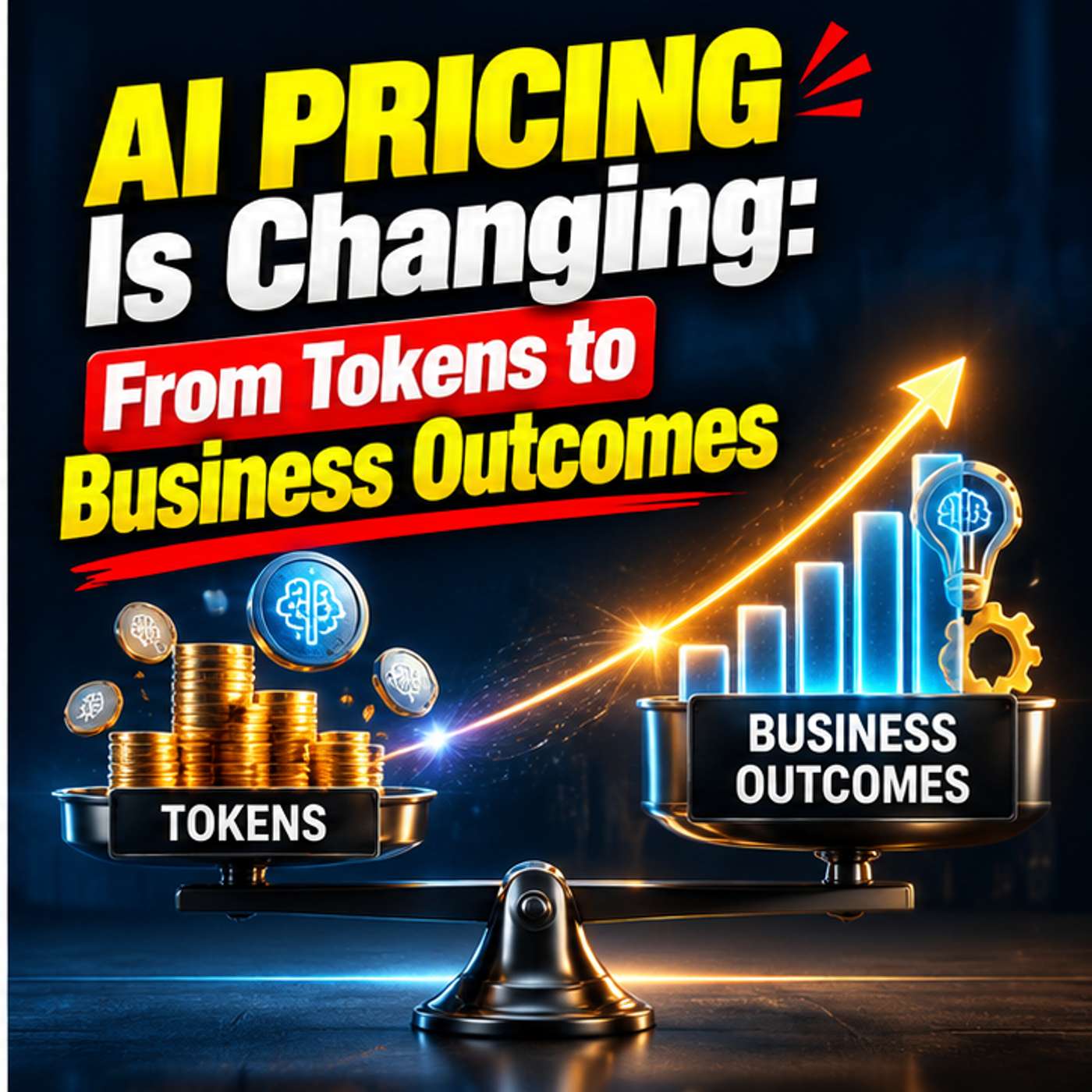





What if the biggest shift in business isn’t simply artificial intelligence replacing jobs, but companies learning how to buy, manage, and profit from intelligence itself? As AI agents become more capable, traditional software pricing models are facing a major challenge. Businesses can pay for users, subscriptions, or AI tokens, but none of those metrics guarantees a valuable business outcome.
In this episode of vpod.ai, host Mike and expert Susan explore why artificial intelligence is emerging as a new economic resource alongside labor and capital. They examine how AI pricing models are evolving, why companies struggle to measure AI return on investment (ROI), and how employees and business leaders can turn AI capabilities into measurable business value.
The conversation begins with a simple restaurant analogy: Customers pay for a great meal, not the electricity used to operate the oven. So why do businesses routinely pay AI vendors for computational usage rather than successful results?
Mike and Susan examine the limitations of token-based AI pricing and explain why outcome-based pricing could offer a more practical alternative for certain business processes. They discuss healthcare payments company Cedar and its AI agent Kora, which helps patients navigate medical bills and complete payments. They also explore how companies such as Sierra are pursuing pricing models connected to completed customer service outcomes.
But outcome pricing has limitations. While resolving a billing inquiry may have a clearly defined success condition, complex projects such as redesigning supply chains require ongoing judgment, changing priorities, and human oversight.
That challenge introduces one of the episode’s most important ideas: the rise of the manager of AI.
In this episode, you’ll discover:
- Why intelligence is becoming a distinct economic resource alongside traditional labor and capital.
- How token-based AI pricing works and why computational usage doesn’t necessarily translate into business value.
- What outcome-based AI pricing means and why companies are exploring payment models linked to successful results.
- How AI agents such as Cedar’s Kora can support healthcare billing and customer service workflows.
- Why closed-loop business processes are better suited to outcome pricing than complex, open-ended projects.
- What it means to become a manager of AI and how employees can guide intelligent agents to solve business problems.
- How human expertise helps identify AI hallucinations, interpret unreliable data, and make important operational decisions.
- How Shopify and Block are discussed as examples of AI-focused productivity and business growth.
- Why forward-deployed engineers are becoming important for implementing AI inside traditional organizations.
- How partnerships involving OpenAI, Anthropic, and major financial firms illustrate changing approaches to enterprise AI deployment.
- Why business leaders should measure AI success through new revenue opportunities, not just reduced operating expenses.
- How employee motivation, AI fluency, and organizational support influence the success of AI adoption.
Mike and Susan also examine the growing importance of forward-deployed engineering, where AI specialists work directly with organizations to connect advanced models with company data, operational processes, and real business challenges. For traditional companies that lack internal AI expertise, these partnerships may help bridge the gap between purchasing powerful technology and successfully deploying it.
The conversation then turns to a strategic question for CEOs, CFOs, and business leaders: Should artificial intelligence be treated primarily as a cost-cutting tool, or as an opportunity to create entirely new sources of revenue?
Rather than using AI only to reduce administrative expenses, the episode explores how companies can redirect employee time toward new products, customer services, and growth initiatives. This approach reframes AI ROI around the additional value an organization can create.
Whether you’re a business executive planning an AI strategy, an employee adapting to AI automation, or a technology professional exploring AI agents and enterprise deployment, this episode offers a thought-provoking look at the changing economics of artificial intelligence.
And it leaves listeners with an important question: As AI agents become capable of managing other AI agents, what will remain the most valuable role for human workers?
Listen to this episode of vpod.ai to explore the future of AI pricing, enterprise automation, human-AI collaboration, and the new business models emerging around intelligent technology.
Enjoyed the discussion? Subscribe to vpod.ai, share this episode with colleagues exploring AI adoption, and join Mike and Susan for more conversations about artificial intelligence, business innovation, and the future of work.