
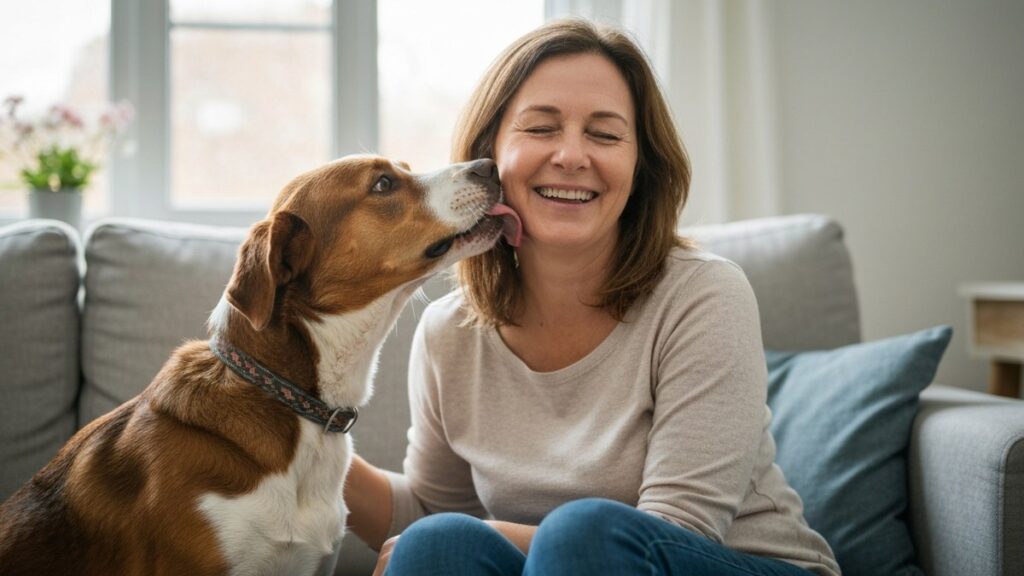
- Most licking is affection, attention-seeking, taste (salty skin), or communication — usually a good sign.
- Watch for red flags: licking that’s frantic, fixated on one spot, or paired with other symptoms can signal anxiety, pain, or allergies.
- Redirect gently and reward calm; never punish, and see a vet if it looks compulsive.
Has your dog ever covered your hand or face in licks? You are not alone, and most of the time the reason is a happy one. So why does my dog lick me so much? Usually it means your dog loves you, wants your attention, likes the salty taste of your skin, or is trying to “talk” to you. But there is one thing to watch for. Licking that turns frantic, never stops, or stays glued to one spot can be a sign of stress, a stuck habit, or a health problem. This guide walks you through both sides. You will learn the sweet reasons your dog licks, and how to spot the rare times it means something is wrong.
Here is the way to hold both ideas at once. Licking is a behavior, not a single message, so the same lick can mean “I love you” on Monday and “my tummy hurts” on Friday. What tells the two apart is the pattern: when it happens, how hard it is to stop, where it is aimed, and what else is going on with your dog. Keep those four questions in your back pocket as you read, and the licking will start to make a lot more sense.
The Everyday Reasons Dogs Lick the People They Love
Most licking is just your dog being a dog. Puppies learn it early, and they carry it into grown-up life. Here are the everyday reasons your dog licks you, plus the simple science behind each one.
1 Affection and Bonding Through Social Licking
Licking is a friendly, social act. The American Kennel Club says licking has become a “ritualized greeting” for many dogs, a bit like the way wild dogs welcome each other back to the group. Your dog isn’t inventing this on the spot. It is running an old, hard-wired script that says, “You’re back, you’re mine, we’re a pack again.”
There may be a feel-good side too. Studies on dogs suggest that friendly contact like this is linked to oxytocin, a feel-good bonding chemical the body makes during happy, close moments (Romero and colleagues, published in PNAS in 2014). Think of oxytocin as the same warm chemistry a person feels during a long hug. When the licking and the closeness happen together, that loop can quietly deepen the bond you already share.
Here is the honest part, though: the proof that licking itself sets off that chemical is not rock solid, and not every study agrees. So the safest way to think about it is this. Licking is one of the ways your dog bonds with you, a lot like a person reaching out for a hug — a real sign of connection, even if the exact brain chemistry is still being worked out.
2 You Taste Interesting: Salt, Sweat, and Food Residue
Sometimes a lick is really just a taste test. Your skin is a little salty, especially after you sweat or on a hot day, and dogs love that. Add a little leftover food, hand lotion, sunscreen, or sweat, and your arm turns into a snack worth sampling. To a nose as sharp as your dog’s, you are basically a walking menu.
The timing usually gives it away. If your dog licks you right after you cook, eat, or work out, taste is almost surely the reason, not deep emotion. This kind of licking tends to be focused and businesslike — a few determined licks at one spot rather than an all-over love bath — because your dog is chasing a specific flavor, then losing interest once it is gone.
3 Attention-Seeking Licking Reinforced by Your Reactions
Dogs are smart about what works. If a lick on your hand once got a laugh, a pat, eye contact, or a treat, your dog learned something simple: licking turns you “on” and gets a reaction. To your dog, your attention is a paycheck, and licking is the button that pays out.
Here is the tricky twist. Even a telling-off can count as a win, because to a dog who wants attention, being scolded still beats being ignored. So when you say “no” or push the dog away, you may feel like you are stopping the behavior, while your dog reads it as “it worked — she looked at me.” This is one of the top reasons a sweet little lick grows into a non-stop habit: you rewarded it without meaning to.
The good news? A habit built on rewards can be un-built the same way. If your attention is what feeds the licking, then quietly removing your attention — and handing it back the second your dog is calm — is the exact lever that turns it down. More on that in the how-to section below.
4 Licking as Communication and Appeasement Signals
Licking is also a way to send a message. In the wild, puppies lick the face and mouth of a returning adult to ask for food, and the AKC notes that this begging-and-greeting behavior carries over into how pet dogs greet people. Your grown dog no longer needs you to cough up dinner, but the old “hello, feed me, I’m friendly” gesture stuck around.
Licking can also be a polite, “let’s keep the peace” signal — what trainers call an appeasement or calming signal. It is something your dog offers to a person or another animal to smooth things over and say, “I’m no threat.” You will often see it during a slightly tense moment: a new visitor, a raised voice, or a dog that isn’t sure if it is in trouble.
So when your dog gives you a few quick licks during a hello, or right after you sound annoyed, it can be their way of saying, “Hi, we’re good, right?” Reading it as a social gesture rather than pure hunger or pure love helps you respond in the way your dog is actually asking for — usually a calm, friendly acknowledgment.
5 The Social Grooming Instinct Carried From Puppyhood
Dogs clean themselves and their close friends by licking, and puppies feel this first from their mom, who licks them to clean, comfort, and even help them go to the bathroom in the first weeks of life. That early experience wires licking to the feeling of safety and family.
When your dog licks your hair, your arm, or another pet at home, it can be that same grooming instinct at work — a sign your dog files you under “my people.” Scientists call mutual grooming between animals “allogrooming,” and it shows up across many social species because it does double duty: it keeps everyone clean and it strengthens the group’s bonds.
If you have more than one pet and you notice them licking each other around the ears and face, that is the same instinct pointed at a housemate. It usually signals comfort and closeness — though if one animal is clearly trying to get away, give them space and make sure the licking isn’t tipping into pestering.
6 Exploring Their World Through Taste and Scent
A dog’s nose and mouth are their main tools for figuring out the world, the way your hands and eyes are for you. A dog’s sense of smell is estimated to be tens of thousands of times sharper than ours, and licking lets your dog get an even closer read by picking up taste and scent molecules right off your skin.
So a lick lets your dog gather real information: where you have been, what you have touched, who else you spent time with, even small changes in your body. That thoughtful lick after you get home from the store, the gym, or a friend’s house? Your dog may simply be “reading the news” of your day, catching up on everywhere you went the way you might scroll through messages.
This is also why a dog can suddenly get very interested in licking you after you have been around other animals. You came home carrying a whole story in scent, and your dog wants to read every line of it.
7 Sensing and Responding to Your Emotions
Dogs are amazing at reading how you feel, and a lot of that comes through their nose. In a 2022 study published in PLOS ONE, dogs could tell the difference between the smell of a calm person and the smell of that same person under stress. In other words, your dog can actually smell when you are stressed, before you have said a single word about it.
So if the licking picks up when you are tense, crying, or worried, your dog may be noticing a real change in you and trying to comfort you the only way they know how. Many dogs move closer, lean in, and lick during a person’s hard moments — a soft, steady response to a signal they picked up chemically.
It is worth knowing this can run both ways. Comforting you can also soothe your dog’s own nerves, since a stressed human often means a stressed household. If your dog seems to melt down alongside you, calm, slow breathing and a relaxed posture from you can quietly settle you both.
When Excessive Licking Is a Red Flag
Affection is the usual story, but sometimes licking is a symptom. The line between “sweet” and “worth a closer look” comes down to how intense the licking is, where it is aimed, and what comes with it. Licking that is hard to stop, stuck on one spot, paired with other symptoms, or just not like your dog is worth watching. Here are the times licking is telling you something is wrong.
1 Anxiety and Stress-Driven Self-Soothing Licking
Licking can let out tension. When a dog feels nervous, torn, or wound up, licking becomes a way to self-soothe, a bit like a person biting their nails or bouncing a knee. The fancy term for it is a “displacement behavior” — a stress-relief action that pops out when a dog doesn’t know what else to do with the feeling.
A little stress-licking now and then is normal and nothing to worry about. The pattern that matters is when it clusters around clear triggers: thunderstorms, fireworks, being left alone, car rides, or strangers in the house. If your dog licks you, themselves, or the furniture a lot in exactly those moments, anxiety is a likely driver.
The real fix is to ease the stress, not just block the licking. If you stop the licking without helping the underlying worry, the anxiety usually just leaks out somewhere else — pacing, whining, chewing, or accidents. Reduce the trigger, add calm routines, and the licking often settles on its own.
2 Compulsive Disorder and Canine OCD-Like Licking Behavior
In some dogs, a stress-relief habit hardens into something they can’t control — the dog version of obsessive-compulsive behavior. According to VCA Animal Hospitals, compulsive habits like repeated licking are tied to long-term stress, inner conflict, and not enough exercise, social time, or mental challenge. The behavior stops being a choice and starts being a loop the dog is stuck in.
One clear example is acral lick dermatitis, where a dog licks the same spot on a limb over and over until the skin gets raw, thickened, and damaged. What starts as an itch or a nervous habit becomes a wound the dog keeps reopening, which itches more, which drives more licking — a cycle that rarely breaks on its own.
The big warning sign is licking that is very hard to interrupt and seems to serve no real purpose. Don’t wait this one out. Compulsive licking needs help from a vet or a veterinary behavior specialist, who can treat both the skin damage and the stress or brain chemistry driving the loop.
3 Boredom and Under-Stimulation Driving Repetitive Licking
A bored dog will make its own fun, and licking is easy to reach for. It even has a calming, steady rhythm — a self-made activity for a brain with nothing to do. Dogs are working animals at heart, and a day with no walk, no training, and no puzzle is a long, empty day.
The tell here is timing. If your dog’s licking spikes on long, dull days and calms down noticeably after a good walk, a training session, or a puzzle toy, plain boredom is a strong suspect. You are essentially watching your dog burn off restless energy through their mouth.
More to do is usually the fix, and it works fast. Two solid walks, a few minutes of training, a food puzzle at mealtime, and some real play can drain the extra energy that was fueling the licking — often within a day or two of upgrading the routine.
4 Pain and Nausea Signaled by Licking
Licking can mean your dog feels sick. A queasy dog often licks their lips, the air, surfaces, or you, sometimes along with drooling, lip-smacking, swallowing a lot, or eating less. This kind of licking is your dog’s body reacting to that unsettled, about-to-be-sick feeling, and it can come on fast.
Licking aimed over and over at one part of their own body often means pain or discomfort right there — a sore joint, a hot spot, a cut, a bee sting, or an infected paw. Dogs instinctively lick what hurts, so a dog suddenly obsessed with one knee, paw, or patch of belly is usually pointing you straight at the problem.
A sudden, out-of-character jump in licking that comes with any other sign — throwing up, low energy, limping, or eating changes — is a reason to call your veterinarian. Pain and nausea are exactly the causes you don’t want to guess about at home.
5 Allergies and Skin Issues That Trigger Licking
If your dog licks and chews their own paws, belly, or sides more than they lick you, itchy skin is a common cause. Allergies — to food, to fleas, or to things in the air like pollen, dust, and grass — are one of the most frequent reasons dogs lick themselves raw, and the itch can be maddening enough to interrupt sleep.
Infections and dry skin pile on. Once a dog licks a spot enough, the warm, damp skin becomes a perfect home for yeast or bacteria, which brings its own itch and often a distinct smell. That is why a paw a dog keeps licking can end up smelling faintly of corn chips or mildew.
Red, sore, or bald patches, dark or thickened skin, or a yeasty smell from the paws all point to a skin problem your vet should check and treat. Allergies rarely fix themselves, and the sooner the itch-lick cycle is broken, the less damage your dog does to their own skin.
6 Cognitive Decline and Dementia in Senior Dogs
In older dogs, a new habit of repeated licking can be a sign of canine cognitive dysfunction syndrome, a condition much like dementia in people. As the aging brain changes, some dogs develop repetitive behaviors, get “stuck,” or seem to do things without a clear reason — and licking can be one of those behaviors.
Research suggests cognitive dysfunction affects a meaningful share of senior dogs, with the risk climbing as they get older. So a dog that never licked much and suddenly starts in their senior years deserves a closer look, especially when the licking seems aimless rather than affectionate.
If your senior dog also seems confused, paces, stares at walls, sleeps poorly or flips their day-night schedule, or seems to “forget” familiar routines and people, tell your vet about the licking as part of the whole picture. Caught early, cognitive decline can often be slowed with diet, enrichment, and medication.
Types of Licking and What Each Likely Means
Not sure which camp your dog’s licking falls into? This quick table lines up the most common licking patterns with what they usually mean and what to do about each. Read your dog’s licking in context — the same lick can mean different things depending on when and where it happens.
| Type of licking | Likely meaning | What to do |
|---|---|---|
| Quick licks during a greeting | Affection, ritualized greeting, appeasement | Enjoy it, or calmly redirect if you dislike face-licking |
| Licking your skin after exercise or cooking | Taste: salt, sweat, food residue | Harmless; rinse off any creams or sprays that aren’t dog-safe |
| Persistent licking when you stop paying attention | Attention-seeking, often reinforced | Ignore the licking, reward calm behavior instead |
| Heavy licking during storms, alone time, or chaos | Anxiety or stress; self-soothing | Address the stressor; add enrichment; consult a vet or behaviorist |
| Obsessive licking of one spot on their own body | Pain, allergy/skin issue, or compulsive disorder | See your veterinarian to find the cause |
| Lip-licking, air-licking, surface-licking with drool | Nausea or gastrointestinal discomfort | Monitor; call your vet if it persists or other symptoms appear |
| New repetitive licking in a senior dog | Possible cognitive dysfunction | Vet visit; evaluate alongside other behavior changes |
How to Gently Reduce Excessive Licking Habits
Maybe the licking is healthy but just too much for you. That is okay. You can dial it down with kindness and a steady routine. The goal is to teach a better habit, not to shut your dog up. Dogs are curious problem-solvers — the same instinct that shows up when cats knead and other pets fall back on comfort behaviors — so give the urge a better outlet and it usually calms fast.
Redirect the Licking to a Better Behavior
The moment the licking starts, ask for something your dog already knows, like “sit,” “touch,” or “go to your mat,” and then reward that instead. You are not fighting the licking; you are giving your dog a different, payable job to do with the same energy.
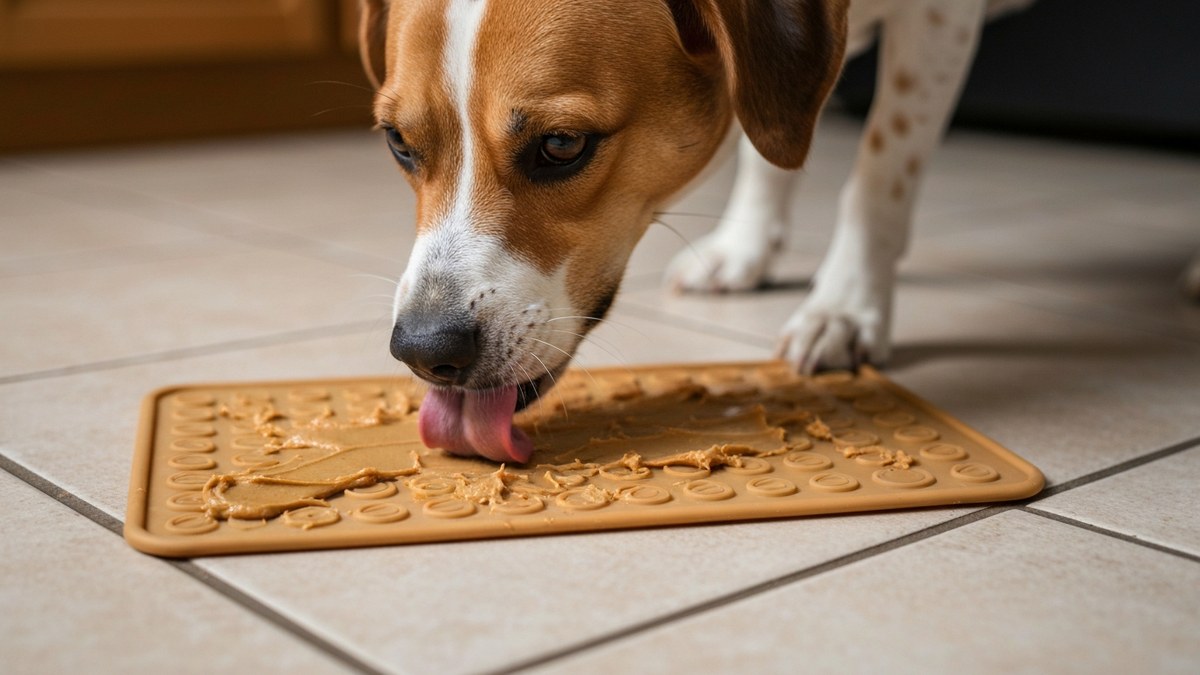
A chew or a lick mat with a little peanut butter (xylitol-free) or plain yogurt gives the licking urge somewhere healthy to go, and the slow, steady licking on a mat is genuinely calming for many dogs. Keep one ready for the moments you know licking tends to start, like when you sit down to relax in the evening.
Ignore the Licking Instead of Punishing It
Since attention often feeds licking, your strongest tool is to calmly take that attention away: stand up, turn away, or step out of the room for a moment, then come back and reward your dog the instant they are calm. Done consistently, this teaches your dog that calm — not licking — is what earns your company.
Don’t punish. Punishment tends to backfire, because it adds stress that can make anxious licking worse, and it chips away at your dog’s trust in you. You want your dog to feel safe with you, which is the opposite of what scolding or scaring them achieves.
Add Daily Enrichment and Exercise
A lot of licking comes down to too little to do, in both body and mind. More walks, sniff-walks where your dog gets to explore at their own pace, short training games, food puzzles, and real playtime give that restless energy somewhere good to go.
Aim to tire the brain, not just the legs. A ten-minute training session or a food puzzle can wear a dog out more than a long walk, and a mentally satisfied dog reaches for compulsive licking far less often. Build a couple of these into every day and you attack boredom and stress at the same time.
Get a Vet Check When You Are in Doubt
If the licking is intense, fixated, causing sore skin, or paired with any other sign, rule out health problems first. Behavior training can’t fix a sore paw or an itchy allergy, so a vet visit makes sure you are solving the right problem before you spend weeks on the wrong one.
For licking that looks compulsive or driven by anxiety, ask your veterinarian for a referral to a veterinary behaviorist. These specialists can build a plan made just for your dog, sometimes combining behavior work with medication — and they turn a frustrating mystery into a clear, doable roadmap.
Frequently Asked Questions
Is it okay to let my dog lick my face?
For most healthy people, it is harmless, and it is just a normal way dogs say hello and bond. Still, dog spit can carry germs, so it is smart to skip face-licking if you are immunocompromised, pregnant, or have an open cut, and to keep licks away from your eyes, nose, and mouth.
Why does my dog lick me so much all of a sudden?
A sudden jump in licking usually means something changed: new stress or worry, an upset stomach or pain, an itchy skin issue, or just a new smell on you from lotion, sweat, or hormones. If the new licking is intense, stuck on one spot, or comes with other symptoms, check in with your vet.
Does my dog licking me mean they love me?
Often, yes. Licking is a friendly, social act tied to saying hello and bonding, and it can trigger feel-good chemistry in dogs. But it also has down-to-earth reasons, like taste, wanting attention, and easing stress, so a lick is best read as one part of a bigger chat rather than a single message.
Why does my dog lick me and then bite gently?
A lick followed by soft “mouthing” is usually play or sweet communication, and it is common in puppies and excited dogs. If the gentle biting turns hard or happens a lot, hand over a chew toy and reward calm behavior instead of reacting in a way that adds more excitement.
How do I know if my dog’s licking is compulsive?
Watch for licking that is hard to stop, locked onto one spot (yours or their own), keeps going when your dog is alone, or leaves the skin raw and bald. Patterns like these point to a compulsive disorder, and they deserve a check from a vet or a veterinary behavior specialist.
Why does my dog lick me when I’m upset or crying?
Dogs are very tuned in to your feelings, and they can even smell stress-related changes in your body chemistry, so they often sense you are upset before you say a word. Licking is one way they try to comfort an upset person, though for a worried dog it can also be a way to settle their own nerves.
About the Author
Elena Brooks
Elena Brooks is the person her group chat texts when something at home stops working or a health trend starts trending. She’s spent years turning that instinct into a job — digging into the research behind everyday questions, calling the experts, and writing up what holds up and what doesn’t. Her beat is wherever curiosity points: kitchens, cars, pets, sleep, money, and the occasional meteor shower.