
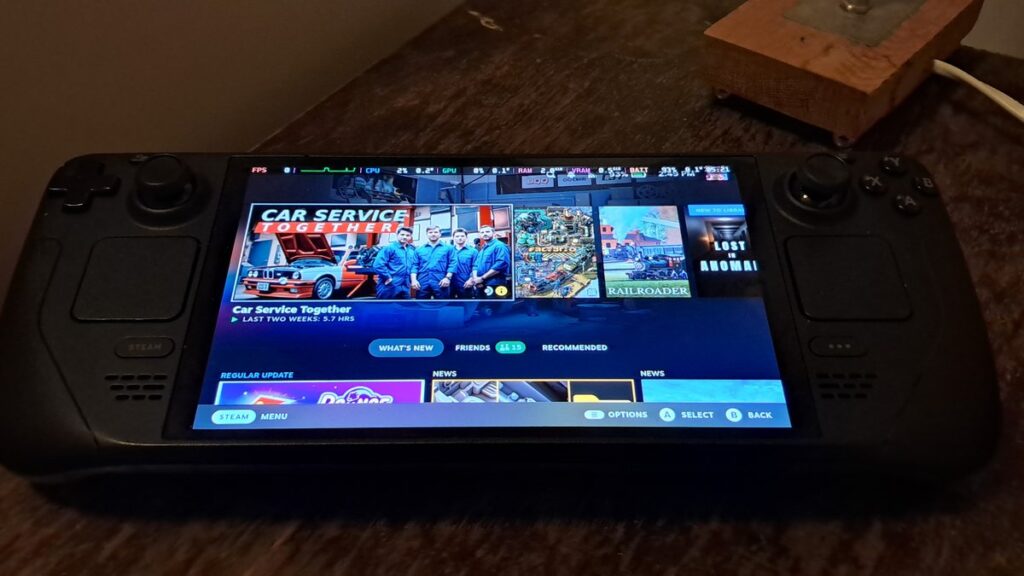
If your Steam Deck won’t turn on, start with two things before you panic: charge it and force-restart it. Plug in the official 45W charger and leave it for at least 30 minutes (a truly dead battery can stay dark a while), then press and hold the power button for a full 10+ seconds to force a hardware shutdown, and press power again to boot. That alone fixes most cases — a frozen system or a flat battery. If the screen stays black but the charge light is on, the Deck has power but isn’t displaying, which points to a software or display issue rather than a dead unit. The full step-by-step is below, including the safety check that actually matters.
Key Takeaways
- Force restart first: hold the power button at least 10 seconds for a hard shutdown (same for LCD and OLED), then press power to boot.
- Charge with the official 45W USB-C charger and give a dead Deck 30 minutes to a few hours — check that the LED by the port lights up (it dims after a few seconds, which is normal).
- Black screen but the light is on means it has power but isn’t outputting video — a software crash or display issue, not a dead battery.
- Stop immediately if you see a swollen battery (bowing back, lifting screen, separating shell) — don’t puncture it, and contact Steam Support.
A Steam Deck that won’t power on is alarming, but the cause is usually something simple and fixable — a drained battery, a frozen system, or a charger that quit. Genuine hardware failure is the rare exception, not the rule. The reason is that the things most likely to go wrong are also the things most easily reset: a software state that has hung, or a power path (charger, cable, outlet, or a deeply depleted cell) that has temporarily stopped delivering energy to the system. Work through these steps in order; the first two solve the large majority of cases, and the rest are for the stubborn ones. Resist the urge to open the device — almost every fix here is external, and opening a Deck unnecessarily risks the battery and your warranty.
First, Force Restart: Hold Power for 10 Seconds
A force restart reboots the hardware when the system has frozen — which often looks exactly like the Deck being “dead,” with a black, unresponsive screen. The distinction that matters is what a normal restart actually does versus what a 10-second hold does. A normal restart is a software request: SteamOS receives the signal, closes processes in an orderly way, and hands control back to the firmware. But if the operating system or a game has hung — the CPU stuck in a loop, a driver wedged, the input layer unresponsive — there is no working software left to receive that request, so a tap on the power button does nothing. Critically, a force restart does not delete your games, saves, or settings; it is the equivalent of cutting power and starting fresh, not a factory reset.
- Press and hold the power button for at least 10 seconds. Holding this long bypasses the operating system entirely and triggers a hardware-level power cut. Inside the Deck, a sustained hold tells the power-management circuitry to drop the rails feeding the SoC (the main system-on-chip that runs the CPU, GPU, and memory), forcibly clearing whatever frozen state the chip was stuck in. Because the freeze lived in volatile memory and in the running state of the SoC, removing power wipes it — when the chip powers back up, it starts from a clean boot rather than the wedged state it was trapped in. According to iFixit’s troubleshooting guide, this 10-second hold is the standard hard-reset for both the LCD and OLED models — the timing does not change between them.
- Wait a few seconds, then press power again to boot. The short pause lets the power rails fully settle and discharge before the next cold start, which is why “hold, release, wait, then press” works more reliably than mashing the button. You’re hoping to see the Steam or SteamOS logo appear, which confirms the SoC is powering up and the firmware is handing off to the operating system.
- For a normal restart (when the screen is working), a shorter press-and-hold of about 3 seconds brings up the on-screen power menu, where you can choose Restart or Shutdown. This is the graceful path: it lets SteamOS shut down cleanly, flushing data to storage and closing apps in order, so reach for the 3-second menu first whenever the display is responsive and save the 10-second hold for a truly frozen unit.
If holding power for 10 seconds does nothing at all — no logo, no light, no fan, no response — the freeze is unlikely to be the whole story, and the most likely remaining culprit is power. A force restart can only do something if there is enough charge to boot; an empty battery will swallow the attempt silently. Move to the next step.
Charge It Properly (and Watch for “Storage Mode”)
A deeply drained battery may not have enough charge to even show signs of life until it’s been plugged in for a while, so don’t assume it’s broken after 30 seconds on the charger. Lithium-ion cells have a built-in protection circuit that disconnects the battery if its voltage falls below a safe minimum — this prevents the cell from being damaged or becoming unsafe when over-discharged. When a Deck is left until it shuts off and then sits for days or weeks, the cell can drift below that threshold, and the protection circuit holds it disconnected. The charger then has to trickle a small, careful current in to bring the cell voltage back above the safe floor before the system will even acknowledge that a battery is present. During those first minutes — sometimes the first half hour or more — the screen can stay completely black, no LED, no response, even though charging is genuinely happening. That is why a dark screen for 30 minutes or more is not, by itself, proof the unit is dead.
1 Use the Official 45W USB-C Charger
Reach for the official 45W USB-C charger and a known-good cable, plugged into a wall outlet you’ve confirmed works. The 45W rating matters because of how USB-C Power Delivery (PD) negotiation works: when you plug in, the charger and the Deck “handshake” to agree on a voltage and current.
A genuine 45W PD charger can offer the higher-voltage profile the Deck wants, so it can both run the system and push current back into a depleted cell. A weak, off-brand, or low-wattage charger may negotiate only a low-power profile — enough to dribble in a trickle, but sometimes not enough to wake a fully flat Deck, which makes a working unit look dead.
2 Give a Flat Battery Real Time to Revive
If the battery was fully flat, leave it charging for at least 30 minutes — ideally a few hours — before you try the power button again. The first stretch is spent quietly nursing the cell back above its protection threshold.
Only after that does normal charging, and any visible reaction, begin. So plug in, walk away, and give it real time before you conclude anything. Judging a dead-looking Deck after 30 seconds on the charger is the most common mistake people make here.
3 Read the Charging LED by the Port
Check the charging LED next to the USB-C port. If charging is working, it should light up — and it’s normal for it to glow and then dim after a few seconds, so a brief flash of light followed by darkness is not a fault.
A steady or breathing light tells you power is reaching the board, which is genuinely reassuring. No light at all, after giving it time, usually means the charger, cable, or outlet is the problem rather than the Deck itself — which is exactly what the next steps test.
4 Wake a New Deck From Storage Mode
Units can ship in a battery “storage mode,” a deliberately built-in state for shipping and long-term storage. In storage mode the battery is electronically disconnected from the rest of the device so it won’t slowly self-discharge on a shelf, and so the power button alone won’t respond — there’s no battery connected for it to draw from.
External power is what wakes it: plugging in the charger reconnects the battery to the system and lets it power on. If it’s a new or long-unused Deck that seems totally unresponsive, simply leave it plugged in for a bit before attempting the first power-on.
What the LED and Screen States Mean
Before you escalate, it helps to read the Deck the way a technician does — the combination of LED behavior and screen behavior tells you where the fault lives, which narrows the fix dramatically. The two signals you have without opening anything are the charge LED next to the USB-C port and what the display does. Reading them together is the fastest way to tell a flat battery apart from a software crash apart from a display fault.
- No LED, black screen, plugged in. This points at the power path: either nothing is reaching the board (dead charger, dead cable, dead outlet) or the cell is so deeply discharged its protection circuit hasn’t reconnected yet. The move is to give it the full charging window above, then swap the charger and cable to rule out the most common failure. Only after both of those come back empty does the Deck itself become the suspect.
- LED lights then dims, black screen. The dim-after-a-few-seconds behavior is normal LED handling, not a fault. A lit LED means power is arriving and the board is alive — so a black screen here is not a power problem. The fault is downstream: either the system has crashed or hung during boot, or the display itself isn’t receiving or showing video. That is exactly the case the next section isolates.
- LED on, you can hear the fan or feel vibration, black screen. Fan spin or haptic feedback is strong evidence the SoC is running and SteamOS may be partway up — the system is alive but nothing is reaching the panel. This skews the diagnosis toward a display or display-cable fault rather than a dead system, and it is the clearest sign that testing external video (next) is worthwhile.
- Logo appears, then black or stuck. If you see the Steam or SteamOS logo and then it freezes or drops to black, power and display are both fine — the problem is software in the boot sequence. A 10-second force restart is the first answer; the BIOS and Boot Manager combos below are the next, for reaching recovery without a working desktop.
Black Screen but the Light Is On?
If the charge LED is lit (or you can hear the fan), the Deck has power — it’s just not putting an image on the screen. That changes the diagnosis entirely: it’s not a dead battery, it’s a software crash or a display problem. The goal now is to isolate which of those two it is, because the fixes are very different — a crash clears with a restart, while a true display fault means the system is fine and only the panel (or its ribbon cable) is at fault. Try this:
- Force restart with the 10-second power hold (above) to clear a frozen boot or a game that hung the system. Because a lit LED already tells you power is fine, a successful restart here strongly implies the original problem was software — the cold boot wipes the hung state and lets SteamOS come up cleanly. If it boots normally afterward, you’ve confirmed it was a crash, not a hardware fault.
- Listen and feel for signs of life — fan spin, vibration, haptics, boot sounds. If the system clearly seems alive but the screen stays dark, the weight of evidence shifts toward the display or its internal cable rather than the whole device. A running fan with a dark panel is a classic “computer is on, monitor is off” pattern, just inside one handheld shell.
- Test video output through a dock or a USB-C-to-HDMI adapter to a TV or monitor. This is the decisive test: the USB-C port can carry a video signal straight off the SoC, bypassing the built-in panel entirely. If you get a clear picture on the external screen, the Deck’s system, GPU, and storage are all working — the built-in display (or its ribbon connector) is the fault, which is a far cheaper and more contained repair than a dead mainboard. If you get nothing externally either, the problem is more likely deeper in the system or the boot, and it’s time to consider the BIOS combos or Steam Support.
Boot Menu & BIOS Button Combos
If the Deck powers on but won’t boot SteamOS normally, the button combos let you reach the BIOS or boot manager to troubleshoot deeper — these are firmware-level screens that load before the operating system, so they work even when SteamOS itself is broken. Reaching either one is also a useful diagnostic in its own right: if the BIOS or boot menu displays, you’ve just proven the power path, the SoC, and the display are all functioning, which means a non-booting Deck is a software or storage problem rather than dead hardware.
- BIOS: with the Deck off, press and hold Volume Up (+) and then press the Power button. Keep holding Volume Up until the BIOS appears. The BIOS is the low-level firmware menu for settings and hardware checks; entering it confirms the board is alive and the panel can draw an image even when the OS won’t load.
- Boot Manager: hold Volume Down (−) and press Power to reach the boot menu. This is where you choose what to boot from — the internal drive, a recovery image on a USB drive or microSD, or another source — which is exactly what you need when the installed SteamOS is corrupted and you want to reinstall or recover without it.
A quick way to remember it: Up for BIOS, Down for Boot menu. These are advanced screens — if you’re not sure what to change, you can usually just exit without altering anything, and the simple act of reaching them confirms the Deck has power and a working display. If you do need to recover or reinstall, Valve publishes an official SteamOS recovery image and instructions; reaching the Boot Manager is the first step toward booting that recovery media.
Swap the Charger and Cable
A dead-looking Deck is very often a dead charger. Chargers and USB-C cables fail more often than the consoles they power — they get yanked, stepped on, coiled tightly, and stuffed in bags, and a single broken conductor inside a cable or a failed component in a power brick can stop charging entirely while leaving no visible damage. Because the symptom (a Deck that won’t wake) is identical whether the fault is the charger or the console, swapping the charger is the single highest-value test you can run before assuming the worst.
- Try a second 45W charger and a different USB-C cable. Underpowered phone chargers may not wake or charge the Deck reliably, because they can’t negotiate the higher-power USB-C PD profile the Deck wants — they may trickle just enough to look “connected” without delivering enough to bring a flat unit back to life. Using a genuine 45W PD charger removes that variable, so if the Deck wakes on the replacement, you’ve found a charger or cable fault, not a console fault.
- Cross-test: plug your Deck charger into another USB-C device to see if it powers that device, or plug another known-good charger into your Deck. This A/B swap quickly isolates the failure: if your charger can’t power anything else, the brick or cable is dead; if a known-good charger revives your Deck, your original charger is the culprit; and if no charger does anything, the problem is more likely inside the Deck. A spare cable matters here too — a perfectly good brick paired with a broken cable behaves exactly like a dead charger.
Check for a Swollen Battery (Important Safety Step)
Safety check. Lithium-ion batteries can swell as they age or fail, because internal decomposition and outgassing generate gas inside a sealed cell — the pouch expands like an inflating balloon, and that swelling is a genuine fire hazard, signaling a cell that is chemically unstable and at risk of venting or igniting. Look for the signs: the back panel or seams separating or bowing, the screen, trackpads, or seams lifting, an unexplained bulge in the housing, or a Deck that only runs while plugged in and won’t hold a charge. If you see any of these, stop using and charging it immediately, do not press, bend, or puncture the device (puncturing a swollen cell can cause it to catch fire), keep it away from anything flammable, and contact Steam Support to arrange a safe repair or replacement. Do not attempt to “fix” a swollen battery yourself.
The reason a Deck that “only runs while plugged in” belongs on this list is that it is often an early symptom of a failing or swelling cell: the battery can no longer hold meaningful charge, so the system survives only on wall power and dies the instant it’s unplugged. Pair that behavior with any physical bowing or lifting and treat it as a swollen-battery situation, not a minor charging quirk. A healthy Deck shell is flat and tightly seated; any new gap, bulge, or part that has started to separate is your cue to stop and get help rather than keep charging it.
When to Contact Steam Support
If you’ve charged it, force-restarted it, swapped chargers and cables, tested external video, and still get nothing — or you spot any battery swelling — it’s time to stop DIY-ing and reach out. At that point you’ve ruled out the common, user-fixable causes, and what remains (a board fault, a failed display, an unsafe battery) needs Valve’s repair process rather than another round of home troubleshooting.
- Go to Steam Support and open a Steam Deck hardware request. Genuine board faults in the first year, without accidental damage, are rare and are typically covered under warranty — so an out-of-the-blue no-power failure on a relatively new Deck is exactly the kind of case the warranty exists for. Don’t pre-emptively open or attempt internal repairs you’re unsure about, since that can complicate a warranty claim.
- Have your details ready: when the problem started, what you’ve already tried (charging time, charger swaps, force restart, external video test), and crucially whether the charge LED lights up. That LED detail tells the technician whether power is reaching the board, which often shortcuts the diagnosis and speeds up the repair or replacement.
Gaming hardware drama is having a moment — from the Switch 2’s blockbuster launch to security scares like the reported Steam account leak. A Deck that won’t boot is far more boring than those headlines, and far more fixable.
Preventing Future Boot Problems
Most no-power scares are preventable, and the habits that prevent them are the same ones that keep the battery healthy for years. The throughline is simple: avoid deeply draining the cell, avoid extreme heat, and keep the charging hardware in good shape — the three things most responsible for a Deck that won’t wake.
1 Don’t Let It Sit Fully Drained for Long
The deep-discharge protection state described earlier — where a flat cell drops below its safe voltage and disconnects — is exactly what makes a Deck look dead and need a long revive. Every time you let it drain to nothing and sit, you invite that scare.
If you won’t use it for a while, leave it with a partial charge (not bone-empty, not pinned at 100%) and top it up occasionally rather than letting it discharge to nothing on a shelf. SteamOS also includes a battery storage and charge-limit setting; using it for long idle periods reduces the stress that leads to swelling and capacity loss.
2 Keep the Deck Out of Heat
Lithium-ion cells degrade and outgas faster when hot, which is the chemistry behind swelling. Heat is the single biggest accelerant of the battery problems that end in a safety scenario.
Don’t leave the Deck in a hot car, in direct sun, or charging under a pillow or blanket where it can’t shed heat. Letting it run cool both extends battery life and lowers that long-term swelling risk considerably.
3 Protect the Charger and Cable
Since a failed charger or cable is one of the most common “won’t turn on” causes, treat them gently — don’t yank the cable by the cord, avoid sharp bends at the connector, and don’t coil it tight.
Sticking with the genuine 45W USB-C charger, or a quality PD equivalent, means the Deck always gets a power profile it can actually use to wake and charge. A five-dollar cable that survives a year of abuse is cheaper than a support ticket.
4 Shut Down Cleanly and Keep SteamOS Updated
Using the 3-second power menu to shut down or restart, rather than relying on hard resets, lets the system close files in order and reduces the chance of a corrupted boot that looks like a dead unit.
Keeping SteamOS current also pulls in firmware and power-management fixes that can quietly resolve the kind of boot and charging glitches that otherwise send people searching for repair options. Updates are free insurance against the exact problems this guide troubleshoots.
Quick Reference: Symptom → Fix
| Symptom | Most likely cause | First thing to try |
|---|---|---|
| Totally dead, no light | Flat battery or bad charger | Charge 30+ min on the 45W charger; check the LED |
| Frozen / unresponsive | System hang | Hold power 10+ seconds to force restart |
| Black screen, light is on | Software crash or display fault | Force restart; test video out to a TV |
| Only runs while plugged in | Failing/swollen battery | Check for swelling; contact Steam Support |
| New Deck won’t power on | Battery storage mode | Leave it plugged in, then power on |
| Power button feels stuck | Debris in the button | Clean gently with isopropyl on a swab |
Frequently Asked Questions
How do I force restart a Steam Deck that won’t turn on?
Press and hold the power button for at least 10 seconds to force a full hardware shutdown — this works the same on the LCD and OLED models, and the timing does not change between them. Holding this long bypasses the frozen operating system entirely and cuts power to the main chip, which clears the hung state held in memory. Wait a few seconds so the power rails fully discharge, then press power again to boot. This won’t delete your games, saves, or settings. If you just want a normal restart and the screen works, a roughly 3-second hold brings up the on-screen power menu with Restart and Shutdown options, which is the gentler, preferred path whenever the display is responsive.
My Steam Deck is completely dead and won’t charge. What do I do?
Use the official 45W USB-C charger and a known-good cable in a working outlet, and leave it for at least 30 minutes — ideally a few hours — since a fully drained lithium-ion battery can stay completely dark for a while. That delay is normal: when a cell over-discharges, its protection circuit disconnects it, and the charger has to nurse the voltage back above a safe minimum before the system even registers the battery or shows any reaction. Check that the LED next to the charge port lights up; it’s normal for it to glow and then dim after a few seconds. If there’s no light at all after giving it time, try a different 45W charger and cable, because a failed charger or cable is one of the most common causes and looks identical to a dead console.
My Steam Deck has a black screen but the light is on. Is it broken?
Not necessarily, and a lit light is actually good news. A lit charge LED (or an audible fan) means the Deck has power and the board is alive — it simply isn’t outputting video, which usually points to a software crash or a display issue rather than a dead device. First, force restart it by holding power for 10 seconds to clear any hung boot or frozen game. If that doesn’t help, connect it to a TV or monitor via a dock or USB-C-to-HDMI adapter, which sends video straight off the main chip and bypasses the built-in panel. If you get a picture externally, the system is fine and the built-in screen (or its internal cable) is the fault — a far more contained repair than a dead mainboard.
Why won’t my new Steam Deck turn on out of the box?
A brand-new or long-stored Deck that seems totally unresponsive is very often in battery “storage mode” rather than broken. To prevent the battery from slowly draining on a shelf during shipping and storage, the cell is deliberately disconnected from the rest of the device electronically, which means the power button alone has nothing to draw from and won’t respond. External power is what wakes it: plugging in the official charger reconnects the battery to the system. Just leave it plugged in for a little while, then try the power button — in most cases it boots normally once it’s seen wall power.
How do I get into the Steam Deck BIOS or boot menu?
With the Deck off, hold Volume Up (+) and then press the Power button to enter the BIOS; keep holding Volume Up until it appears. To reach the boot manager instead — where you choose what to boot from, including recovery media on a USB drive or microSD — hold Volume Down (−) and press Power. An easy way to remember it: Up for BIOS, Down for the Boot menu. These firmware screens load before SteamOS, so they work even when the OS is broken, and simply reaching one confirms your power, main chip, and display are all functioning. They’re for advanced troubleshooting, so if you’re unsure, just exit without changing anything.
How do I know if my Steam Deck battery is swollen?
Look for the back panel or seams bowing or separating, the screen or trackpads lifting, an unexplained bulge in the housing, or a Deck that only runs while plugged in and won’t hold a charge. Swelling happens because a failing lithium-ion cell decomposes and outgasses, inflating the sealed pouch — and that makes it chemically unstable and a genuine fire hazard. If you spot any of these signs, stop using and charging it, do not press, bend, or puncture the device (puncturing a swollen cell can cause it to ignite), and keep it away from anything flammable. Don’t try to repair it yourself; contact Steam Support to arrange a safe repair or replacement.
When should I contact Steam Support about my Deck?
Reach out once you’ve worked through the user-fixable causes with no success — you’ve charged it for a good while, force-restarted it, swapped chargers and cables, and tested external video — or immediately if you see any sign of battery swelling. At that point what remains (a board fault, a failed display, or an unsafe battery) needs Valve’s repair process rather than more home troubleshooting. Open a Steam Deck hardware request through Steam Support, and have ready when the issue started, what you’ve already tried, and whether the charge LED lights up, since that tells the technician whether power is reaching the board. First-year board faults without accidental damage are uncommon and usually covered under warranty.
Troubleshooting steps are based on official Steam Support and iFixit guidance as of June 2026. For a suspected hardware or battery fault, contact Steam Support rather than opening the device yourself.
About the Author
Elena Brooks
Elena Brooks is the person her group chat texts when something at home stops working or a health trend starts trending. She’s spent years turning that instinct into a job — digging into the research behind everyday questions, calling the experts, and writing up what holds up and what doesn’t. Her beat is wherever curiosity points: kitchens, cars, pets, sleep, money, and the occasional meteor shower.