
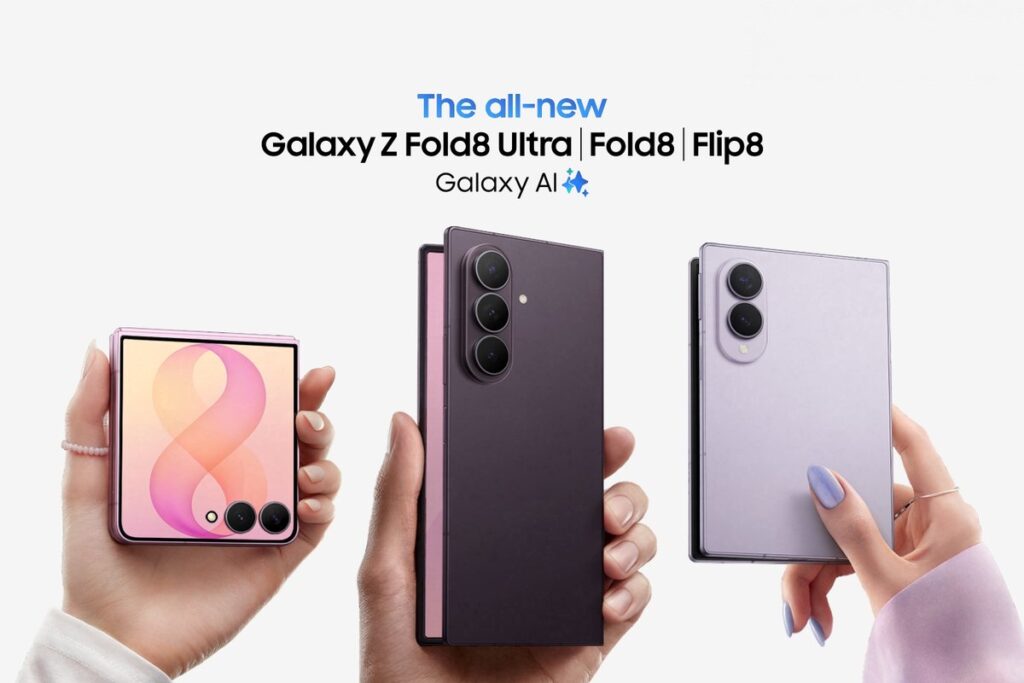
- Samsung split the Fold line in two on July 22, 2026: the wider, lighter Galaxy Z Fold 8 at $1,899 and the spec-monster Z Fold 8 Ultra at $2,099. Both hit shelves August 7.
- The Z Fold 8 Ultra is the real Z Fold 7 successor. It keeps the same footprint and 8-inch inner screen, then adds a 5,000 mAh battery, 45W charging, and a smaller crease.
- The base Z Fold 8 is a sidegrade from a Z Fold 7, not an upgrade. You gain a fresh wide shape and lose the 200 MP main camera and the 3x telephoto entirely.
- Most Z Fold 7 owners should skip this cycle. The chip and battery gains are real, but your phone already has 7 years of updates ahead of it.
- New buyers get a genuinely great deal: the Fold 8 launches $100 cheaper than the Fold 7 did, and discounted Fold 7 stock just became the value play of the year.
Samsung just pulled a fast one. At today’s Galaxy Unpacked event in London, it didn’t announce a Fold 7 successor. It announced two phones and gave the familiar name to the wrong one. So before you type galaxy z fold 8 vs z fold 7 into another search box and start comparing spec rows, you need to know the trick: the phone called Galaxy Z Fold 8 is a different kind of foldable, and the phone that actually replaces your Z Fold 7 is called the Z Fold 8 Ultra.
That one naming decision changes all the upgrade math. If you own a Z Fold 7, the “obvious” upgrade path now costs $2,099, not $1,899. And the $1,899 phone? It trades away the 200 MP camera and the telephoto lens your Fold 7 already has. This is not a normal year-over-year comparison. It’s a fork in the road.
We watched the launch coverage live, pulled every number below from Samsung’s official spec sheets and launch-day reporting, and did the math for three kinds of readers: Fold 7 owners wondering if they should upgrade, first-time foldable buyers, and bargain hunters eyeing a discounted Fold 7. Let’s sort it out together.
Samsung Split the Fold Into Two Phones This Year
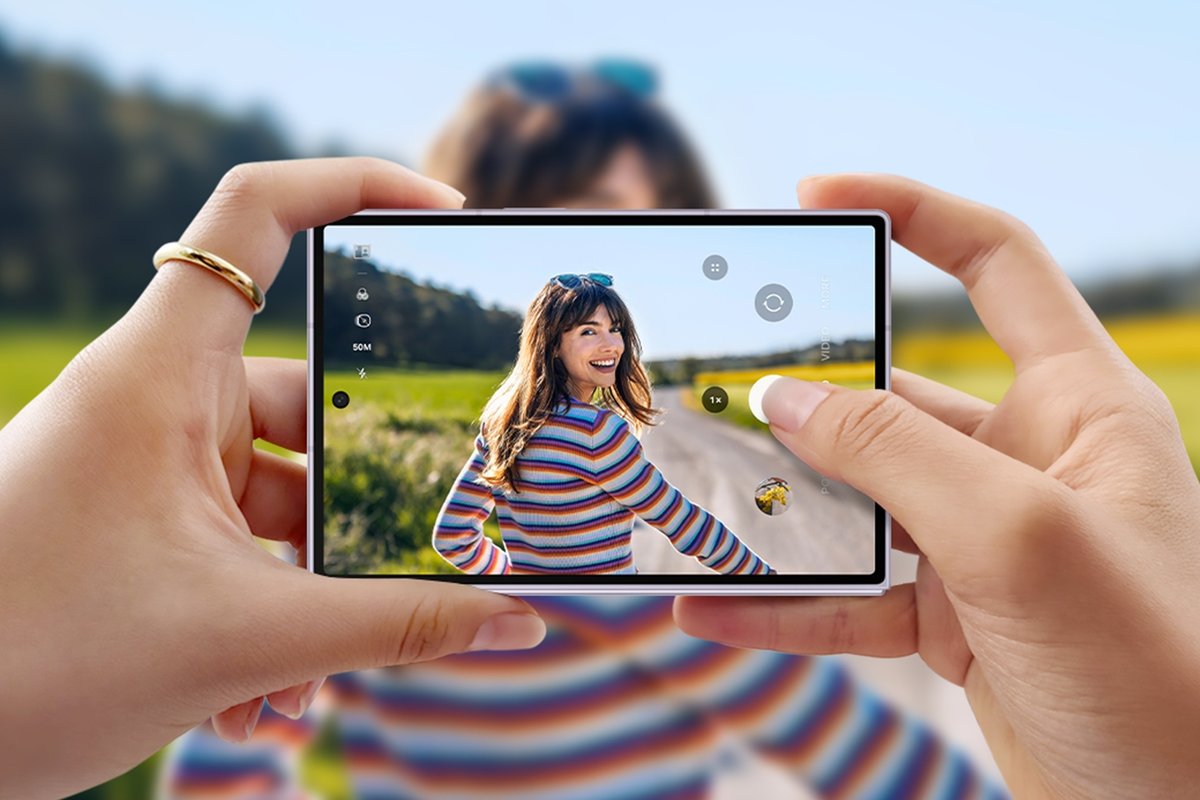
Here’s the headline most spec tables will bury: for the first time since the original Fold launched in 2019, Samsung is selling two book-style foldables at once. The company confirmed the whole lineup in its official launch announcement this morning: Galaxy Z Fold 8, Galaxy Z Fold 8 Ultra, and the Z Flip 8, with preorders open today and a release date of August 7, 2026.
Why does that matter? Because “Fold 8” no longer means “Fold 7, but better.” Samsung borrowed the playbook Apple has run for years with the Pro and non-Pro iPhone: one device for reach, one for the ceiling. The base Fold 8 is the reach device. It’s wider, lighter, $100 cheaper than last year’s Fold 7 was at launch, and deliberately simplified. The Ultra is the ceiling. Same tall body you know, pushed thinner, with the best camera and battery Samsung has ever put in a foldable.
There’s a second layer to this move that’s easy to miss. The base Fold 8’s new short-and-wide shape isn’t a Samsung invention. It’s the shape the Oppo Find N and the original Google Pixel Fold used, the one reviewers kept calling more natural for reading and video. Android Central’s hands-on from the London event describes it as feeling “like a passport in hand.” After seven generations of defending its tall, narrow design, Samsung just conceded the point. That’s not a small tweak. That’s the market leader admitting the other shape won the argument.
So when you compare the galaxy z fold 8 vs z fold 7, you’re really answering a different question than last year’s buyers faced. It’s not “is the new one better?” It’s “which of three phones fits my life?” That’s what the rest of this guide works through.
What the New Galaxy Z Fold 8 Actually Is
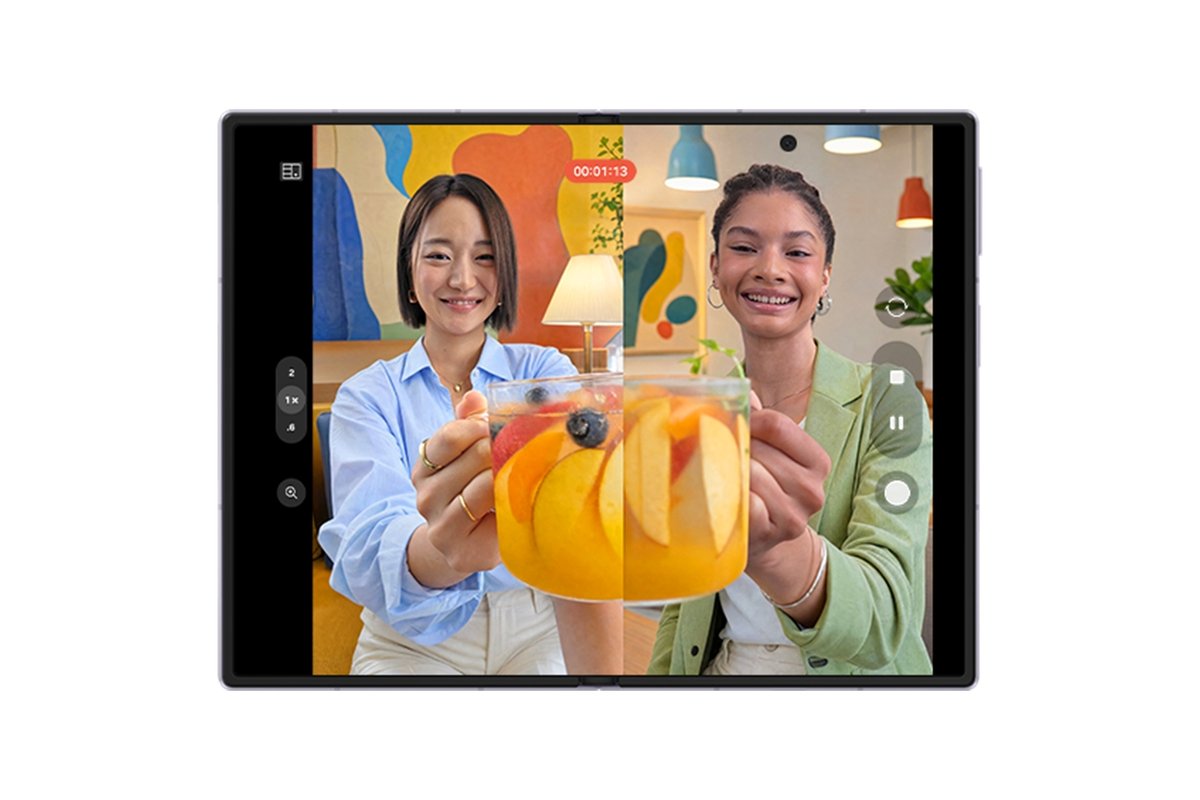
Think of the Galaxy Z Fold 8 as a paperback book that opens into a small tablet. Samsung rebuilt the whole phone around how people actually consume stuff: scrolling, reading, and watching video. It’s the lightest Fold Samsung has ever shipped, at 201 grams. Your Z Fold 7 weighs 215 grams, and so does the new Ultra. That 14-gram drop sounds tiny on paper, but on a phone you hold up in bed every night, you feel it.
A Shorter, Wider Body That Feels Like a Passport
The numbers tell the shape story fast. Folded, the Z Fold 8 measures 123.9 mm tall by 81.9 mm wide. Your Fold 7 is 158.4 mm tall and just 72.8 mm wide. So the new phone is about 3.5 cm shorter and nearly a full centimeter wider. Closed, it genuinely reads as a passport, not a TV remote.
The cover screen is a 5.5-inch panel with a 10:16 ratio, running at 120Hz like everything else here. It’s shorter and squatter than the Fold 7’s 6.5-inch cover display, which means it behaves less like a regular phone screen and more like a compact one. Reviewers who handled it say typing feels fine and apps resize well, but if you live on your cover screen all day, this is the single biggest adjustment you’d make.
Displays That Change Jobs When You Rotate Them
Open the phone and you get a 7.6-inch inner display with a 4:3 aspect ratio, 2,448 x 1,848 resolution, and up to 3,000 nits of peak brightness. Here’s the clever bit: 4:3 is the shape movies and games feel comfortable in, and when you rotate the phone it becomes 3:4, which is almost exactly the shape of a printed book page. Samsung’s pitch is that one display does both jobs, and honestly, it’s a good pitch.
Note that the inner screen is slightly smaller than the 8-inch panel on your Z Fold 7 and on the new Ultra. You’re trading a bit of area for a more useful shape. For spreadsheets and split-screen work, the old tall layout holds its own. For a Kindle-style reading session or a Netflix episode, the Fold 8’s proportions waste fewer pixels on black bars.
Flex Titanium Makes the Crease Harder to Find
Both new Folds get Samsung’s new Flex Titanium display structure: a titanium-alloy film layered with an enhanced titanium plate under the folding screen. Samsung says it absorbs pressure, supports the panel, and reduces crease visibility over time. Hands-on reports back this up. Android Central called the crease “nearly non-existent when viewing content or swiping across the screen.”
The crease has been the number one “I’ll wait” excuse for foldable skeptics since 2019, so this matters beyond vanity. A flatter fold zone means less visible aging as the phone racks up thousands of fold cycles. Add the new low-reflection screen finish and this is the most confident folding display Samsung has shipped. Your Fold 7’s crease was already improved; this generation pushes further.
Where the Galaxy Z Fold 8 Ultra Fits
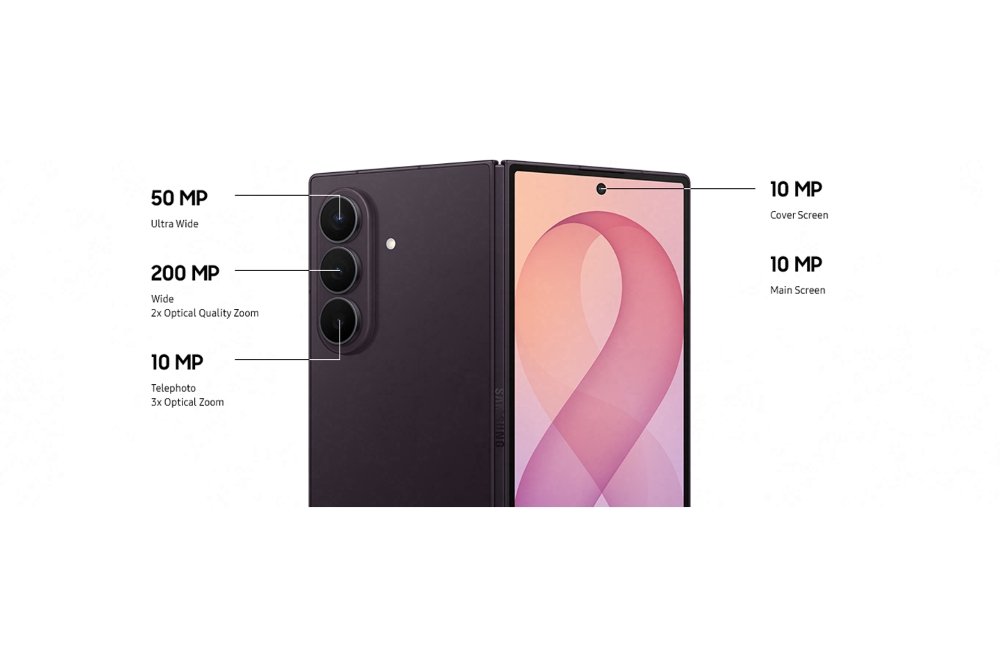
Now the phone Samsung should arguably have called the Fold 8. The Z Fold 8 Ultra is the direct continuation of your Z Fold 7: same 158.4 x 72.8 mm folded footprint, same 215-gram weight, same 8-inch inner display size, same 6.5-inch cover screen. Set them side by side and, as Android Central put it, you can barely tell them apart. Every change hides inside.
The Same Footprint as the Fold 7, Pushed Thinner
Unfolded, the Ultra measures 4.1 mm thick. That’s Samsung’s slimmest Fold ever, a tenth of a millimeter under the Fold 7’s 4.2 mm. Folded, both close to 8.9 mm. A 0.1 mm difference is marketing garnish, not something your hand will register, and that’s exactly the point: the Ultra isn’t trying to change what the Fold is. It’s the “tock” refinement year after the Fold 7’s dramatic slim-down, per 9to5Google’s launch coverage.
The display stack does bring one real durability upgrade: the cover screen graduates to Gorilla Glass Ceramic 3, and the inner panel gets the same Flex Titanium backing as the base model. The 8-inch QXGA+ inner screen holds at 2,504 x 2,256 with a 1-120Hz adaptive refresh rate and 3,000-nit peak, now with an anti-reflective finish that should help outdoors, where foldable inner screens have always struggled.
An Ultra Camera System the Base Model Skips
The Ultra keeps the triple camera your Fold 7 introduced and sharpens it. The 200 MP main camera returns with an f/1.7 lens and gains HDR processing at full 200 MP resolution. The ultra-wide jumps from the Fold 7’s 12 MP to a new 50 MP sensor with autofocus, which also unlocks sharper macro shots. The 10 MP 3x telephoto carries over unchanged, which is the one place the “Ultra” name still rings a little hollow — Samsung’s own Galaxy S series flagships zoom much further.
For creators there’s real meat here: 8K recording through the new APV codec and Cine LUT color controls on-device. Nightography gets another round of low-light tuning. None of this exists on the base Fold 8, and that split is deliberate. Samsung is betting camera-first buyers will pay the extra $200 without blinking.
The Battery Fold Fans Waited Seven Years For
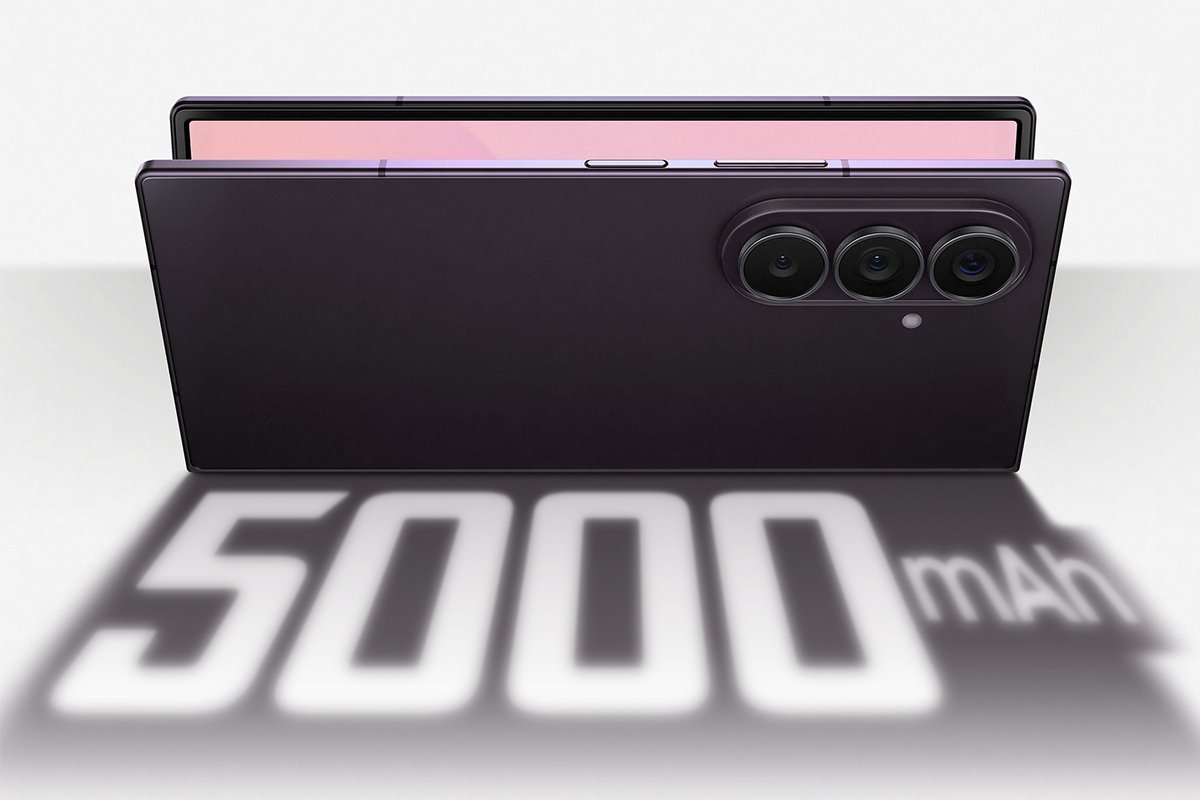
Here’s the Ultra’s headline act: a 5,000 mAh battery, up from 4,400 mAh in your Z Fold 7. Samsung finally adopted silicon-carbon battery chemistry, which packs more energy into the same space — that’s how the biggest battery ever in a Galaxy Fold fits inside the thinnest Galaxy Fold ever. Charging rises from the Fold 7’s aging 25W to 45W through a new dual-path charging design. Samsung quotes 67% in about 30 minutes.
Battery has been the Fold line’s most-complained-about weakness in every generation since 2019, and this is the first time Samsung has moved the number meaningfully rather than nudging efficiency. If one spec sells Fold 7 owners on upgrading, it’s this one.
All Three Foldables Side by Side on Paper
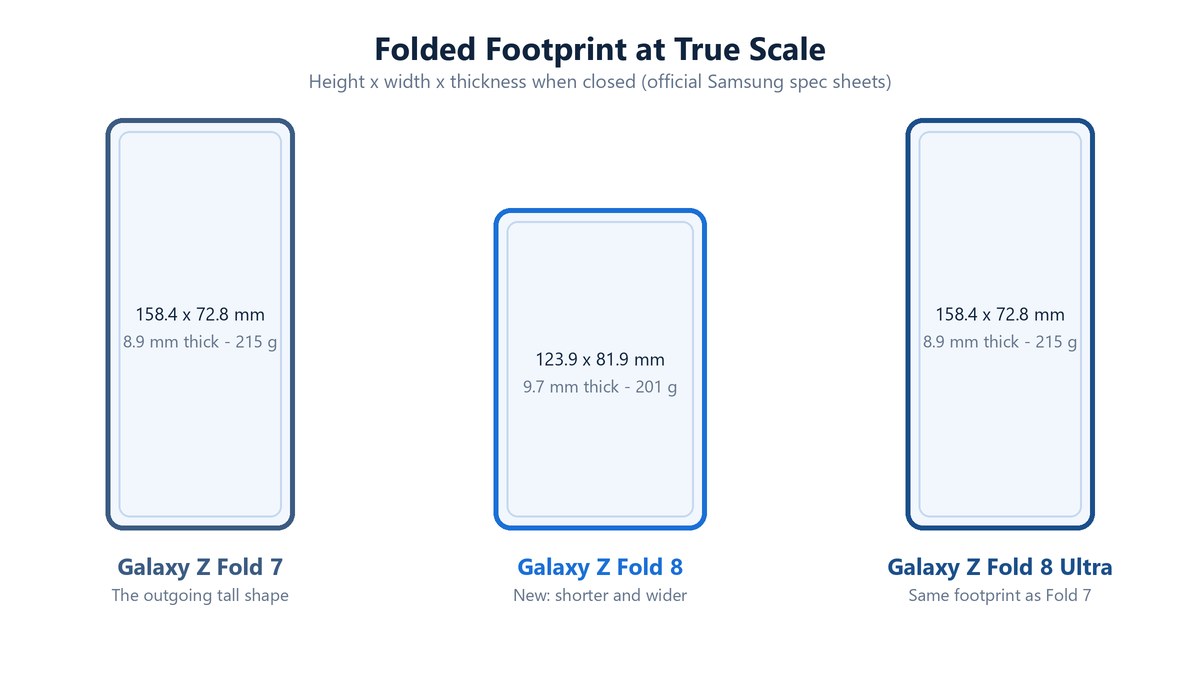
Numbers first, verdicts after. Every Fold 8 and Ultra figure below comes from Samsung’s official launch spec sheet published today; Fold 7 figures are its 2025 launch specs.
| Spec | Galaxy Z Fold 7 (2025) | Galaxy Z Fold 8 | Galaxy Z Fold 8 Ultra |
|---|---|---|---|
| Launch price | $1,999 | $1,899 | $2,099 |
| Inner display | 8.0-inch, 2184 x 1968, 120Hz | 7.6-inch 4:3, 2448 x 1848, 120Hz | 8.0-inch, 2504 x 2256, 120Hz |
| Cover display | 6.5-inch 21:9, 120Hz | 5.5-inch 10:16, 120Hz | 6.5-inch, 120Hz |
| Folded size | 158.4 x 72.8 x 8.9 mm | 123.9 x 81.9 x 9.7 mm | 158.4 x 72.8 x 8.9 mm |
| Unfolded thickness | 4.2 mm | 4.5 mm | 4.1 mm |
| Weight | 215 g | 201 g | 215 g |
| Chip | Snapdragon 8 Elite | Snapdragon 8 Elite Gen 5 | Snapdragon 8 Elite Gen 5 |
| RAM / storage | 12-16 GB, 256 GB-1 TB | 12-16 GB, 256 GB-1 TB | 12-16 GB, 256 GB-1 TB |
| Main camera | 200 MP f/1.7 | 50 MP f/1.8 | 200 MP f/1.7, 200 MP HDR |
| Ultra-wide | 12 MP | 50 MP | 50 MP |
| Telephoto | 10 MP, 3x optical | None | 10 MP, 3x optical |
| Battery (typical) | 4,400 mAh | 4,800 mAh | 5,000 mAh |
| Wired charging | 25W | 45W-class (63% in 30 min) | 45W (67% in 30 min) |
| Wireless charging | 15W | 20W | 20W |
| Water/dust rating | IP48 | IP48 | IP48 |
| OS at launch | Android 16, One UI 8 | Android 17, One UI 9 | Android 17, One UI 9 |
Two rows deserve a second look. First, folded thickness: the “new” Fold 8 is actually 0.8 mm thicker in your pocket than the phone it’s supposedly replacing. Wider and shorter also means it won’t slide into every pocket the same way. Second, the camera rows: read down the base Fold 8 column and you’re looking at a hardware downgrade from a 2025 phone in two of three lenses. Keep both facts handy for the verdict.
Five Real Reasons for Z Fold 7 Owners to Upgrade
Let’s steelman the upgrade first. These are the genuine, verified gains waiting if you trade your Z Fold 7 for a Fold 8 Ultra — and, where noted, the base Fold 8 too.
1 The Battery Jump Is the Biggest in Fold History
The Ultra’s 5,000 mAh cell is a 13.6% capacity bump over your 4,400 mAh Fold 7, and the silicon-carbon chemistry means it arrived without any extra thickness. Even the base Fold 8’s 4,800 mAh beats your current phone by 9%. Combine that with a more efficient chip and the first Fold generation that can plausibly promise a full heavy day is here.
If your Fold 7 already limps to 9 p.m., this is the one upgrade you’ll feel every single day. Battery anxiety compounds: it changes how you use maps, hotspotting, and the big inner screen itself. A phone you don’t ration is a different phone.
2 Charging Finally Escapes 25W
The Fold 7 charges at 25W, a spec Samsung had barely touched since 2019. Both new Folds move to 45W-class charging, with Samsung quoting 67% in about 30 minutes on the Ultra and 63% on the base model. That’s roughly a lunch break to two-thirds full, versus closer to 50% on your current phone.
Wireless charging also ticks up from 15W to 20W across the lineup. It’s not the 80W-plus some Chinese foldables hit. On wired speed specifically, Android Central notes the new 45W-class charging still trails the Razr Fold, but it finally removes the Fold’s slowest-in-class charging label.
3 A Crease You Stop Noticing
Flex Titanium isn’t a marketing sticker; it’s a structural change to the folding display, and every hands-on so far says the visible crease shrank dramatically. On top of that, the fold-open action itself was re-tuned — hinge tension, display support, and magnets rebalanced so the phone opens more smoothly.
Fold 7 owners know the crease mostly disappears in daily use anyway. But if you read a lot on the inner screen, where a light-catching seam is most annoying, this generation delivers the cleanest canvas yet. Resale logic applies too: a less-creased used foldable holds value better.
4 The Snapdragon 8 Elite Gen 5 Unlocks One UI 9’s Agentic AI
Both new Folds run the Snapdragon 8 Elite Gen 5 for Galaxy with 12 or 16 GB of RAM, launching on Android 17 and One UI 9. The AI story is the bigger half: Gemini automation that chains real actions across more than 40 apps, Now Nudge suggestions that surface mid-conversation, and a Gemini Notebook workspace — plus a bundled 6-month Google AI Pro trial worth $19.99 a month. On-device AI is exactly the workload where a new NPU earns its keep, the same dynamic we covered when Apple built its M5 chip around local AI.
Your Fold 7’s Snapdragon 8 Elite is still fast, and much of One UI 9 will reach it in software updates. But Samsung has been clear that the heaviest on-device AI features favor the newest silicon, and that gap will widen over this phone’s life, not shrink.
5 A Sharper Ultra-Wide Camera on Both New Models
The ultra-wide jump from 12 MP to 50 MP is the quiet camera win of this launch. It’s the lens you use for group shots, landscapes, and tight indoor spaces, and on the Ultra it gains autofocus for genuinely sharp macro photography — something your Fold 7’s fixed-focus ultra-wide simply can’t do.
On the Ultra this slots alongside the improved 200 MP main sensor with full-resolution HDR and the new 8K APV recording path. If you shoot a lot on your Fold, the Ultra’s camera package is a real generational step, not a spec-sheet shuffle.
Five Reasons to Think Twice Before You Switch
Now the other side of the ledger, and it’s heavier than most launch-day coverage admits. Some of these apply only to the base Fold 8; two apply to the whole lineup.
1 The Base Fold 8 Deletes the Telephoto Lens Entirely
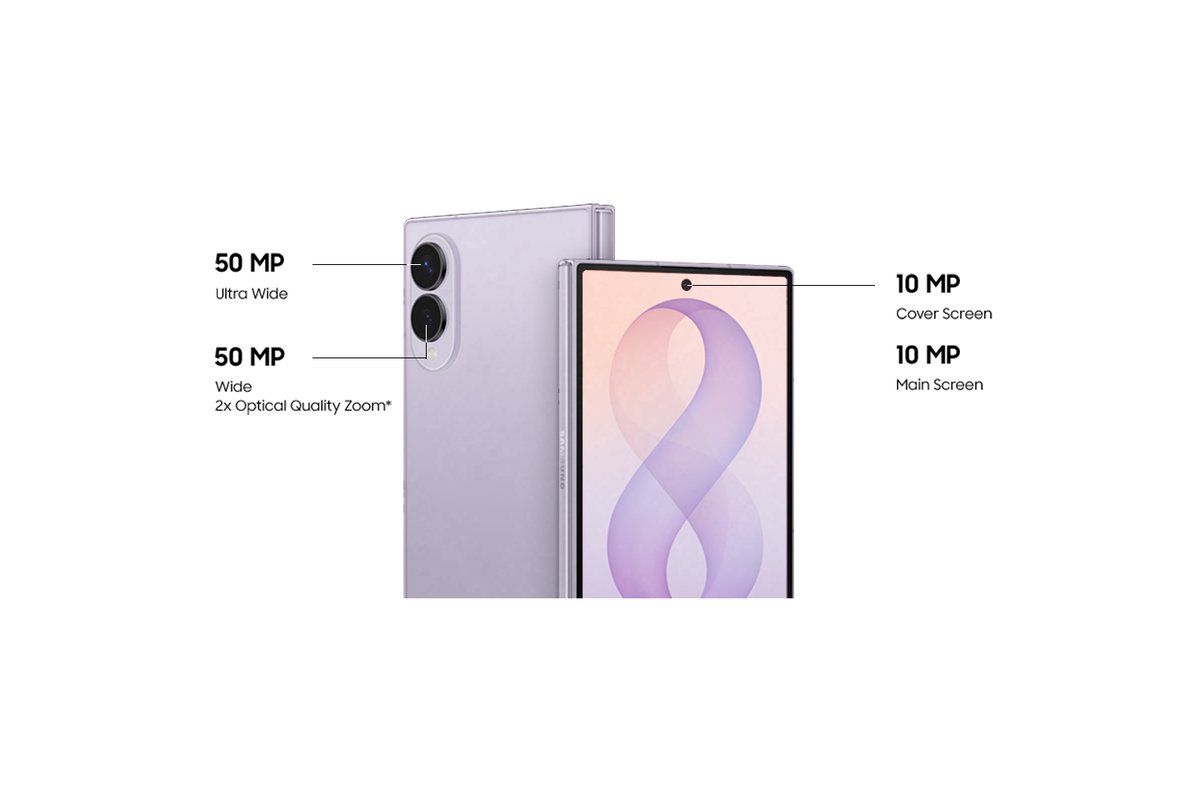
Read that spec table again: the $1,899 Fold 8 has no telephoto camera at all. Your Z Fold 7 has a 10 MP 3x optical zoom. The Fold 8 answers with “2x optical-quality zoom,” which is a center-crop of its 50 MP main sensor — clever software, but physics is physics, and at 3x and beyond your two-year-old phone will out-shoot the brand-new one.
If you zoom on concerts, kids’ games, or travel landmarks even weekly, moving from a Fold 7 to a base Fold 8 is a camera downgrade you’ll notice fast. Samsung locked the telephoto behind the Ultra on purpose. Don’t pay $1,899 to lose a lens.
2 The 200 MP Main Camera Becomes Ultra-Exclusive
Same story, bigger sensor. The Fold 7’s 200 MP main camera — the single biggest camera upgrade in Fold history when it arrived — does not carry down to the base Fold 8, which ships a 50 MP f/1.8 main instead. It’s a good 50 MP sensor with dual-pixel autofocus and OIS, and most social-media shots won’t betray the difference. Big crops and low light will.
The pattern is worth naming: Samsung didn’t build the base Fold 8 up from the Fold 7. It built it down from the Ultra. That’s fine for new buyers who never had the better hardware. It stings for owners trading in a phone with a stronger camera than the one they’re buying.
3 The New Shape Is a Bet, Not a Guaranteed Win
The wide passport form is genuinely lovable in hands-ons — but you, a Fold 7 owner, already voted for the tall shape with $2,000. The Fold 8 is also thicker folded (9.7 mm vs 8.9 mm) and its 5.5-inch cover screen is a real adjustment after a 6.5-inch one. Some Fold 7 habits, like one-handed cover-screen typing with your thumb reaching the whole keyboard, translate awkwardly to a short, wide slab.
Multitasking flips the same coin: the Fold 8’s 4:3 screen runs three apps side by side beautifully, but its inner display is 0.4 inches smaller than what you use today. If your Fold is a pocket office first and a media tablet second, the shape change works against you, not for you.
4 Still No S Pen Anywhere in the Lineup
Samsung dropped S Pen support when it slimmed down the Fold 7, and the official Fold 8 spec sheets list no stylus support for either new model — the digitizer layer stayed out to keep the phones thin. If you moved from a Note or an older Fold partly for pen input and hoped this generation would bring it back, it didn’t.
That silence is telling for the product line’s direction: thinness and weight are winning every internal argument at Samsung right now. Pen users are no longer the target Fold customer, and there’s no sign that reverses next year.
5 Your Fold 7 Is Nowhere Near End of Life
The quiet math that launch events never mention: the Z Fold 7 shipped with 7 years of OS and security updates, the same policy the new phones carry. Your phone gets Android updates into the 2030s. Its Snapdragon 8 Elite still benchmarks among the fastest chips in any phone sold today. Nothing about it stopped working this morning.
Should You Upgrade From the Z Fold 7?
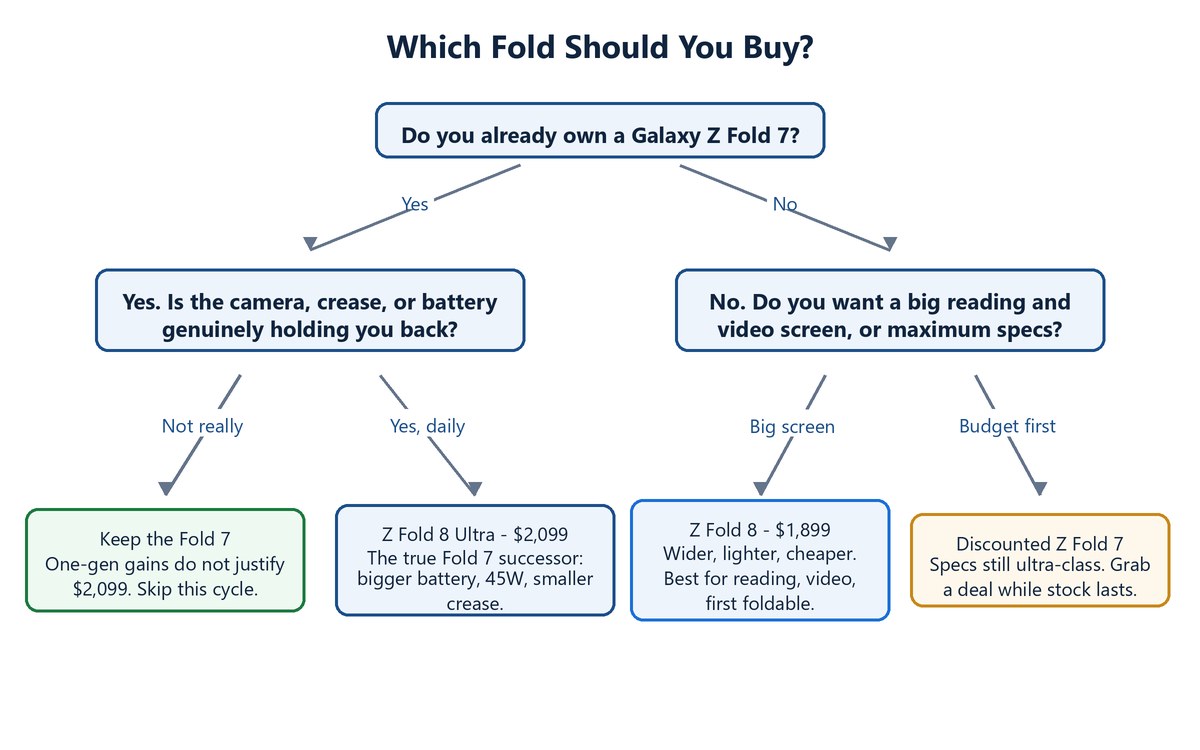
Our verdict: most Z Fold 7 owners should not upgrade this year — and the ones who should, should skip the phone with “Fold 8” on the box and go straight to the Ultra.
Here’s the reasoning, compressed. The base Fold 8 is disqualified for most Fold 7 owners on camera hardware alone: you’d pay $1,899 to lose the telephoto and the 200 MP sensor while gaining a shape you didn’t choose last time. That leaves the Ultra as the only true upgrade path, and its gains — 600 mAh of battery, 45W charging, a smaller crease, a faster chip, a better ultra-wide — are the definition of a strong “tock” year. Meaningful, real, and entirely survivable to skip.
The tell is in Samsung’s own launch framing. The company didn’t spend today arguing the Ultra transforms the Fold 7 experience. It spent today arguing that foldables now come in two shapes for two audiences. That’s a lineup-expansion pitch aimed at new buyers, not an upgrade pitch aimed at you. When the maker of your phone isn’t pushing hard on the upgrade case, believe them.
There’s one honest exception: if your Fold 7’s battery genuinely fails your day — you’re a heavy inner-screen user hitting 15% by dinner — the Ultra fixes your single biggest daily pain with the largest battery jump in Fold history plus charging that refills two-thirds of it over lunch. Pair that with a strong launch-window trade-in on a mint Fold 7 and the math can work. For everyone else, the Fold 9 generation, likely facing its first foldable iPhone competition, is the smarter target.
Four Signs You Should Skip This Upgrade Cycle
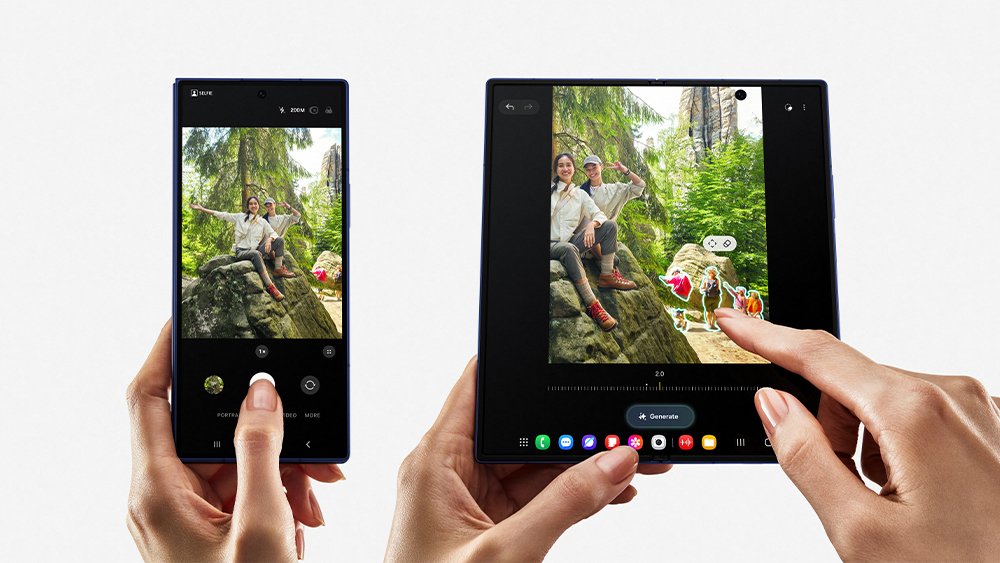
The decision tree above compresses this whole guide, but these four profiles account for most Fold 7 owners we’d flatly tell to keep their phone.
1 You Bought Your Z Fold 7 Within the Last Year
The Fold 7 went on sale July 25, 2025 — not quite a year ago. If you bought at launch, you own a phone with 6 remaining years of updates, a top-three mobile chip, and the same 8-inch display size as the new $2,099 Ultra. Depreciation on foldables front-loads brutally, so trading now means eating the steepest part of your Fold 7’s value curve to buy the shallowest part of the Ultra’s improvement curve.
Wait one more cycle. Every rumor points to the real fight — thinner bodies, bigger batteries, and Apple’s entry — landing next year, and your trade-in leverage will survive the wait better than you’d think.
2 You Zoom More Than You Crop
Base Fold 8 shoppers specifically: if the 3x button is part of your muscle memory, this phone removes it. There’s no configuration, case, or software update that adds a telephoto lens later. The only way to keep optical zoom in this lineup is the Ultra, and if the Ultra is out of budget, your Fold 7 remains the better camera phone. Full stop.
Samsung’s 2x “optical-quality” crop is respectable for portraits. It is not a zoom lens, and beyond 2x it falls off a cliff your current phone doesn’t have.
3 You Were Hoping This Was the S Pen Comeback Year
It isn’t, on either model. If pen input is your line in the sand, nothing announced today moves you, and the direction of travel — two straight generations without a digitizer — suggests the Fold has permanently left Note territory. Keep the Fold 7, or if you truly work by stylus, watch the Ultra tablet line instead.
Holding out also costs you nothing here, because this is the rare upgrade cycle where your current phone’s feature set is a superset of the cheaper new model’s. You lose no software features by waiting; One UI 9 comes to the Fold 7 as an update.
4 Your Battery Still Finishes the Day
Be honest about your actual battery graph, not your worst travel day. If your Fold 7 lands at 20-30% most nights, the Ultra’s extra 600 mAh buys you comfort, not capability. Comfort is a want, and a $2,099 want at that — minus whatever trade-in softens it.
New Buyers Face a Different Choice Entirely
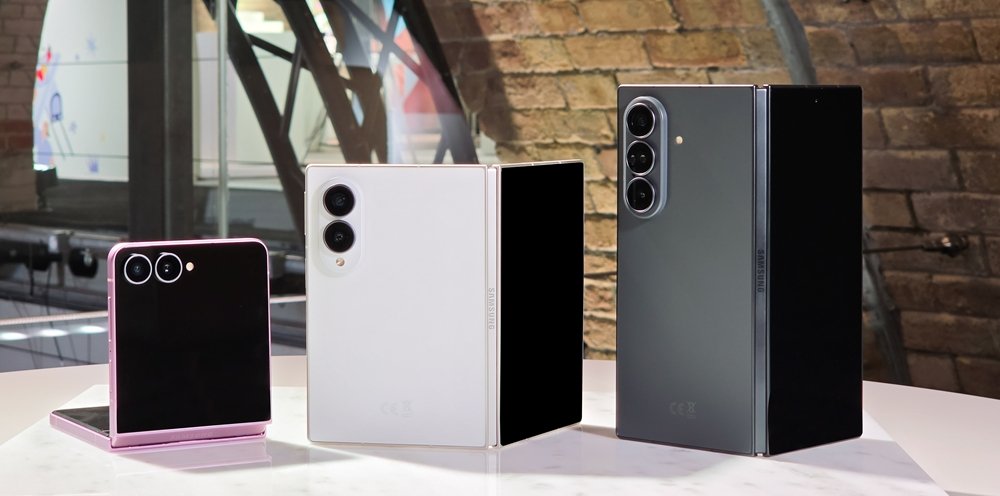
If you don’t own a foldable yet, ignore everything above about losses — you can’t lose what you never had. Your decision is a three-way price ladder, and it’s the friendliest foldable buying moment Samsung has ever offered.
The Galaxy Z Fold 8 at $1,899 is the pick for most first-timers. It launches $100 under the Fold 7’s debut price, as 9to5Google confirmed, it’s the lightest ever at 201 grams, and its wide shape is built for exactly what pulls normal people toward foldables: reading, video, and a big screen for the couch. Its dual 50 MP cameras are honest flagship-grade for everything except long zoom. The full experience — Flex Titanium crease, 3,000-nit screens, One UI 9’s Gemini automations — is intact at the lower price.
Step up to the Z Fold 8 Ultra at $2,099 only if you can name the reason: you want the 200 MP camera and 3x telephoto, the 8-inch workspace for real multitasking, or the 5,000 mAh battery for heavy travel days. Those are excellent reasons; they’re just specific ones. The $200 gap is Samsung’s cleanest product segmentation yet — pay for the ceiling only if you’ll touch it.
And the dark-horse option: a discounted Galaxy Z Fold 7. It launched at $1,999 a year ago, and outgoing-generation foldables get cut hard once successors ship. A Fold 7 undercutting the Fold 8’s price is a spec bargain — 200 MP main camera, telephoto, 8-inch screen, years of updates — as long as you accept 25W charging and the bigger crease. Check street prices before you preorder anything; exact discounts vary by retailer and week, so we won’t pretend to quote one.
Release Date, Price, and Preorder Details Confirmed Today
Everything in this section is confirmed launch-day information, not rumor. Preorders for the whole lineup opened today, July 22, 2026, and general availability starts August 7, 2026 through Samsung.com, carriers, and major retailers, per SamMobile’s pricing confirmation and the Engadget liveblog from the event.
Galaxy Z Fold 8 pricing runs $1,899 for 12 GB/256 GB, $2,099 for 12 GB/512 GB, and $2,499 for 16 GB/1 TB. The Z Fold 8 Ultra starts at $2,099 for 12 GB/256 GB, with the 512 GB tier confirmed on Samsung’s official US buy page at $2,299.99 and the 16 GB/1 TB tier at $2,699.99. Colors: Graphite and Cream across both, Lavender and online-only Pistachio on the Fold 8, Violet Shadow and online-only Green Shadow on the Ultra.
One buying nuance worth knowing: that $2,099 price point buys either a 512 GB base Fold 8 or a 256 GB Ultra. That’s the whole comparison in one line — the same money buys storage and the new shape, or camera and battery ceiling in the classic shape. The gap only gets sharper if you actually want Ultra-level storage: a 512 GB Ultra runs $2,299.99, a full $200 more than a 512 GB Fold 8 for the same capacity. Samsung also throws in 6 months of Google AI Pro (with 5 TB of cloud storage) on all models, and bundles 3 free months of Samsung Care+ on Samsung.com foldable purchases.
Frequently Asked Questions
When is the Galaxy Z Fold 8 release date?
The Galaxy Z Fold 8 and Z Fold 8 Ultra were announced at Galaxy Unpacked on July 22, 2026, with preorders open the same day. Both phones ship and reach stores on August 7, 2026 in Samsung’s launch markets, sold through Samsung.com, carriers, and major retailers.
How much does the Galaxy Z Fold 8 cost?
The Galaxy Z Fold 8 starts at $1,899 for 12 GB of RAM and 256 GB of storage. The 512 GB model costs $2,099 and the 1 TB model with 16 GB of RAM costs $2,499. That starting price is $100 lower than the Z Fold 7’s launch price of $1,999 in 2025.
What is the difference between the Galaxy Z Fold 8 and the Z Fold 8 Ultra?
Shape and ceiling. The Fold 8 is shorter, wider, and lighter with a 7.6-inch 4:3 inner screen and dual 50 MP cameras for $1,899. The Ultra keeps the classic tall shape with an 8-inch screen, adds a 200 MP main camera, a 3x telephoto, and a 5,000 mAh battery, and starts at $2,099. Chip, software, and durability tech are the same on both.
Is the Galaxy Z Fold 8 bigger than the Z Fold 7?
No — it’s a different shape, and slightly smaller on the inside. The Fold 8’s inner display is 7.6 inches versus 8.0 inches on the Fold 7, and folded it’s much shorter but wider and a little thicker. The Fold 8 is lighter, though: 201 grams against the Fold 7’s 215 grams.
Does the Galaxy Z Fold 8 support the S Pen?
No. Neither the Galaxy Z Fold 8 nor the Z Fold 8 Ultra supports the S Pen, and Samsung’s official spec sheets list no stylus input for either phone. Samsung removed the digitizer layer starting with the Z Fold 7 to make the phones thinner and lighter, and it has not returned this generation.
Should I buy a discounted Z Fold 7 instead of the Fold 8?
If you want maximum specs per dollar, yes — a discounted Fold 7 still offers a 200 MP main camera, a 3x telephoto, and an 8-inch display, hardware the $1,899 Fold 8 doesn’t match. Choose the Fold 8 instead if you want the lighter wide-body design, the smaller crease, faster 45W-class charging, and the longest update runway.
Does the Galaxy Z Fold 8 have a telephoto camera?
No. The base Galaxy Z Fold 8 has two rear cameras — a 50 MP main and a 50 MP ultra-wide — plus a 2x “optical-quality” zoom that crops from the main sensor. The only phone in the lineup with a true telephoto lens is the Z Fold 8 Ultra, which carries a 10 MP 3x optical zoom camera.
About the Author
Elena Brooks
Elena Brooks is the person her group chat texts when something at home stops working or a health trend starts trending. She’s spent years turning that instinct into a job — digging into the research behind everyday questions, calling the experts, and writing up what holds up and what doesn’t. Her beat is wherever curiosity points: kitchens, cars, pets, sleep, money, and the occasional meteor shower.