

- TrueNAS 26 “Halfmoon” is at BETA.2, dated 17 June 2026. There is no announced GA date.
- The REST API is not deprecated in 26 — it is removed. Your automation moves to JSON-RPC 2.0 over WebSocket or it stops working.
- Installing 26 is reversible. Upgrading the pool is not: new feature flags close the door back to 25.10.
- Full LXC support with Enterprise HA failover is the first stable landing zone for CORE users still running jails.
- Kernel jumps from the 6.12 LTS line to 6.18 LTS, and OpenZFS lands at 2.4.1 in both betas.
- The move to an annual cadence with 26.x point releases is the structural story, not the feature list.
Start with the part the feature announcements bury. As of August 2026, TrueNAS 26 “Halfmoon” has shipped exactly two builds — BETA.1 on 7 April and BETA.2 on 17 June — and iXsystems has announced no GA date at all. Everything below is therefore a question about a pre-release, which is the answer to “should I upgrade” before any feature enters the conversation.
What makes the release interesting anyway is not the feature list. It is a deliberate trade: iXsystems gave up release frequency for an annual cadence with point releases, betting one carefully-baked major per year beats two rushed ones. That bet either buys stability or concentrates a year of risk into a single event. Halfmoon is where we find out which.
TrueNAS 26 Halfmoon Is Still at Beta.2, and That Is the Whole Answer
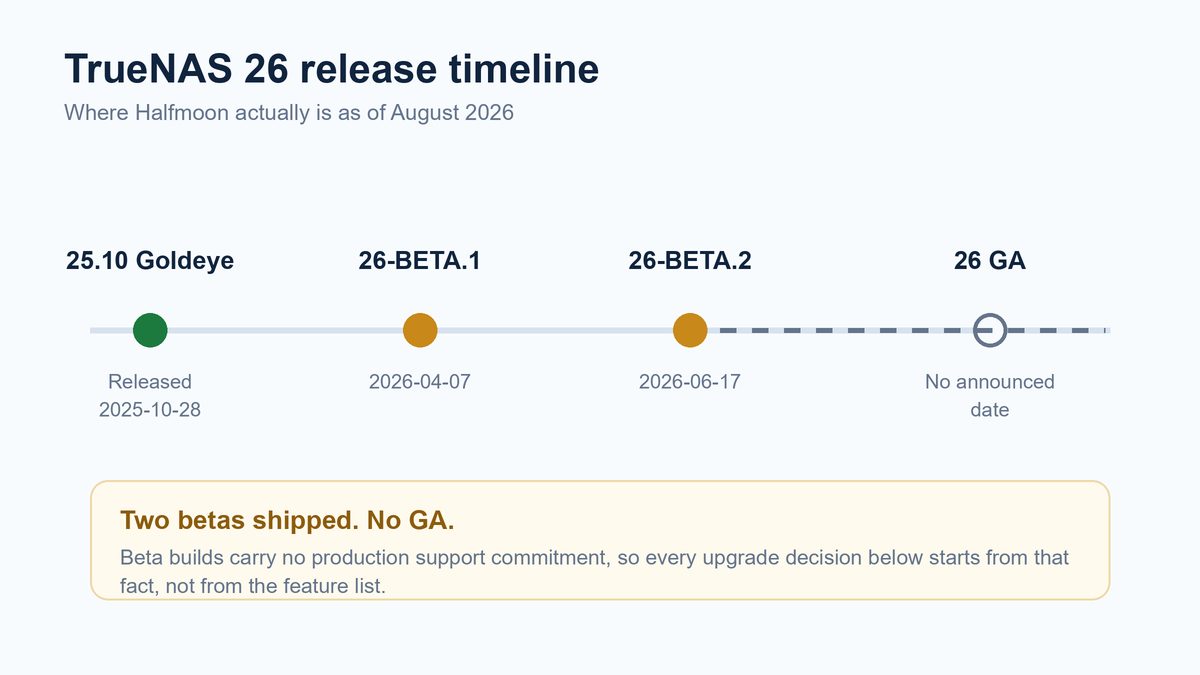
Two betas exist. BETA.1 arrived 7 April 2026 on kernel 6.18.13; BETA.2 followed on 17 June 2026 on kernel 6.18.23. Both carry OpenZFS 2.4.1. Between them the kernel moved ten patch versions inside the same LTS line — the shape of a release still absorbing fixes, not one settling down.
A beta designation is a support statement, not a quality guess. iXsystems has not committed to standing behind this code on your production array, so any Enterprise support conversation about a failure on 26 starts from a worse place than the same conversation about 25.10. The predecessor, TrueNAS 25.10 “Goldeye,” has been generally available since 28 October 2025 with maintenance releases landing on it ever since. Nine months of field hardening against two beta drops is the actual comparison, and no feature in Halfmoon closes it.
So the upgrade question splits cleanly in two. On a lab box or a spare pool you can reinstall without a change ticket, running Halfmoon now is useful and cheap. On anything holding data you would miss, the answer is not “no forever” — it is “not until there is a GA build with at least one point release behind it.”
Five Ways TrueNAS 26 Pulls Ahead of 25.10 Goldeye
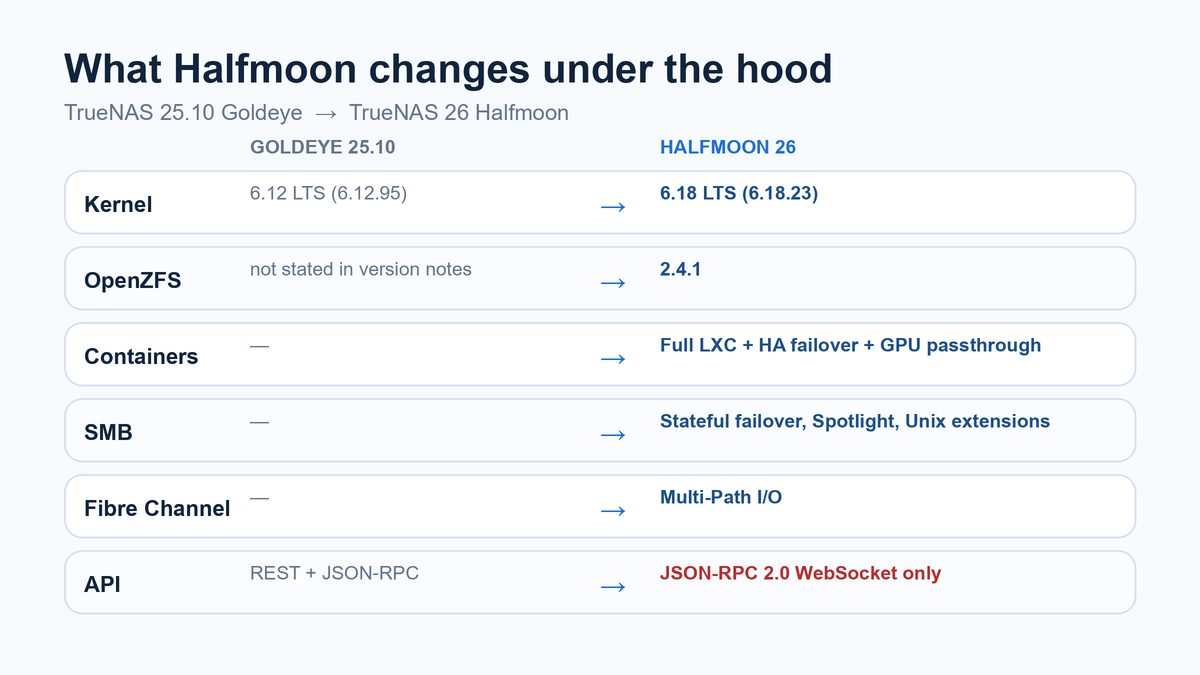
The feature set is substantial, and most of it targets the two things Goldeye left half-finished: containers and multiprotocol file serving. Here is what actually moves.
1 Kernel 6.18 LTS Replaces the 6.12 Line
Goldeye runs the 6.12 LTS kernel, reaching 6.12.95 by its 25.10.5 maintenance release. Halfmoon jumps to 6.18 LTS, at 6.18.23 in BETA.2. On a storage appliance that is mostly hardware enablement — newer NICs, newer NVMe controllers, newer GPUs recognised without out-of-tree drivers.
It is also the single biggest source of beta risk. A jump of that size touches every driver in the stack, and driver regressions are exactly the class of bug a two-hour smoke test misses. If your array runs anything unusual — an older HBA, a niche 25GbE card, a passthrough GPU — that is what to test first and what is most likely to bite.
2 What OpenZFS 2.4.1 Actually Changes for Your Pool
Both betas ship OpenZFS 2.4.1. TrueNAS describes the integration as adding hybrid pool support for combining flash and HDD storage, physical block rewriting, and dynamic gang header improvements.
Two upstream additions matter more day to day. The new zfs rewrite command gives you a supported way to rewrite existing blocks in place — the missing piece for anyone who expanded a RAIDZ vdev and wants old data sitting on the new parity ratio. And a vdev can now sit out a child device that has gone abnormally slow, so one dying disk stops dragging the whole vdev’s latency behind it (OpenZFS 2.4.0 release notes).
Neither is a headline number, and that is the point. These are the changes you notice six months in, when the thing that used to page you at 3am quietly stopped.
3 Full LXC Containers With Enterprise HA Failover
Container support in 26 is no longer partial. LXC is fully supported, participates in Enterprise HA failover, and takes GPU passthrough for NVIDIA and other supported GPUs. Goldeye already brought the NVIDIA open GPU kernel modules for Turing and newer; 26 makes them useful inside a container, not only inside a VM.
The HA detail is worth pausing on. A container that fails over with the pool is infrastructure; one you restart by hand on the surviving head is a pet. For an Enterprise HA pair, that is the difference between putting real services on the array and keeping them on separate hosts.
4 SMB Gains Stateful Failover and Spotlight Search
Three SMB changes ship together: stateful failover across an HA failover event, Spotlight search for macOS clients, and SMB3 Unix extensions for multiprotocol shares. Stateful failover is the meaningful one — the difference between a Windows client noticing a controller failover and not noticing.
Spotlight and the Unix extensions are narrower but land hard where they land. Post-production shops running Mac clients have gone years without working Spotlight; anyone serving one dataset over both SMB and NFS has lived with permission and symlink mismatches. Neither is a headline; both remove a long-running annoyance.
5 Fibre Channel Multi-Path I/O and Full-Text WebShare Search
26 adds Multi-Path I/O (MPIO — redundant paths between host and storage) for Fibre Channel, closing a gap that mattered to exactly the customers running FC. It sits alongside what Goldeye delivered on the block side: NVMe-oF over TCP for Community and RDMA for Enterprise, up to 400GbE. If that lane is new to you, our sister site’s primer on NVMe and NVMe-oF covers why the transport matters more than the media.
Also new: WebShare with TrueSearch full-text indexing, reboot-reason tracking, and FEC (forward error correction) as a configurable NIC setting. Reboot-reason tracking is the sleeper — knowing whether a head went down from a panic, a watchdog, or a human is the difference between a root cause and a shrug.
TrueNAS 26 Versus 25.10 Goldeye, Line by Line
| TrueNAS 25.10 “Goldeye” | TrueNAS 26 “Halfmoon” | |
|---|---|---|
| Status | Released 2025-10-28 | BETA.2, 2026-06-17 — no GA as of August 2026 |
| Kernel | 6.12 LTS (6.12.95 by 25.10.5) | 6.18 LTS (6.18.23 in BETA.2) |
| OpenZFS | Not stated in the version notes | 2.4.1 |
| Containers | — | Full LXC, Enterprise HA failover, GPU passthrough |
| SMB | — | Stateful failover across HA, Spotlight, SMB3 Unix extensions |
| Storage networking | NVMe-oF: TCP (Community), RDMA (Enterprise), 400GbE | Multi-Path I/O for Fibre Channel |
| Virtualisation | VM Secure Boot, disk import/export (QCOW2, RAW, VDI, VHDX, VMDK), Enterprise HA failover | Container GPU passthrough |
| File access | Update profiles | WebShare with TrueSearch full-text indexing |
| API | REST and JSON-RPC | REST removed — JSON-RPC 2.0 WebSocket only |
| Cadence | Roughly twice yearly | Annual, with 26.x point releases |
The blank OpenZFS cell is deliberate: the 25.10 version notes do not state a version, and inventing one to fill the table is how a guess quietly becomes the internet’s answer.
The REST API Is Gone, and Your Automation Will Break
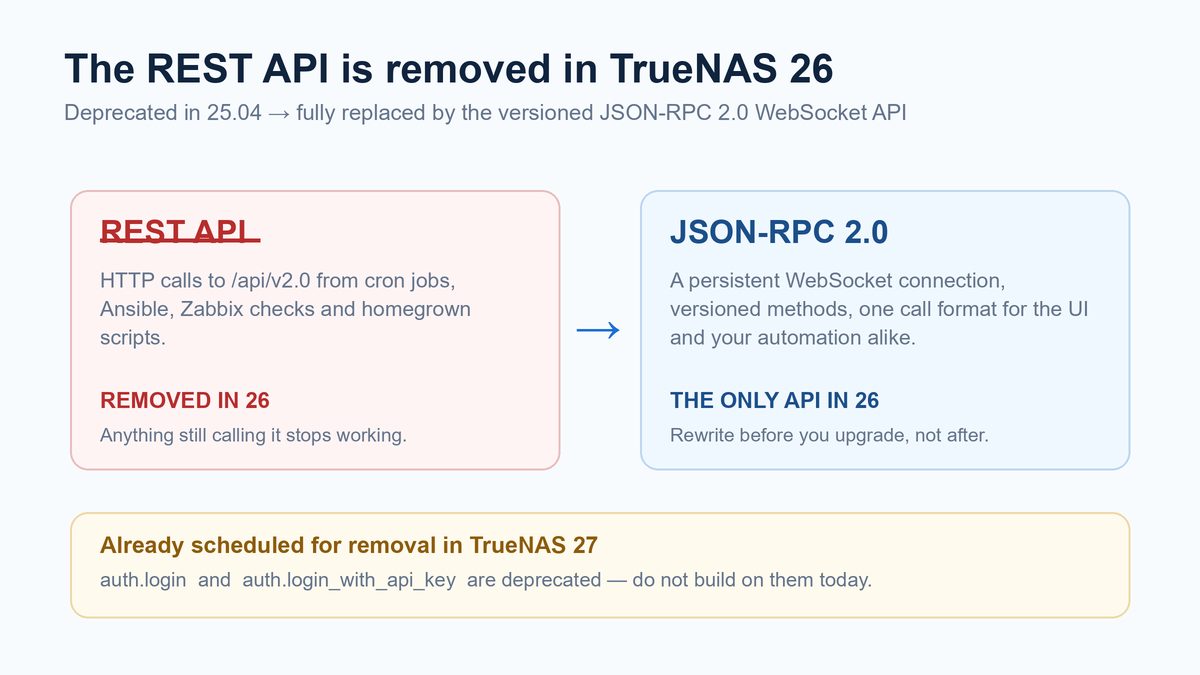
Here is the change nobody leads with. The TrueNAS 26 version notes state that the REST API — deprecated back in 25.04 — is removed in 26 and fully replaced by the versioned JSON-RPC 2.0 WebSocket API. Not soft-deprecated. Not behind a flag. Removed.
If you have ever pointed a cron job, an Ansible task, a monitoring check, or a five-line shell script at /api/v2.0, that code stops working the moment the system boots 26 — and it will not fail loudly, because the upgrade never scans your scripts. It fails later, quietly, in whatever prunes your snapshots or exports your capacity metrics.
Step One. Inventory Every Script That Calls the REST Endpoint
Before touching a build, grep your automation estate for /api/v2.0 and any HTTP client pointed at the array — including the places you forgot: a Zabbix or Checkmk template, a Rundeck job, a Grafana datasource, a colleague’s laptop script that has emailed weekly pool reports since 2023.
Do this on 25.10, while REST still answers. An inventory taken against a live API is a list of things you can test; one taken after the upgrade is a list of things already broken.
Step Two. Rewrite Against the JSON-RPC 2.0 WebSocket API
JSON-RPC over a persistent WebSocket is a different shape from stateless HTTP calls: you open a connection, authenticate once, then issue versioned method calls over it. Anything that fires a one-shot HTTP request per check needs restructuring, not just a URL swap.
The upside is that this is the same API the web UI drives, so method coverage is complete and behaviour matches the interface. Versioning also pins a method’s contract instead of letting it implicitly track the release — the guarantee the old REST surface never gave you.
Step Three. Stop Building on auth.login Before TrueNAS 27
Two methods are already marked deprecated for removal in TrueNAS 27: auth.login and auth.login_with_api_key. If you are rewriting automation in 2026, writing it against a method that has a published expiry date means doing this migration twice.
That deprecation is also a signal about the pace: iXsystems is not done reshaping the API surface. Treat automation written against 26 as something to review at each major release, not a set-and-forget asset.
Upgrading the Pool Is the One-Way Door, Not the Install
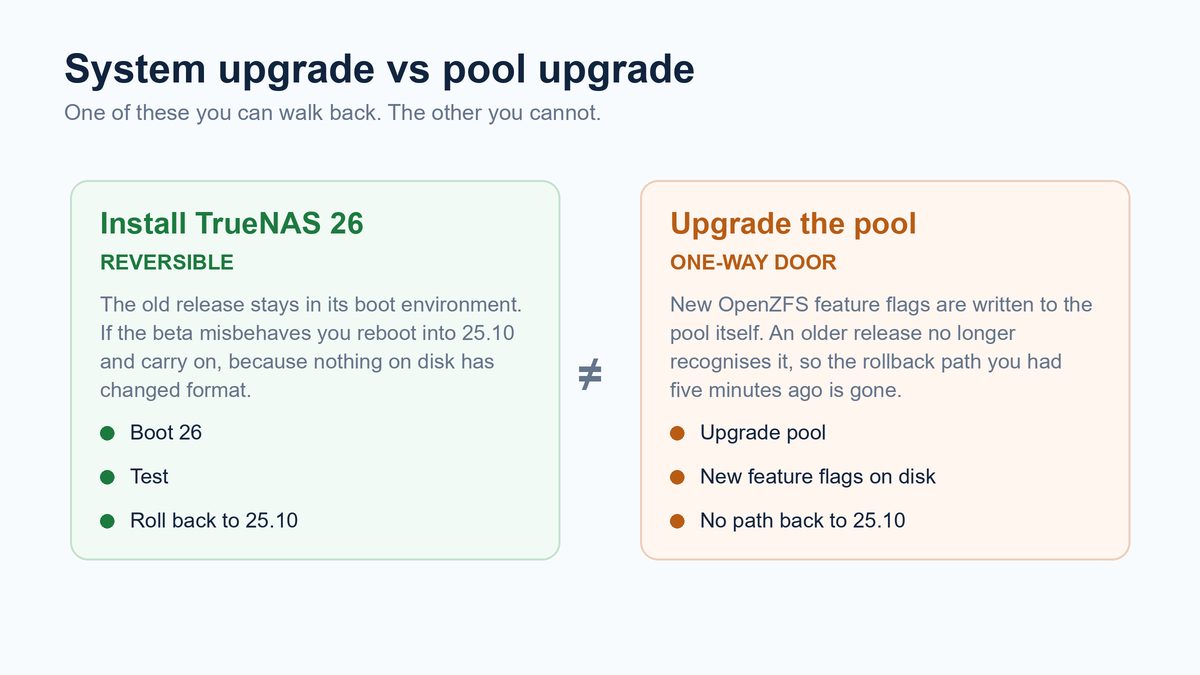
Before you touch a beta, understand that installing the release and upgrading the pool are two separate acts with very different consequences.
Installing 26 is reversible. The previous release stays in its boot environment, so if Halfmoon misbehaves you reboot into 25.10 and carry on — nothing on disk has changed format. That is what makes beta testing on real hardware survivable at all.
Upgrading the pool is not. That step writes new OpenZFS feature flags into the pool itself, and an older release no longer knows how to read what it finds; the rollback you had five minutes earlier is gone. The discipline is simple: run 26, use 26, benchmark 26 — and leave the pool version alone until 26 is a release you would have installed anyway.
Why CORE Holdouts Should Care About Full LXC Support
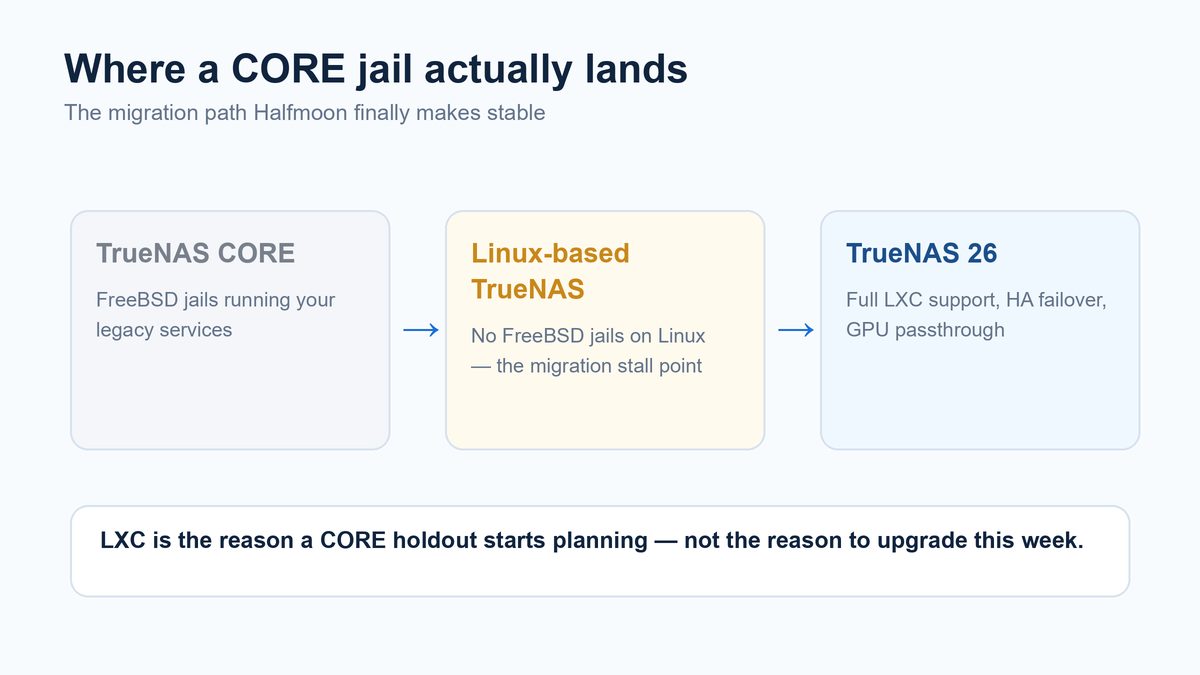
If you are still on TrueNAS CORE in 2026, it is almost certainly because of jails. FreeBSD jails held the services that made the array useful — a media server, a DNS resolver, a reverse proxy, some homegrown thing nobody has re-packaged — and the Linux-based line had no equivalent to move them into. So you stayed.
That is the gap 26 closes. Full LXC support, with Enterprise HA failover and GPU passthrough, is the first landing zone where a jail-shaped workload has a genuinely equivalent home: a persistent, lightweight Linux container you administer like a small machine rather than repackaging as an app. Nothing converts a jail for you — it is not a migration tool — but it is the first time the destination has been stable enough to plan against.
So LXC in 26 is the reason a CORE holdout should start planning the move — not the reason to run the beta this quarter. Build the container definitions on a test box, confirm your services behave under LXC, and be ready to execute when 26 goes GA. The planning has no downside; doing it on your production array during a beta does.
What the Annual Release Cadence Actually Buys You
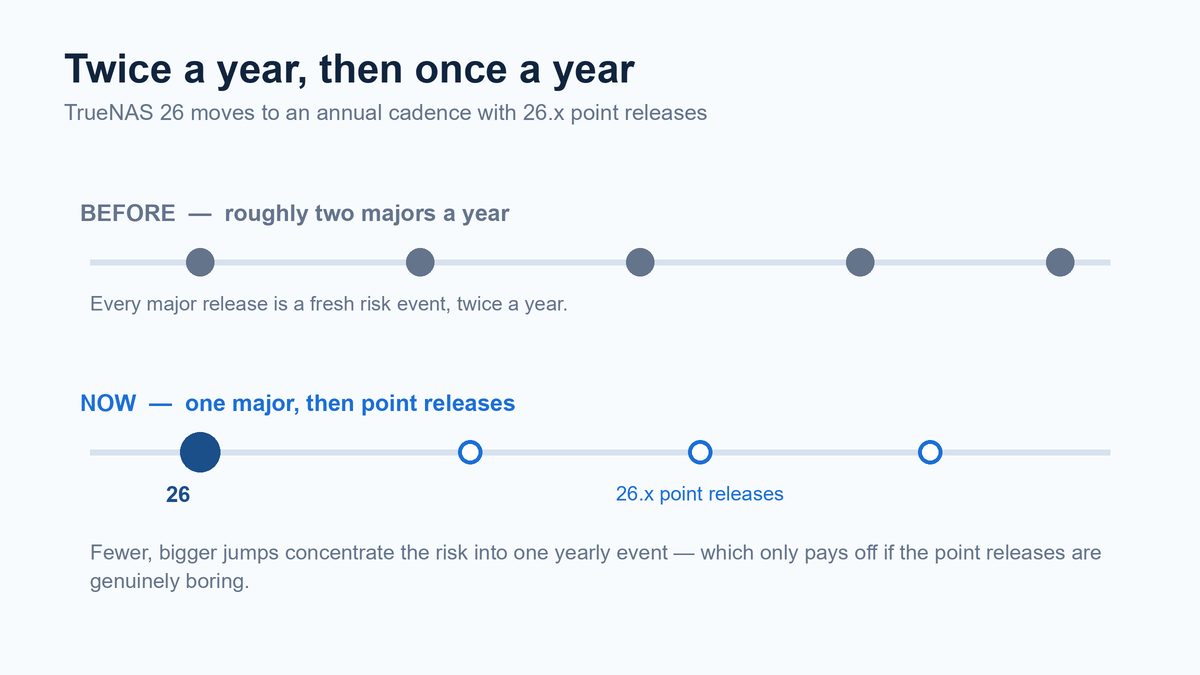
Here is the thesis. TrueNAS 26 moves to an annual cadence with 26.x point releases, down from roughly two majors a year. iXsystems traded release frequency for confidence, and that trade only pays off under one condition: the point releases have to be genuinely boring.
Slower majors are usually good for storage admins. Every major version is a risk event — a kernel jump, a ZFS jump, an API removal — and halving them per year halves the maintenance windows you spend proving nothing broke. Each release also gets more soak time before the next pulls attention away.
The counter-argument is concentration. At two releases a year, a rough one was survivable because a better one was six months out. On an annual cycle a rough major is your platform for twelve months, and the pressure to cram a year of work into one build is exactly what produces a rough major. That risk is not hypothetical for infrastructure vendors — the VMware licensing upheaval showed how fast one vendor decision resets a team’s roadmap.
Which way it lands is measurable: if the 26.x point releases arrive on time and fix things without adding features, the trade worked. If the first one carries new functionality, the cadence changed on paper only.
Who Should Install TrueNAS 26 Today, and Who Should Not
Install it if you run a lab, a test pool, or a second array whose data lives somewhere else too. The kernel jump and the API removal both want real-hardware testing, and the people who file good beta bugs are why the GA build ends up boring. Just do not upgrade the pool, and do not let the test box quietly become something people depend on.
Wait if the array holds production data, backs anything up, or is half of an Enterprise HA pair. There is no EOL pressure on 25.10 and no GA build to move to, so the whole cost of moving early is yours. If this array is a copy in your backup rule, it is not a beta candidate.
Frequently Asked Questions
Is TrueNAS 26 released yet?
No. As of August 2026 the newest build is 26-BETA.2, dated 17 June 2026, following 26-BETA.1 on 7 April 2026. iXsystems has announced no GA date, so any general-availability timeline you see is speculation, not a published commitment.
What is TrueNAS 26 called?
TrueNAS 26 carries the codename “Halfmoon.” Its predecessor, TrueNAS 25.10, is “Goldeye” and has been generally available since 28 October 2025.
Does TrueNAS 26 still have a REST API?
No. It was deprecated in TrueNAS 25.04 and is removed entirely in 26, fully replaced by the versioned JSON-RPC 2.0 WebSocket API. Any automation still making HTTP calls to the old endpoint stops working after the upgrade, so inventory and rewrite those scripts before you move.
Can I roll back if TrueNAS 26 goes badly?
Yes, as long as you have not upgraded the pool. The previous release stays in its boot environment, so you reboot back into 25.10 with the pool untouched. Once you upgrade the pool, new OpenZFS feature flags are written to disk and the older release can no longer import it — that is the point of no return.
What version of OpenZFS does TrueNAS 26 use?
Both 26-BETA.1 and 26-BETA.2 ship OpenZFS 2.4.1. The 25.10 version notes do not state an OpenZFS version, so a direct version-to-version comparison is not available from the official documentation.
When does TrueNAS 25.10 reach end of life?
No end-of-life date has been published for 25.10. That matters for planning: nothing forces a move to 26, so you can wait for a GA release plus at least one point release without falling off a support cliff.
About the Author
Elena Brooks
Elena Brooks is the person her group chat texts when something at home stops working or a health trend starts trending. She’s spent years turning that instinct into a job — digging into the research behind everyday questions, calling the experts, and writing up what holds up and what doesn’t. Her beat is wherever curiosity points: kitchens, cars, pets, sleep, money, and the occasional meteor shower.