
- The best cordless vacuum for pet hair is decided by four specs working together: suction power, an anti-tangle brush roll, battery runtime, and weight. Nail those and everything else is a bonus.
- Suction pulls embedded hair up out of carpet fibers; the anti-tangle brush roll stops long hair from wrapping the roller into a solid, useless donut. You need both, not just one.
- Battery is a trap. The long runtime on the box is the low-power setting. On the boost mode you actually need for ground-in hair, most cordless vacuums last only 5 to 12 minutes, so a swappable battery matters.
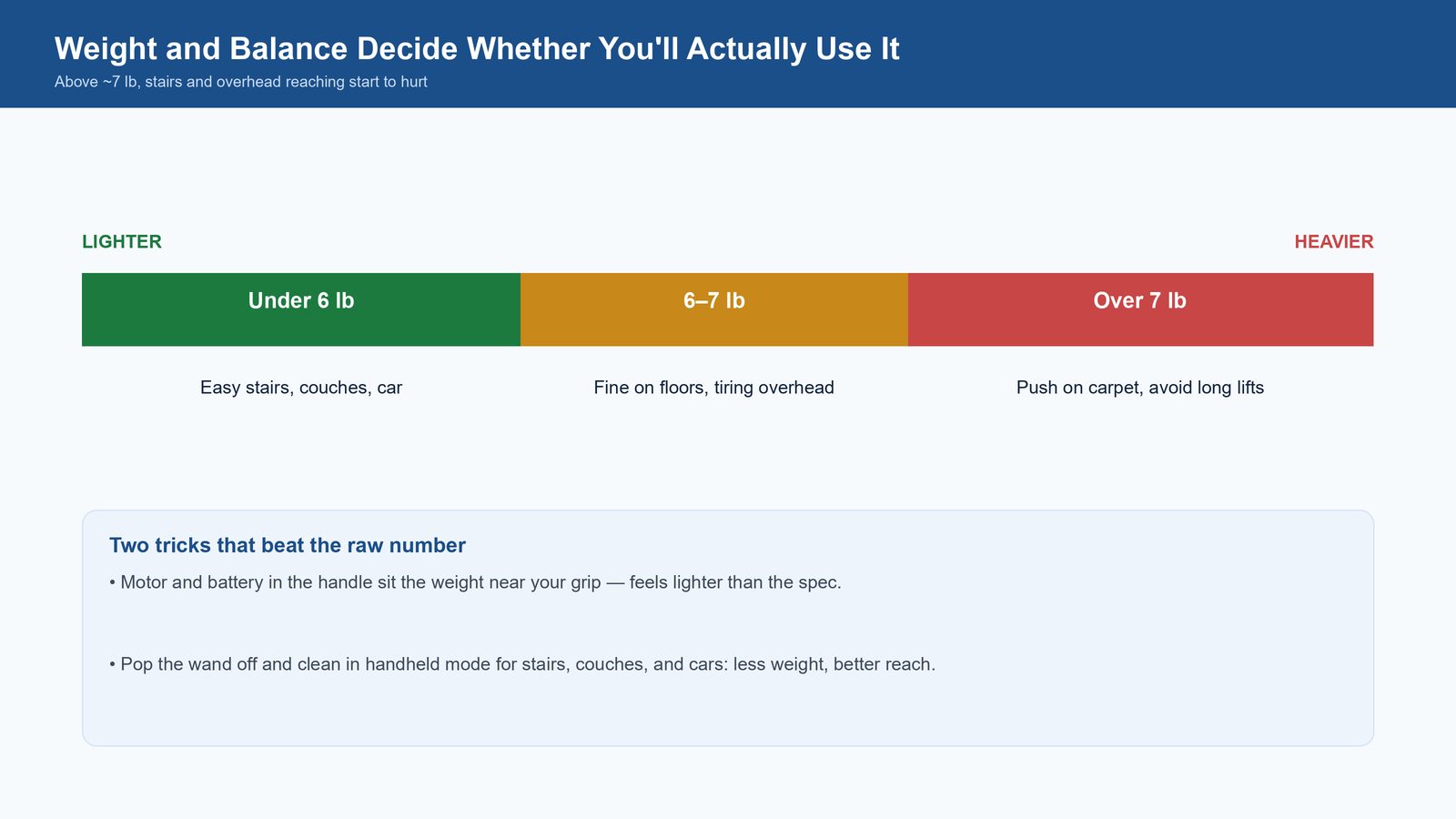
- Weight decides whether you’ll actually use it. Above roughly 7 pounds, cleaning stairs and reaching under furniture starts to hurt, and a vacuum you dread is a vacuum you skip.
- A cordless vacuum is the manual deep-clean partner to a robot, not a rival. The robot handles daily floors; the cordless handles the stairs, couches, and car seats a robot can never reach.
- Pick by need: whole-home shedders want a Dyson or a high-suction Shark; hardwood-and-quick-clean homes want a lighter Tineco or budget stick; tight budgets can still get real pet-hair pickup from a budget stick if the head is right.
Let’s be honest about what you’re really fighting. It isn’t dust. It’s the tuft of fur wedged deep in the couch cushion, the gray fuzz woven into the stair carpet, and the drift of hair on the car seat that a lint roller just laughs at. Your dog or cat sheds a little every single day, and it goes exactly where a big upright vacuum can’t follow.
That’s the job a cordless vacuum is built for. Grab it, point it at the mess, deep-clean the stairs and the sofa and the car, and set it back on the wall. No cord to drag, no heavy machine to haul upstairs. So the question isn’t really “should I get one.” It’s which one actually grabs the hair instead of pushing it around.
Here’s the thing almost every guide gets wrong: it tells you to buy the most expensive one and calls it a day. But the best cordless vacuum for pet hair for your home depends on four specs, and once you understand them, the choice mostly makes itself. This guide is built around those four numbers, then points each type of pet owner at the right pick.
What matters most in a cordless?
★ Your pick: Tineco Pure One S15
Near-flagship suction and smart dust sensing for hundreds less than a Dyson.
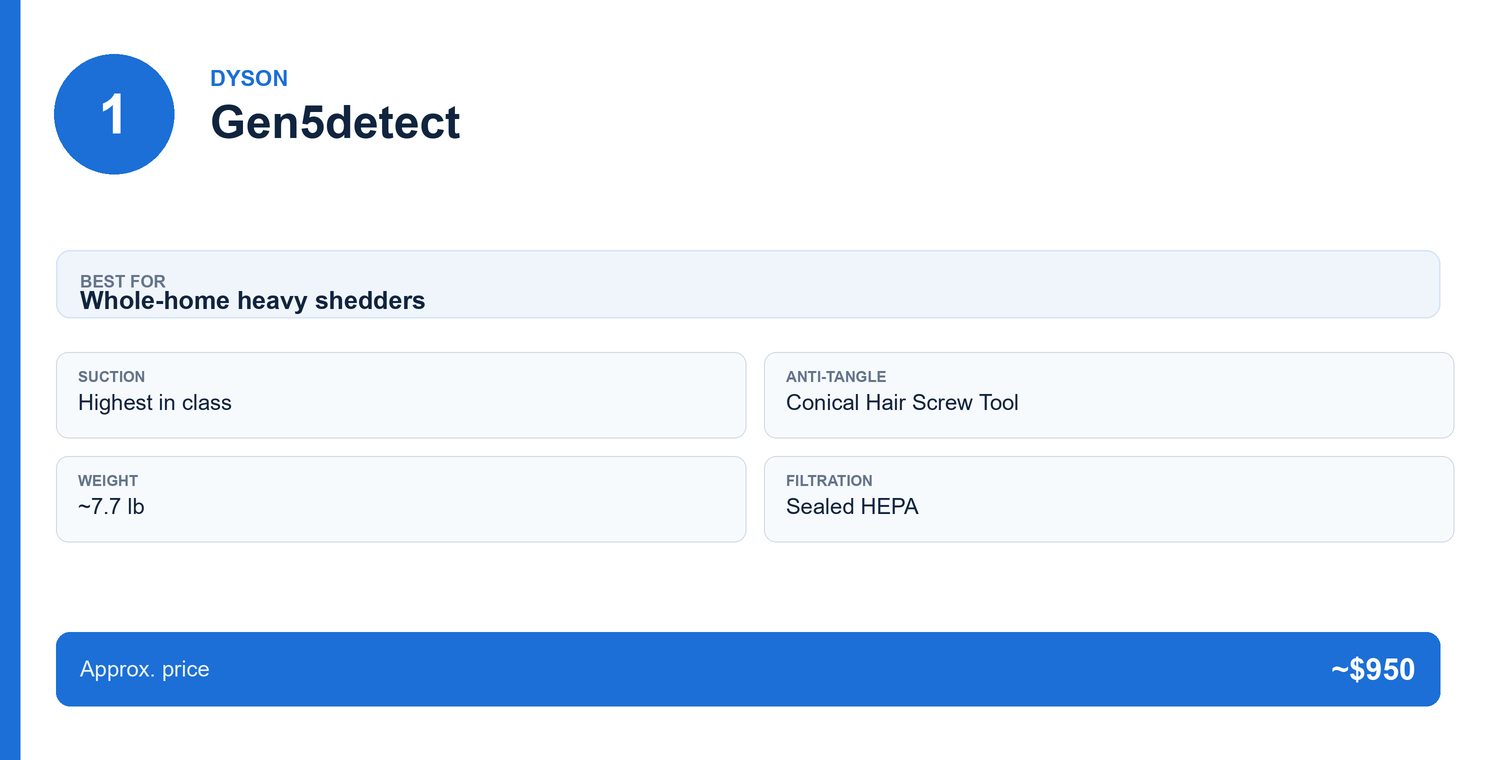
★ Your pick: Dyson Gen5detect
The highest published suction in the category, paired with a genuine conical anti-tangle tool and full HEPA filtration.
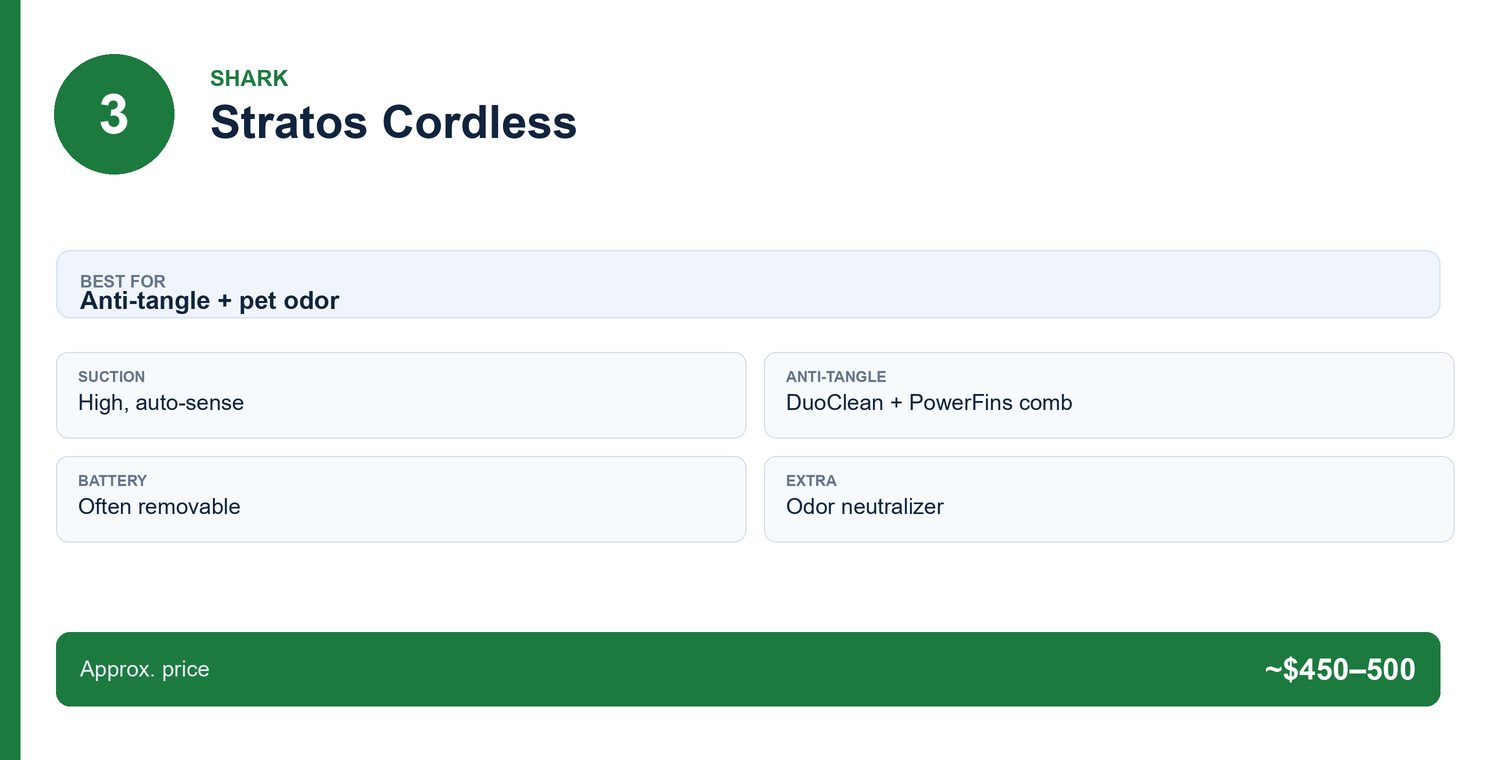
★ Your pick: Shark Stratos
DuoClean plus PowerFins tangle-fighting and an odor-neutralizing feature for hundreds less than the Dyson flagships.

★ Your pick: budget cordless stick
Real pet-hair pickup on a budget if you protect the anti-tangle head and the removable battery.
👑 Our Top Pick — Best Overall Value
Tineco Pure One S15
Near-flagship suction and smart dust sensing for hundreds less than a Dyson.
Opens on our Top Pick. Tap an option to see the best match for you.
Why a Cordless Vacuum Is the Pet-Hair Tool Your Robot Can’t Replace
If you already have a robot vacuum, you might wonder why you’d want a cordless one too. Fair question. The short answer: they do two completely different jobs, and pet owners need both.
A robot vacuum is a floor-maintenance machine. It hums around the open floor every day, sipping up the fresh hair before it piles into tumbleweeds. That’s genuinely useful, and if daily hands-off floor cleaning is what you’re after, a robot is the tool. We cover that side of the house in our guide to the best robot vacuum for pet hair.
But a robot lives on the floor. It cannot climb into your lap-height couch cushions, it cannot clean a staircase, and it will never do the back seat of your car. Pet hair doesn’t stay politely on the floor. It burrows into upholstery, clings to stair carpet, coats the cat tree, and rides around in the car. That vertical, hands-on, get-into-the-crevices work is exactly where a cordless stick vacuum shines.
Think of it like this. The robot is the roomba that keeps the field mowed. The cordless is the trimmer you pick up to do the edges, the slopes, and the tight corners by hand. One keeps up with the everyday; the other does the deep clean the everyday can’t reach.
The Four Specs That Actually Decide Pet-Hair Pickup
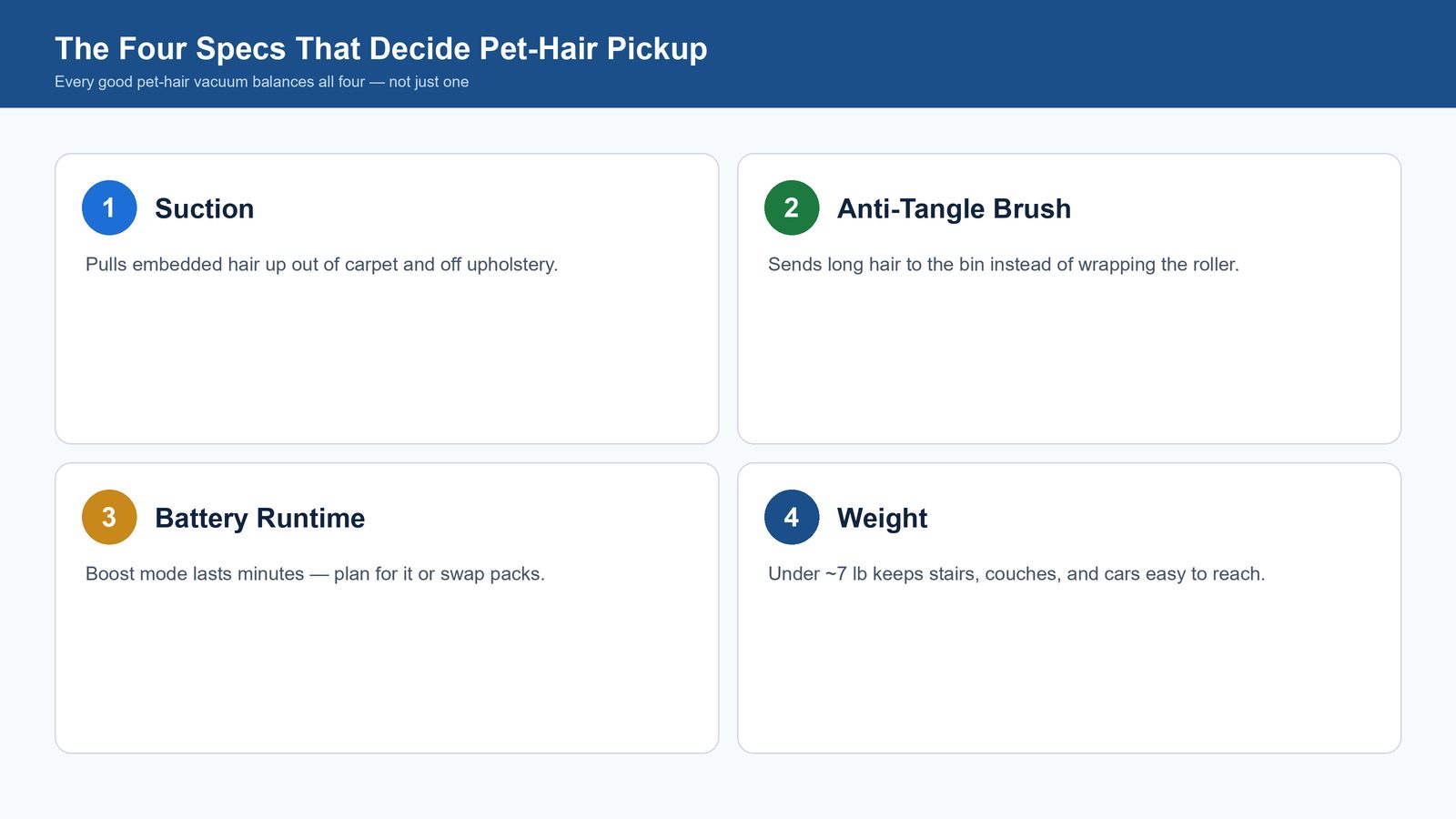
Before we name a single model, let’s name the four things that separate a vacuum that eats pet hair from one that smears it around. Every recommendation later in this guide is really just these four specs in different mixes.
The reason pet hair is hard isn’t that there’s a lot of it. It’s that hair is long, light, and sticky. It clings to fabric with static, it weaves itself between carpet fibers, and the moment it hits a spinning brush it tries to wrap around it. A vacuum beats pet hair by doing four things at once: pulling hard enough to lift embedded hair, spinning a brush that won’t tangle, running long enough to finish the job, and staying light enough that you actually carry it to the mess.
Here’s what each one does, and each gets its own section below because each one has a catch.
- Suction is the raw pulling power that yanks hair up out of deep carpet and off upholstery. Too little and the hair stays put.
- The anti-tangle brush roll is the spinning bar in the floor head. On pet-hair vacuums it’s specially shaped so long hair slides off into the bin instead of choking the roller.
- Battery runtime is how long it actually cleans on the power level you need, which is almost never the number on the box.
- Weight is how heavy it feels in your hand after two minutes of stairs and overhead reaching, which decides whether you keep using it.
How Suction Power Really Pulls Embedded Pet Hair Out of Carpet
Suction is the spec everyone thinks they understand and almost nobody measures the same way. Let’s fix that, because it’s the single biggest thing separating the best cordless vacuum for pet hair from a toy.
When your cat’s hair falls on a hard floor, almost any vacuum can grab it. The trouble starts on carpet and upholstery, where hair slips down between the fibers and grabs on with static. To pull it back out, the vacuum has to create a strong, sealed stream of air right at the floor. That pulling power is what the industry tries to describe with a spec called air watts, which measures how much cleaning power the airflow actually delivers, not just how loud the motor is.
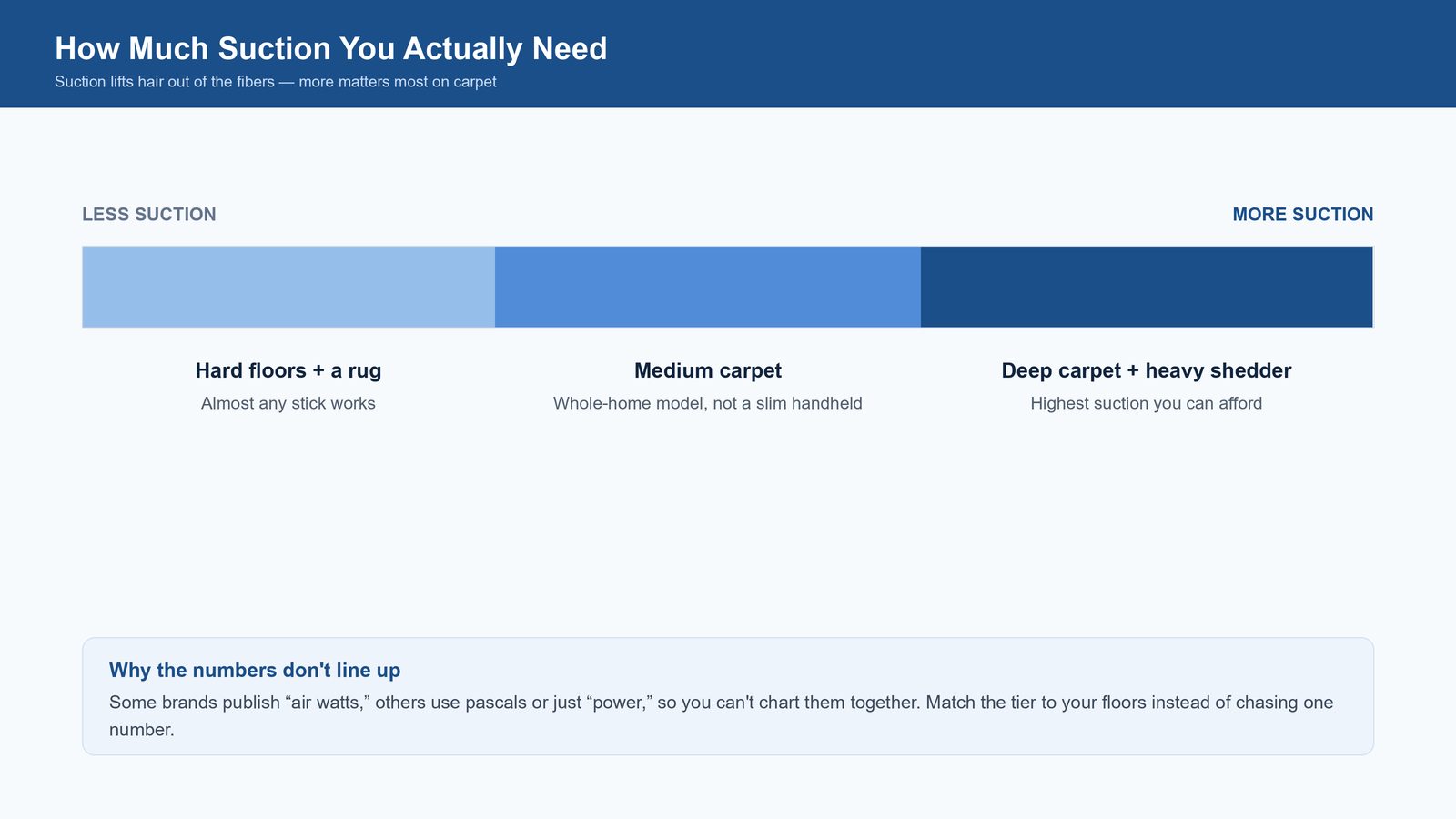
The honest problem: only some brands publish air watts, and others use their own words like “suction power” or a pressure number in pascals. You can’t line them up on one chart without comparing apples to oranges, and any guide that pretends you can is guessing. What you can do is understand roughly how much is enough.
How Much Suction You Actually Need
For a quick pass on hard floors, almost nothing is required. For lifting embedded pet hair out of a medium-pile carpet, you want a machine that’s clearly built for whole-home cleaning, not a slim handheld. Premium Dyson cordless models publish some of the highest air-watt figures in the category, which is a big part of why they’re the default answer for heavy shedders on carpet. Mid-range Sharks and Tinecos don’t always print an air-watt number, but the good ones back their suction with a smart floor head that presses the hair up toward the airflow.
The takeaway is simpler than the spec sheet. If your home is mostly hard floors with the odd rug, you do not need to pay for the maximum. If you have carpet and a heavy shedder, suction is the one place not to cut corners, because no clever brush design makes up for air that can’t lift the hair in the first place.
Why an Anti-Tangle Brush Roll Beats Raw Suction for Long Hair
If suction is the muscle, the brush roll is the part that decides whether you spend Sunday afternoon cutting hair off a roller with scissors. For long-haired pets especially, this is the feature that matters most, and it’s the one cheap vacuums skimp on.
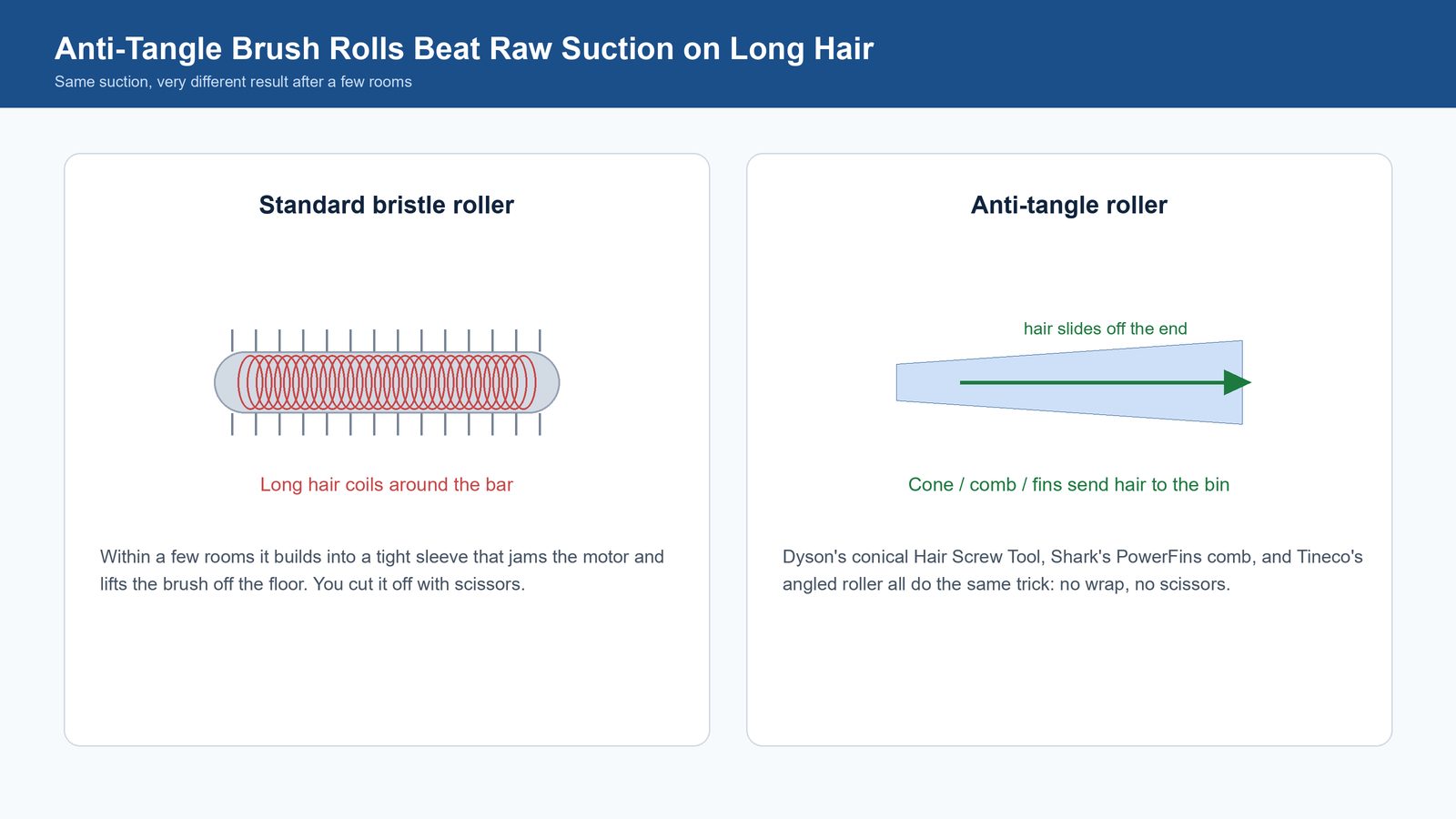
A traditional brush roll is a straight bar wrapped in stiff bristles. It spins fast and agitates the carpet to knock hair loose, which is great, right up until the hair it lifts wraps around the bar. Long dog and cat hair coils around a straight roller and, within a few rooms, builds into a tight gray sleeve that jams the motor and stops the brush from touching the floor at all. Then you’re picking at it with a seam ripper.
Anti-tangle brush rolls solve this with geometry. Instead of a straight bristle bar, they use a cone shape, a stiff comb built into the head, or angled fins that guide hair sideways off the end of the roller and straight into the bin, so it never gets a chance to wrap. Dyson calls its version a conical Hair Screw Tool; Shark builds a comb into its DuoClean and PowerFins heads; Tineco and others use their own angled designs. The name changes, the trick is the same: send the hair to the bin, not around the bar.
How to Spot a Real Anti-Tangle Head
Marketing loves the words “anti-tangle,” so read past them. Look for a physically different shape: a cone or tapered roller, a visible comb or hard fins across the head, or a brush split into two rollers. If the floor head just has one straight, fully-bristled bar like a vacuum from 2005, expect to clean hair off it by hand no matter what the box promises.
Battery Runtime and Why Max Mode Drains in Minutes
Here’s the spec that fools the most people. The box says “up to 60 minutes,” you picture cleaning the whole house on one charge, and then reality shows up.
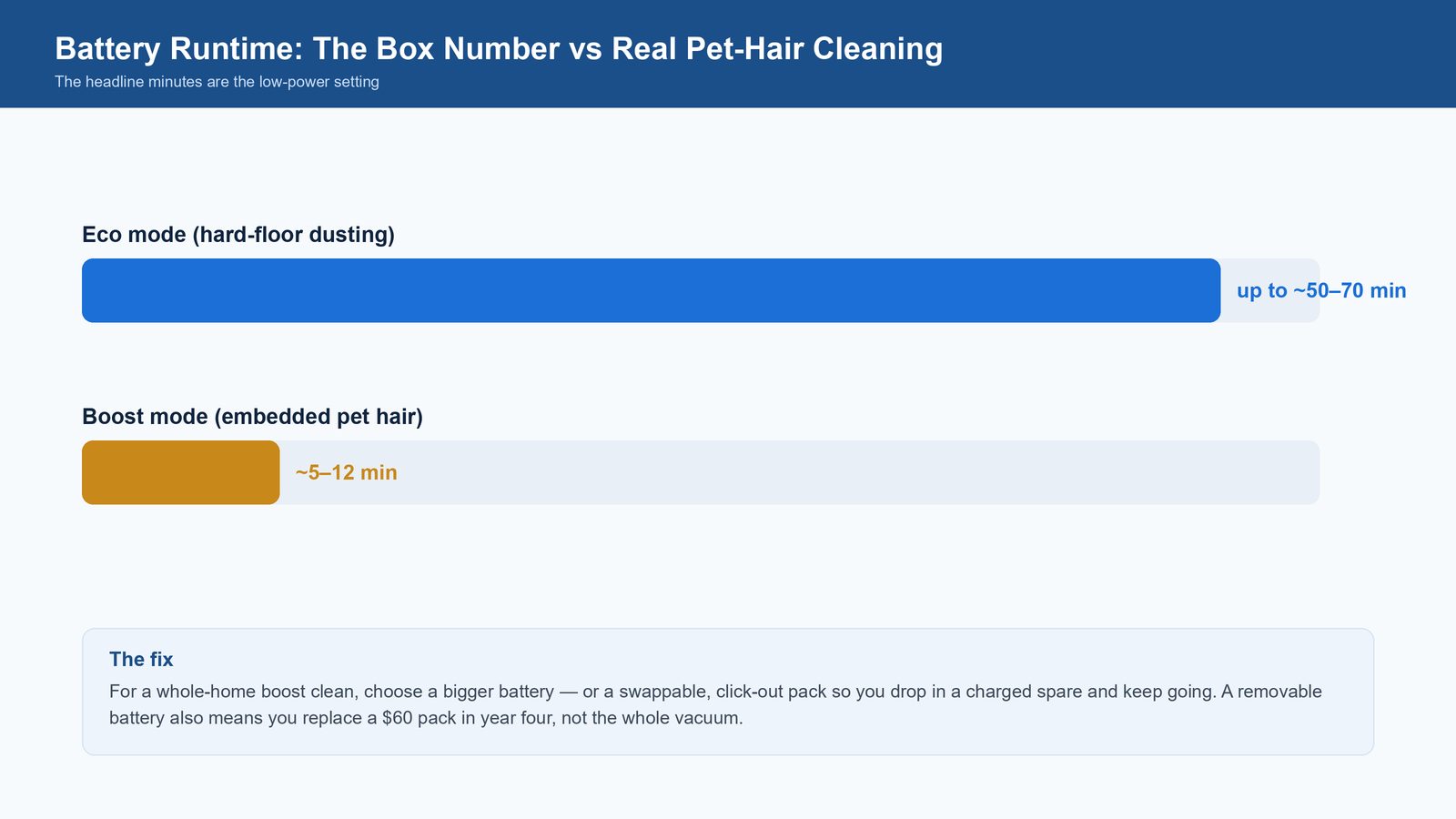
That headline runtime is measured on the lowest power setting, with no motorized brush running. It’s real, but it’s the number for dusting a hard floor, not for driving ground-in pet hair out of carpet. The moment you switch to the boost or “max” mode you actually need for embedded hair, the motor and brush pull far more current, and runtime collapses. On most cordless vacuums, boost mode lasts somewhere in the range of 5 to 12 minutes.
That’s not a scandal; it’s physics. A small battery can only hold so much energy, and high suction burns through it fast. What matters is how you plan around it. For a quick daily touch-up, even a short boost window is plenty. For a whole-home deep clean of a shedding household, you want one of two things: a big enough battery to finish the main areas on boost, or a battery that pops out so you can drop in a charged spare and keep going.
Why a Swappable Battery Changes the Math
A removable, click-out battery is quietly one of the most useful features on a pet-hair vacuum. It means the runtime problem is solved by buying a second battery instead of a whole second vacuum, and it means that in three years, when the original pack starts to fade, you replace a battery instead of throwing the machine away. Several Shark and Tineco cordless models use swappable packs; some Dyson models do and some don’t, so check the exact model.
Weight and Balance for Stairs, Couches, and Overhead Cleaning
The last spec is the one people ignore in the store and curse at home. A cordless vacuum only helps if you actually pick it up, and weight decides whether you do.
Most full-size cordless stick vacuums land somewhere around 5.5 to 8 pounds fully assembled. That doesn’t sound like much until you’re holding it out at arm’s length to do a staircase, or up over your head to get the top of a curtain, or twisted sideways to reach the back of the car. All of that puts the weight on your wrist and shoulder, and the difference between a 6-pound vacuum and an 8-pound one is enormous after the third stair.
Balance matters as much as raw weight. Stick vacuums with the motor and battery up in the handle feel lighter in the hand than the number suggests, because the weight sits near your grip instead of way out at the floor. Many cordless models also let you pop the long wand off and clean with just the handheld core, which is the setup you’ll use most for couches, stairs, and cars, and where a light, well-balanced body really pays off.
Match the Weight to Where You Clean
If your pet-hair battle is mostly stairs, upholstery, and the car, prioritize a light body and a comfortable handheld mode over maximum suction. If it’s mostly big carpeted floors, you can carry a little more weight because you’re pushing it along the ground, not holding it up. Be honest about which one you are before you pay for power you’ll find too heavy to lift.
The Best Cordless Vacuums for Pet Hair, Reviewed
Now the picks. Every one below is chosen through the same four-spec lens, matched to a specific kind of pet owner. Prices are rough US figures that move with sales, so treat them as tiers, not quotes, and check the live price before you buy.
| Vacuum | Best for | Suction | Anti-tangle head | Weight | Approx. price |
|---|---|---|---|---|---|
| Dyson Gen5detect | Whole-home heavy shedders | Highest in class | Conical Hair Screw Tool | ~7.7 lb | Flagship |
| Dyson V15 Detect | Carpet + seeing the hair | Very high | Conical Hair Screw Tool | ~6.8 lb | Premium |
| Shark Stratos Cordless | Anti-tangle + odor | High | DuoClean + PowerFins comb | ~7.5 lb | Upper mid |
| Shark PowerDetect Cordless | Mixed floors, set-and-forget | High, auto-adjusting | Anti-hair-wrap comb | ~8 lb | Upper mid, a step higher |
| Tineco Pure One S15 | Hardwood + carpet, lighter | Smart auto-adjust | Anti-tangle roller | ~6 lb | Mid range |
| Budget stick (INSE, Eufy, etc.) | Small spaces, tight budget | Modest | Basic, check the head | ~5 lb | Budget |
1 Dyson Gen5detect Is the Best All-Around Pet-Hair Cleaner
If you have a heavy shedder, a lot of carpet, and the budget, the Dyson Gen5detect is the safe answer. It sits at the top of Dyson’s cordless line and pairs the highest published suction in the category with a HEPA filtration system that traps fine allergens instead of blowing them back into the room. For homes where pet hair is a daily, whole-house reality, that combination is hard to beat.
Its anti-tangle credentials are genuine, not marketing. The conical Hair Screw Tool spirals long hair off the end of the roller straight into the bin, which is exactly the design long-haired-pet owners need. It also lights up dust on hard floors with a laser and shows a live particle count on a screen, which is more fun than useful but does confirm when a spot is actually clean.
The catch is the price and the weight. At flagship money and roughly 7.7 pounds, it’s a real investment and it’s not the one you’ll want for long overhead sessions. You’re paying for maximum suction and filtration, so it only makes sense if your home genuinely needs them.
2 Dyson V15 Detect Shows You the Hair You’re Missing
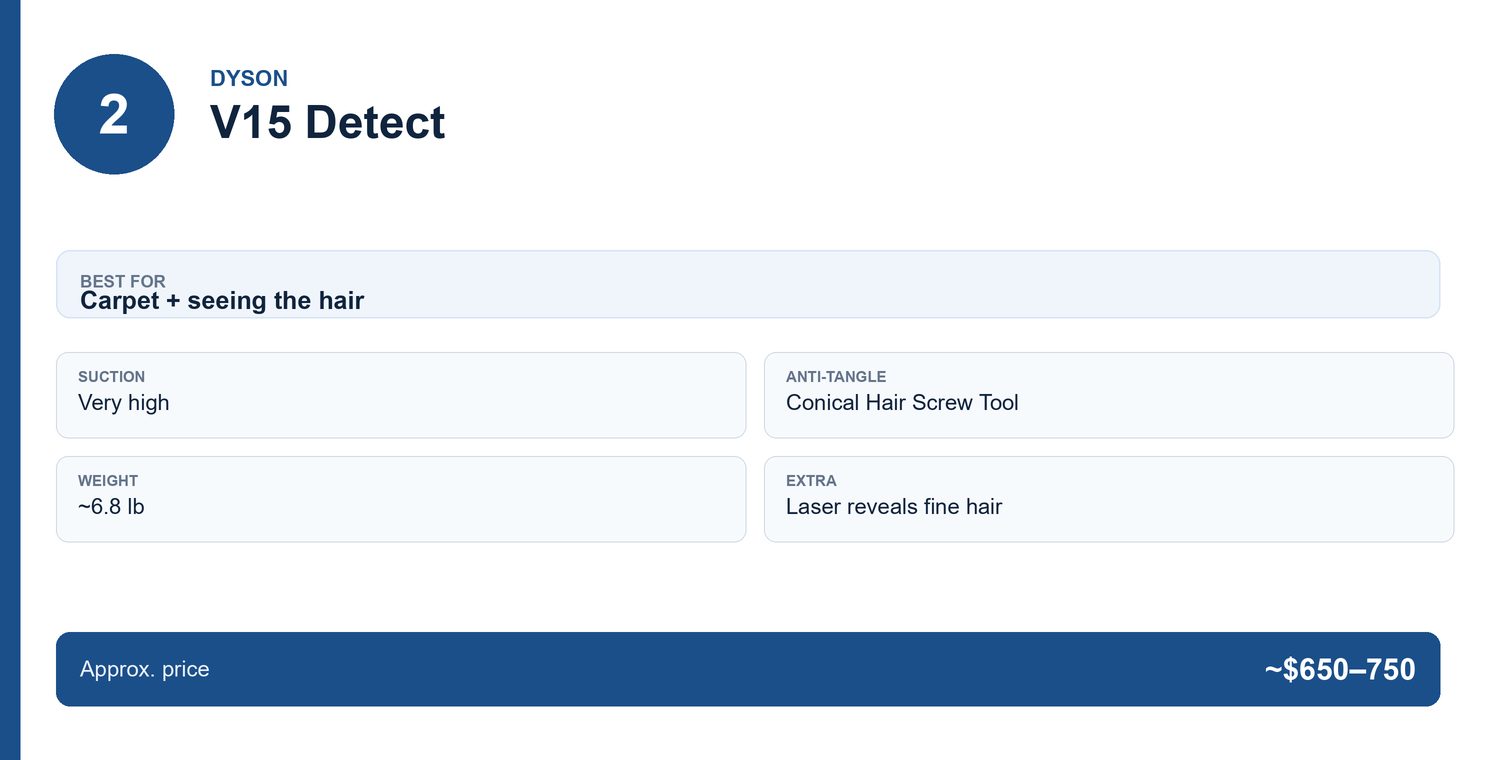
The Dyson V15 Detect is the slightly older, usually cheaper flagship, and for many pet owners it’s the smarter buy. You get most of the Gen5’s strengths: very high suction, the same conical anti-tangle tool, strong whole-machine filtration, and the laser head that reveals the fine hair and dust you’d otherwise walk past.
It’s a touch lighter than the Gen5detect at roughly 6.8 pounds, which makes stairs and upholstery a little kinder on your arm. If you want top-tier Dyson pet-hair performance and the newest model’s extra suction isn’t worth a few hundred dollars to you, this is where a lot of people should land.
The honest downside is that it’s still a premium-priced Dyson, and like all of them, boost mode drains fast. Plan your cleaning around short high-power bursts, or keep the charger handy for a mid-clean top-up.
3 Shark Stratos Fights Tangles and Pet Odor at Once
Shark’s pitch is aimed squarely at pet owners, and the Shark Stratos cordless is the clearest example. Its floor head combines a DuoClean roller with the PowerFins and comb design, which is genuinely effective at pulling long hair off the roller rather than letting it wrap. If tangle is your number-one headache, this is a strong, less-expensive alternative to a Dyson.
Two extras make it a pet pick specifically. It has an odor-neutralizing feature that helps with the faint dog-vacuum smell that builds up over time, and many configurations use a removable battery, so you can buy a spare instead of a second machine. Suction is high and, on the Clean Sense models, adjusts to how dirty the floor is.
It undercuts the Dyson flagships on price while covering the two things pet owners care about most, tangle and smell. It’s a little heavier in the hand than the lightest sticks, so factor that in if you do a lot of stairs.
4 Shark PowerDetect Adjusts Itself for Mixed Floors
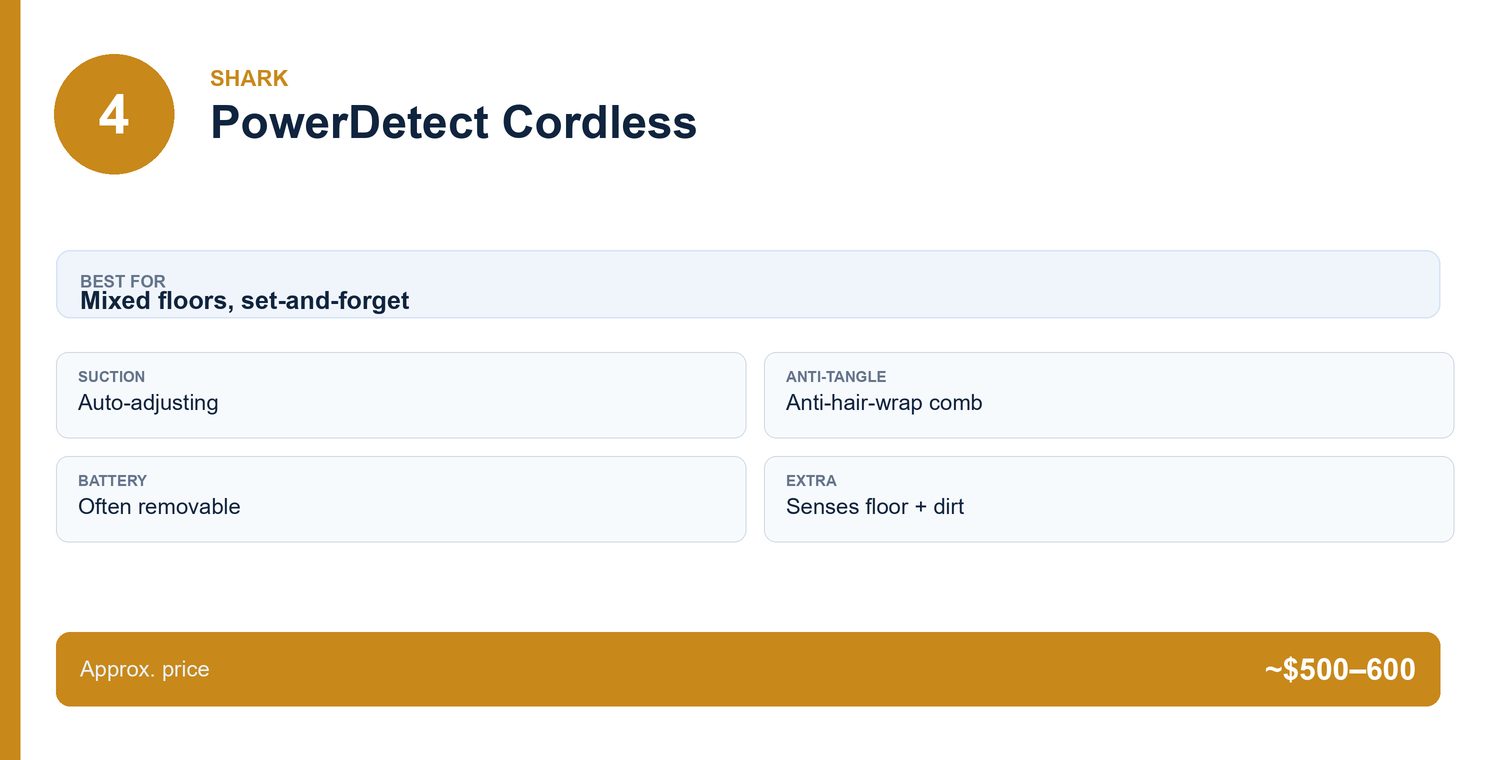
If you hate fiddling with power settings, the Shark PowerDetect is built for you. Its whole idea is automation: it senses the floor type, senses where the dirt is heaviest, and ramps suction up or down on its own, boosting along edges and in high-hair zones without you touching a button. For a home that’s part hardwood, part rug, part tile, that set-and-forget behavior is genuinely handy.
It keeps the anti-hair-wrap head that makes Sharks good pet vacuums, and it typically uses a removable battery like the Stratos. The trade is that all that sensing adds a little weight and a little price, landing it a step above the Stratos and toward the heavier end of our list.
Choose it over the Stratos if your floors are mixed and you want the vacuum to think for you; choose the Stratos if you’d rather save money and set the power yourself.
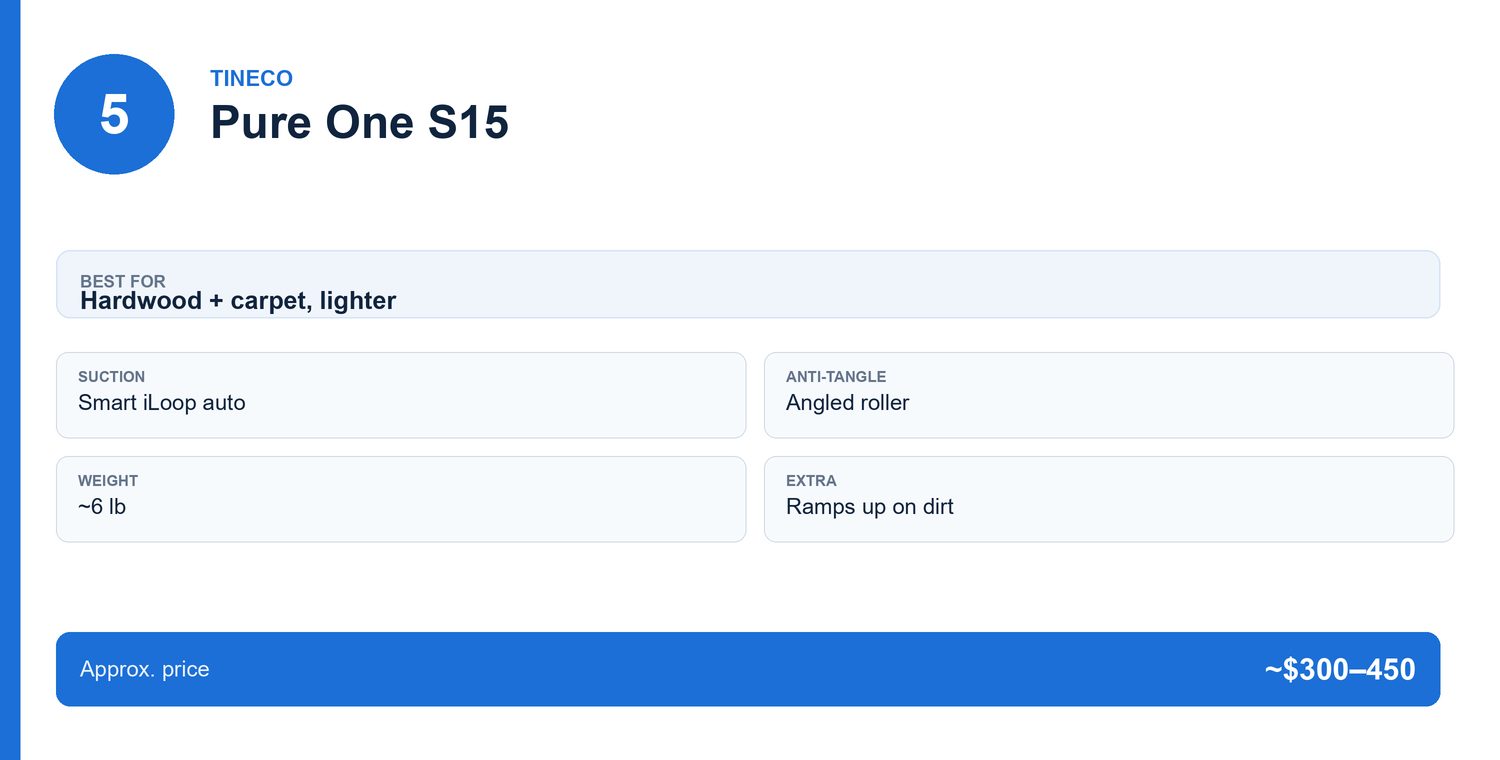
5 Tineco Pure One S15 Is the Smart Pick for Hardwood and Carpet
For the reader searching specifically for the best cordless vacuum for pet hair and hardwood floors, the Tineco Pure One S15 deserves a serious look. Its headline feature is a smart iLoop sensor that reads how much dust and hair is in the airflow and automatically dials suction up when it hits a dirty patch and down when the floor is clean. That saves battery on hardwood and ramps up for the embedded hair in a rug, which is exactly the balance a mixed home wants.
It’s also lighter than the Dyson and Shark flagships at around 6 pounds, with a soft-roller-friendly design that glides on hard floors without scattering hair, plus an anti-tangle roller for the long stuff. For hardwood-heavy homes with a shedding pet, that lighter, self-adjusting package often fits better than a heavier maximum-suction machine.
Depending on the exact model and sale, it’s the value-smart middle of this list. It won’t out-muscle a Gen5detect on deep carpet, but for hardwood plus the occasional rug, most people won’t feel the gap.
6 The Best Budget Cordless Vacuum for Pet Hair
You do not have to spend upper-mid money to get real pet-hair pickup, and this is the pick for anyone searching for the best cordless vacuum for pet hair on a budget. Budget stick vacuums from brands like INSE, Eufy, Prettycare, and Belife sit at the budget end and, if you choose carefully, handle a small home’s shedding perfectly well.
The rule for buying cheap is to protect the two specs that matter and let the rest go. Make sure the floor head has some kind of anti-tangle help, even a simple comb, and make sure the battery is removable so you can replace it in a couple of years instead of tossing the vacuum. You’ll give up maximum suction, fancy sensors, and the nicest filtration, and that’s a fair trade for a small apartment or a light shedder.
Where budget vacuums struggle is deep carpet and big homes, because the modest suction and short battery run out of steam. If that’s your situation, spending up pays off. But for hard floors, a rug or two, and one moderate shedder, a well-chosen budget stick is the honest best cordless vacuum for pet hair for the money.
How to Match a Cordless Vacuum to Your Home and Floors
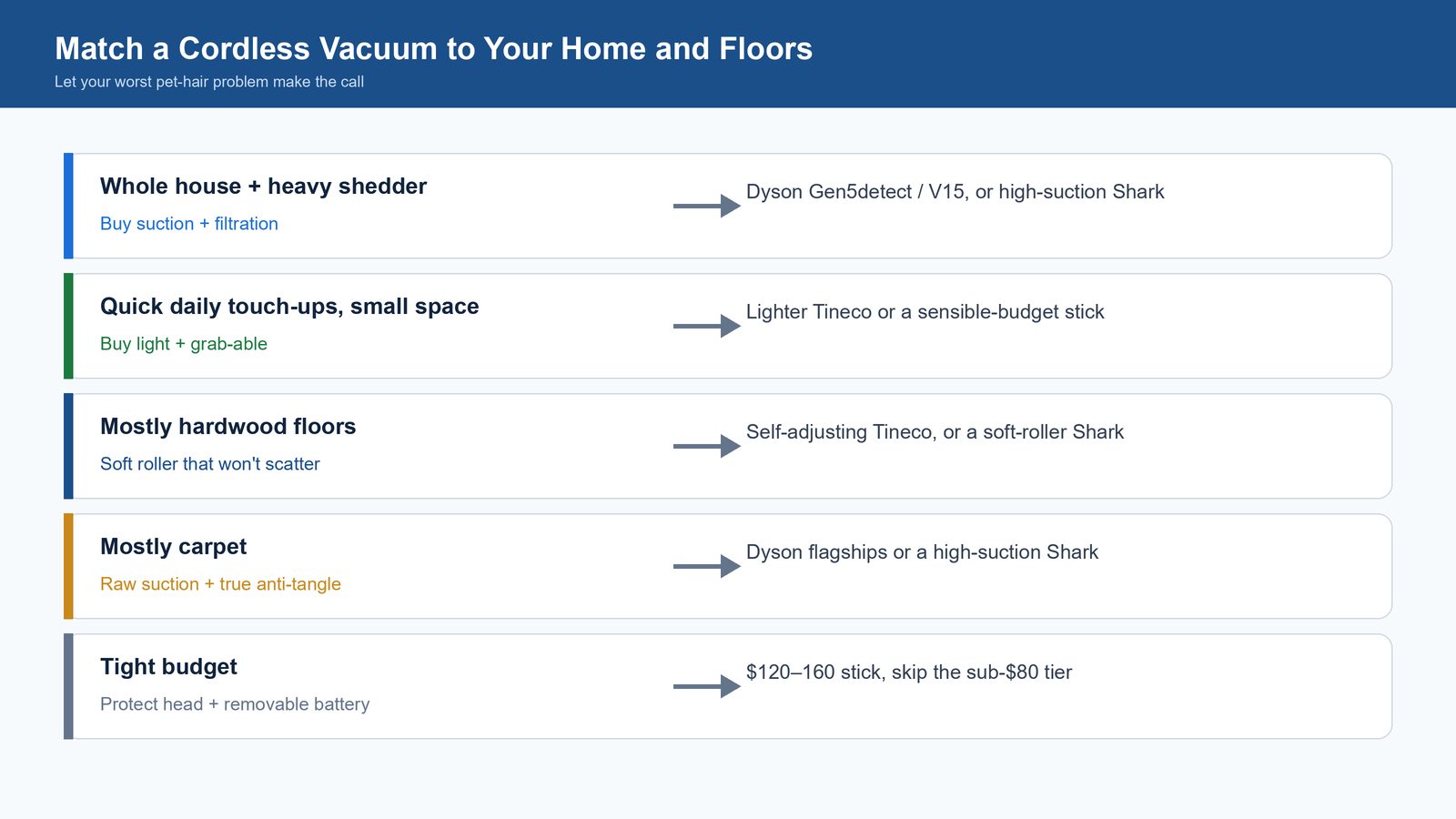
Specs are only useful once they point at a decision. So forget “which is best in the world” and answer a simpler question: which one fits how you actually live and what your floors are made of. Sort yourself into one of these and you’re basically done.
If You Have a Whole House and a Heavy Shedder
Carpet everywhere, a big dog or two cats, hair as a daily fact of life? Buy suction and filtration and don’t flinch at the weight, because you’ll mostly push it along the floor. A Dyson Gen5detect or V15 Detect, or a high-suction Shark, is your lane. This is the one situation where paying up genuinely pays back.
If You Mostly Do Quick Daily Touch-Ups
Small apartment, one moderate shedder, mostly hard floors with a rug? You want light and grab-able far more than you want maximum power. A lighter Tineco or a well-chosen budget stick, ideally under about 6 pounds, will get reached for constantly, and a vacuum you use daily beats a powerhouse you avoid. This is also the profile that most wants the best cordless vacuum for pet hair and lightweight handling in the same sentence.
If Your Floors Are Mostly Hardwood
Hardwood shows every hair but is easy to clean, so you don’t need brute carpet suction. You need a soft-roller-friendly head that glides without flinging hair around, plus enough smarts or control to not scatter it. Tineco’s self-adjusting suction is a natural fit here, and any of the Sharks with a soft roller work well too.
If Your Floors Are Mostly Carpet
Carpet is where hair hides deepest, so this is the profile that most needs raw suction and a true anti-tangle brush. For the reader after the best cordless vacuum for pet hair on carpet, lean toward the Dyson flagships or a high-suction Shark, and be willing to carry a bit more weight for the pulling power that gets hair out of the pile.
If You’re on a Tight Budget
Protect the anti-tangle head and the removable battery, accept less suction, and buy in the sensible-budget tier rather than the rock-bottom one. A small home with a light shedder is perfectly served by a budget stick that hits those two specs.
Getting the Most Pet Hair Out of Any Cordless Vacuum
The vacuum you buy is only half the story. Pet hair is uniquely good at clogging filters and choking rollers, and a neglected cordless loses suction fast. A few minutes of upkeep keeps whichever model you pick performing like the day you bought it.
Empty the Bin Early and Often
Cordless bins are small, and pet hair fills them faster than dust because it’s fluffy and tangles into a mat. A packed bin blocks airflow and kills suction long before it looks full. Empty it every clean, or even mid-clean for a heavy session, and tap or pull the matted hair out of the bin’s inlet where it likes to bridge across.
Wash the Filter on Schedule
Fine pet dander and hair coat the filter and slowly strangle the airflow, which is often why a vacuum “loses power” after a few months. Most cordless filters are washable. Rinse it in plain water on the maker’s schedule, usually monthly, and let it dry fully for 24 hours before putting it back, because a damp filter can damage the motor.
Clear the Brush Roll Before It Jams
Even a good anti-tangle head catches some hair over time. Every week or two, pop the roller out, cut away any wrapped hair along the molded groove, and check the ends where hair likes to spin into the bearings. Thirty seconds here prevents the slow decline into a roller that spins but no longer touches the floor.
Frequently Asked Questions
What is the best cordless vacuum for pet hair overall?
For a whole-home heavy shedder, the Dyson Gen5detect is the strongest all-around pick because it pairs the highest published suction in the category with a genuine conical anti-tangle tool and HEPA filtration. But “best overall” depends on your home. If you mostly have hardwood, a lighter self-adjusting Tineco fits better, and if you’re on a budget, a well-chosen budget stick covers a small home fine. Match the four specs to your floors and shedding level rather than just buying the most expensive machine.
Do I need a cordless vacuum if I already have a robot vacuum?
Yes, if you have pets, because they do different jobs. A robot vacuum keeps the open floor clear day to day, but it can’t climb stairs, clean couch cushions, or do the car. A cordless stick handles all that vertical, hands-on deep cleaning. Many pet owners run a robot for daily floors and one good cordless for the weekend deep clean of furniture, stairs, and the car, which together cost less than a single flagship upright.
What suction power do I need for pet hair on carpet?
Enough that the vacuum is clearly a whole-home model rather than a slim handheld. Suction is what lifts hair up out of carpet fibers, so carpet-heavy homes with heavy shedders should lean toward the highest suction they can afford, like the Dyson flagships or a high-suction Shark. If your home is mostly hard floors, you can safely skip the maximum and save money, because a clever floor head and modest suction handle hard surfaces easily.
Why does my cordless vacuum die so fast on the highest setting?
Because the long runtime on the box is measured on the lowest power mode with no powered brush, and the boost mode you need for embedded pet hair pulls far more current. On most cordless vacuums, boost lasts only about 5 to 12 minutes. It’s normal physics, not a defect. If you need to deep-clean a big area on boost, choose a model with a bigger battery or a swappable, click-out pack so you can drop in a charged spare and keep going.
What is the best budget cordless vacuum for pet hair?
Budget sticks from brands like INSE, Eufy, Prettycare, and Belife can handle a small home’s pet hair well if you buy carefully. Protect two specs: make sure the floor head has some anti-tangle help like a built-in comb, and make sure the battery is removable so you can replace it later. Accept less suction, weaker filtration, and no smart sensors as the fair trade. Avoid the very cheapest tier, where sealed batteries and flimsy heads usually mean buying a second vacuum within a year.
How do I stop pet hair from wrapping around the brush roll?
Buy a head designed to prevent it and then keep it clean. Anti-tangle rollers use a cone shape, a built-in comb, or angled fins to guide long hair off the end of the roller into the bin instead of letting it wrap, so look for a physically different head shape rather than just the word “anti-tangle.” Even so, clear the roller every week or two by popping it out and cutting away any hair along the molded groove most brands include, which keeps the brush touching the floor.
Is a cordless vacuum good for pet hair on hardwood floors?
Very good, as long as the head suits hard floors. Hardwood shows every hair but is easy to clean, so you don’t need brute carpet suction; you need a soft-roller-friendly head that glides without scattering hair and enough control to not fling it around. A lighter, self-adjusting Tineco is a natural hardwood pick, and Sharks with a soft roller work well too. If you also have rugs, choose a model that ramps suction up for carpet and down for hardwood so you’re not wasting battery.
About the Author
Elena Brooks
Elena Brooks is the person her group chat texts when something at home stops working or a health trend starts trending. She’s spent years turning that instinct into a job — digging into the research behind everyday questions, calling the experts, and writing up what holds up and what doesn’t. Her beat is wherever curiosity points: kitchens, cars, pets, sleep, money, and the occasional meteor shower.