

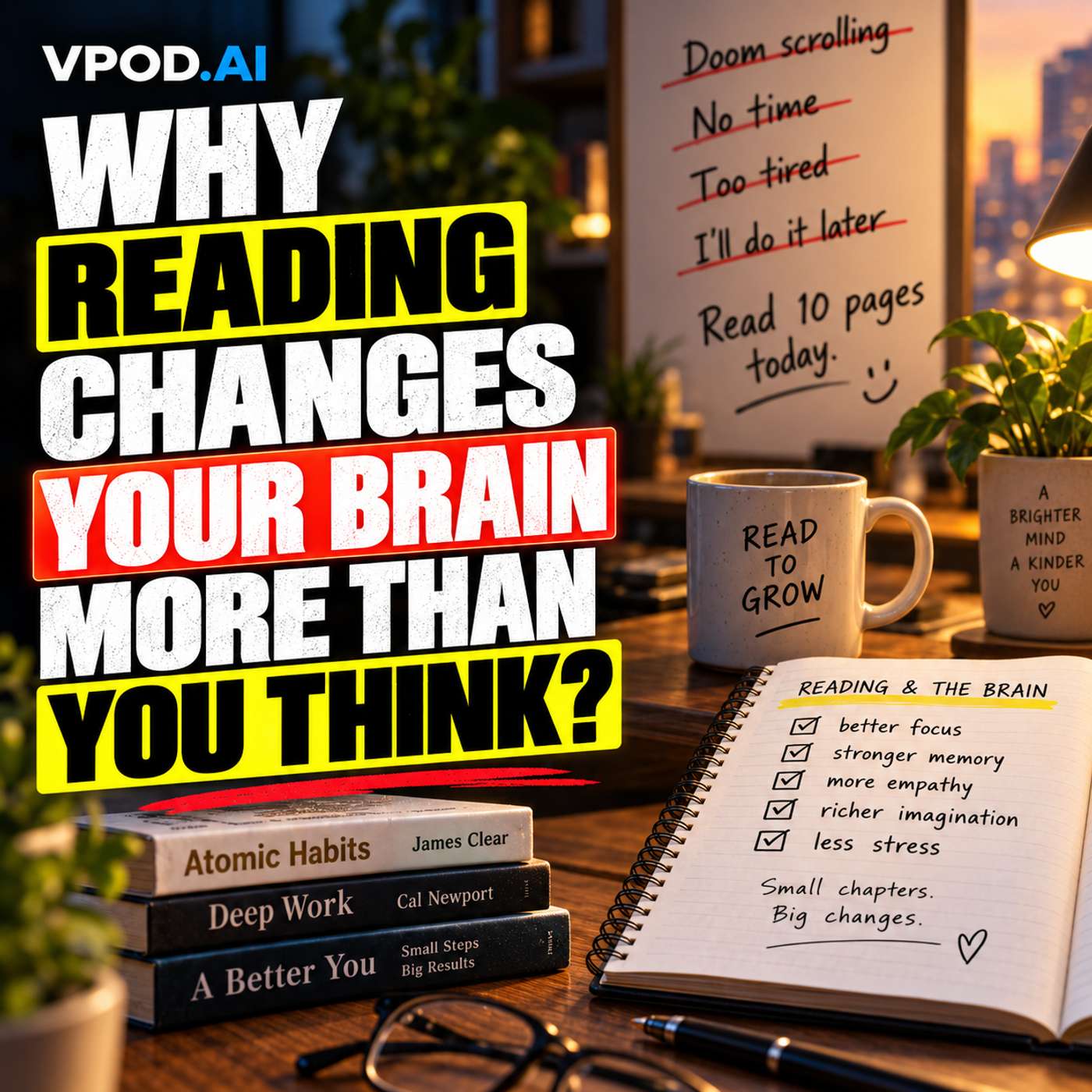




Reading feels effortless, but your brain was never biologically designed to do it.
In this episode of vpod.ai, Mike and Susan explore the neuroscience behind one of humanity’s most remarkable cognitive achievements: turning visual symbols on a page into sounds, ideas, emotions, and even physical sensations.
Unlike spoken language, reading is a relatively recent human invention. Instead of evolving a dedicated “reading center,” the brain repurposes existing neural systems through a process known as neuronal recycling. The result is a highly specialized reading network shaped by the language you learn and the way you consume information.
The conversation explores:
- Why the human brain is naturally equipped for speech but not reading
- How neuronal recycling helps create the brain’s reading network
- What the visual word form area does when we recognize written words
- Why learning English and Chinese can produce different neural pathways
- How a bilingual stroke case revealed language-specific reading networks
- Why emotional stories can trigger genuine physical sensations
- How the anterior insula connects reading, emotion, disgust, and empathy
- Why deep reading may act as an exercise for empathy and perspective-taking
- How scrolling and digital skimming encourage different reading behaviors
- What the online “F-pattern” reveals about how people consume digital text
- Why constant digital stimulation can affect attention and executive function
- How deep reading supports critical analysis and resistance to misinformation
- Why parents and educators play an important role in modeling reading habits
- How physical books and focused reading can help reinforce deeper cognitive pathways
The episode also raises a much larger question: if our brains continually adapt to the way we read, what happens when deep reading gives way to constant scanning, scrolling, and rapid-fire digital stimulation?
Reading is more than a way to absorb information. It can become a form of neurological maintenance—strengthening attention, critical thinking, emotional simulation, and the ability to engage with complex ideas.
The next time you have twenty free minutes and reach for your phone instead of a book, consider what you may actually be training your brain to do.
Subscribe to vpod.ai, share this episode with someone who spends a little too much time scrolling, and keep reading, questioning, and thinking deeply.