
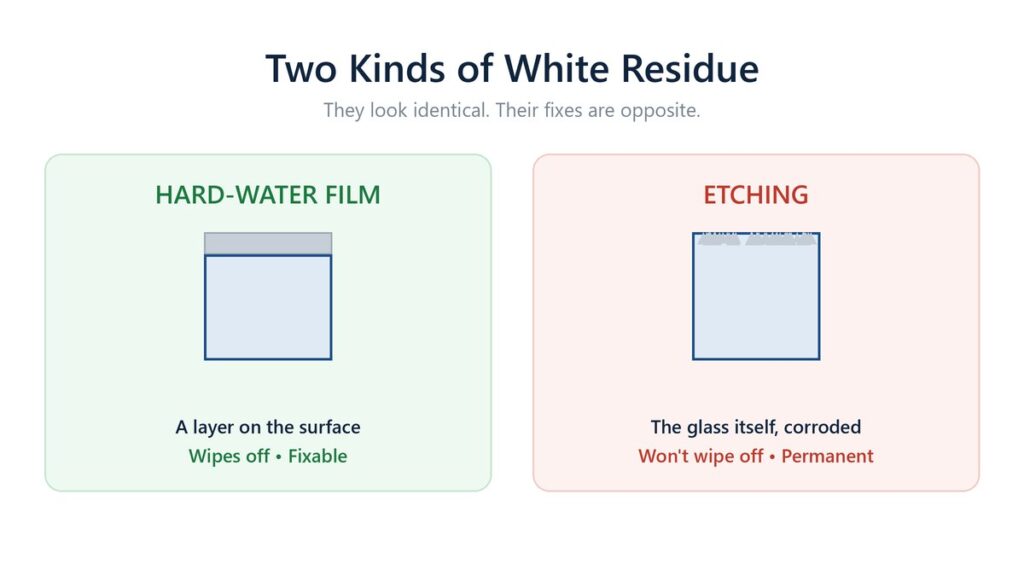
- White residue is really two problems in disguise: a hard-water mineral film that wipes off, and permanent glass etching that does not. They look the same but need opposite fixes.
- The two-minute test: wipe a cloudy glass with white vinegar. If the cloud clears, it is mineral film. If nothing changes, it is etching, and that damage cannot be reversed.
- Hard-water film is caused by dissolved minerals in your water. The fixes are rinse aid, matching your detergent dose to your water, dishwasher salt if your machine takes it, and a monthly acid clean.
- Etching is caused by the opposite: soft water plus too much detergent plus high heat. The only cure is prevention, because once glass is etched it stays etched forever.
- A clogged filter, blocked spray-arm holes, an empty rinse-aid tank, or old caked detergent can all fake a white film too, so check those before you spend money.
- Most of the time it really is the water, not the machine. Your detergent also quietly got weaker in 2010, which is why rinse aid matters more now than it used to.
You unload the dishwasher expecting clean, sparkly glasses. Instead, every cup and plate is coated in a dull, chalky white haze. Your dishes feel gritty. Your clear glasses look foggy. And you have washed them, so how are they somehow dirtier than before?
Here is the thing almost nobody tells you. When you ask why is my dishwasher leaving white residue, you are actually asking about two completely different problems that happen to look identical. One is a film sitting on top of your dishes. The other is damage baked into the glass itself. They have opposite causes, opposite fixes, and one of them is permanent. So before you buy new detergent or blame your machine, you need to find out which one you have. It takes about two minutes, and the whole rest of this guide depends on the answer.
Get the diagnosis right and the fix is usually cheap and simple. Get it wrong and you can make the problem dramatically worse, sometimes ruining a whole set of glasses in a few wash cycles. Let’s sort out which residue you are looking at, then fix the right one.
Two White Residues That Look the Same but Aren’t
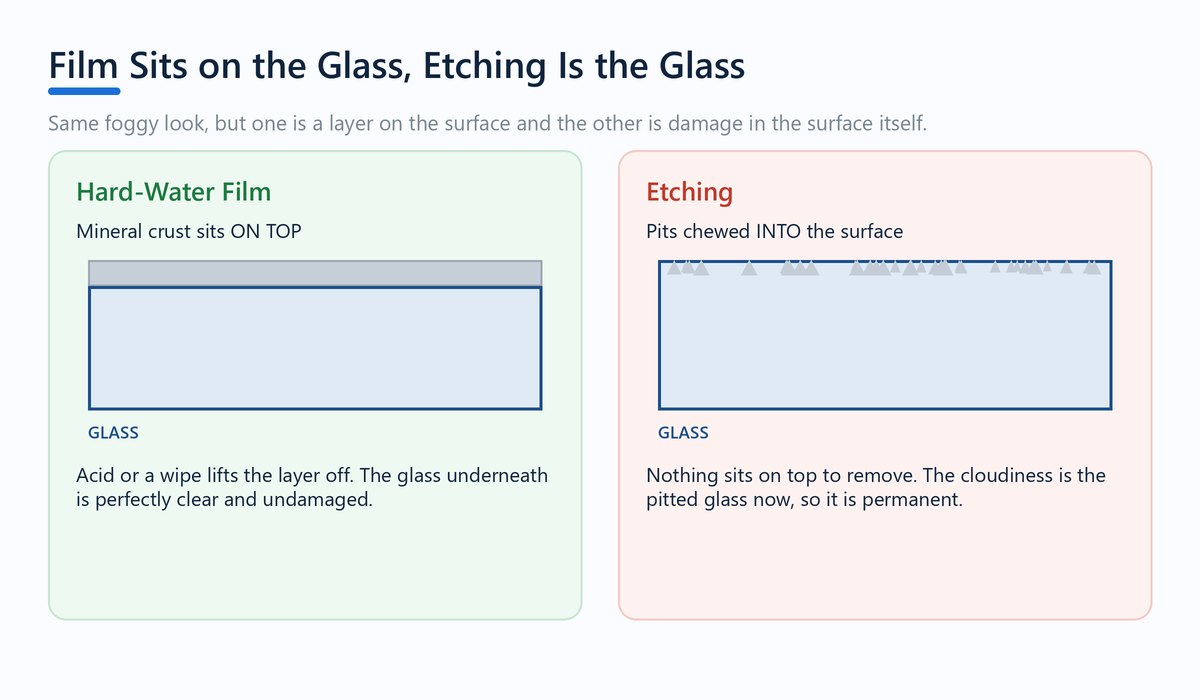
Picture two foggy glasses side by side. To your eye they are twins. Both are cloudy, both came out of the same machine, both feel a little off. But at the microscopic level they could not be more different, and that difference decides everything you do next.
The first kind is hard-water film, also called limescale. This is a thin crust of minerals, mostly calcium and magnesium, that your water leaves behind as it dries. It sits on the surface like dust on a table. It is not part of the glass; it is a layer parked on top of it. That means it can come off. A quick wipe, a splash of acid, and the glass underneath is perfectly fine.
The second kind is etching. This is not a layer sitting on the glass. It is the glass itself, corroded. Under the surface, thousands of microscopic pits have been chewed into it, and those pits scatter light so the glass looks permanently frosted. Sometimes you will even see a faint rainbow or oil-slick sheen when you tip it toward a window. Nothing is sitting on top to wipe away, because the cloudiness is the glass now. No cleaner, no soak, no scrub will bring it back. This is the one you must catch early, because every etched glass is a glass you will eventually throw out.
The Vinegar Test That Settles It in Two Minutes
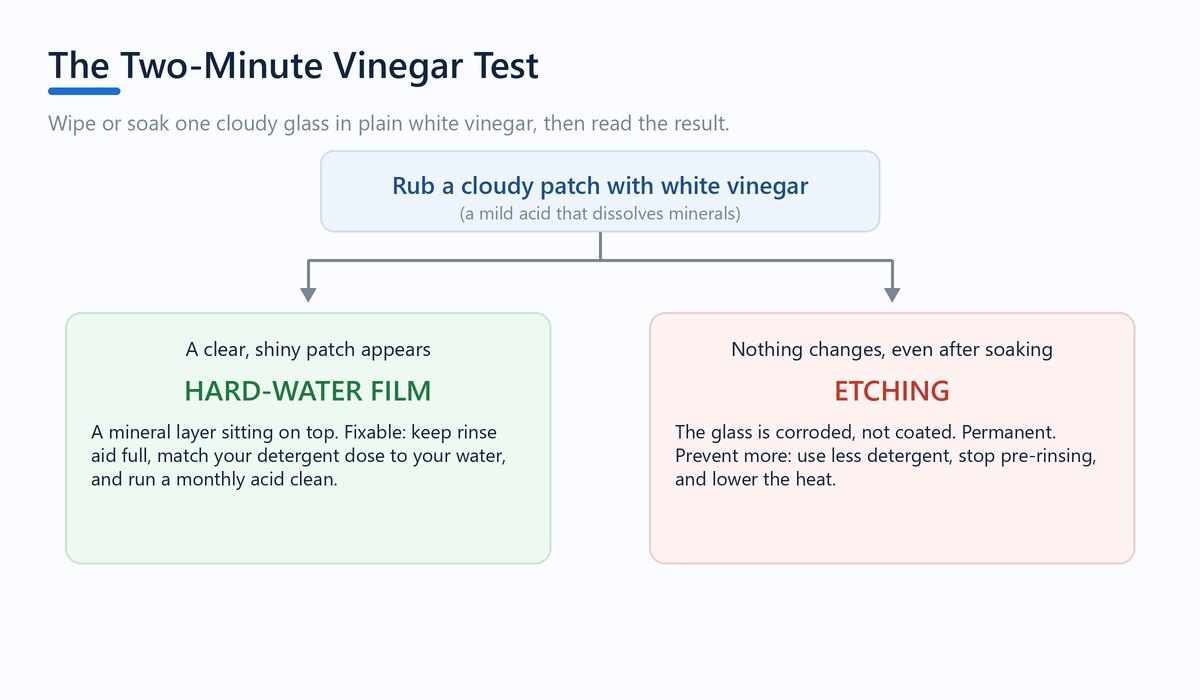
You do not have to guess. There is one simple test that tells film and etching apart, and it costs nothing. Grab a cloudy glass and a bottle of plain white vinegar.
Dip a corner of a cloth or paper towel in white vinegar and rub a small patch of the fog, or just dunk the glass in a bowl of vinegar for five minutes. Vinegar is a mild acid, and acid dissolves minerals. So if the cloudiness is hard-water film, that patch will turn clear and shiny while the rest of the glass stays foggy. You will see a clean window where you rubbed. That is your answer: it is film, it is on top, and it comes off.
If you rub, and soak, and hold it to the light, and absolutely nothing changes, you have etching. The acid has nothing to dissolve because there is no layer, only damaged glass. A second confirming sign is that iridescent rainbow shimmer, which mineral film does not have. Once you see the test result, the rest is easy, because now you know whether you are fighting your water or your detergent.
Hard-Water Film: The Limescale Problem
If your test showed a clean patch where the vinegar touched, congratulations, you have the easier problem. Your dishwasher is leaving a mineral film, and the root cause is not the machine at all. It is what comes out of your tap.
Water is called “hard” when it carries a lot of dissolved minerals, mainly calcium and magnesium. The U.S. Geological Survey measures water hardness in milligrams of mineral per liter, and roughly 85 percent of American homes have hard water to some degree. When that mineral-rich water heats up and dries on your dishes, the water leaves but the minerals stay, welding themselves into a pale, chalky crust. The hotter and harder the water, the thicker the film. This is the exact same limescale that furs up your kettle and clouds your shower door, just deposited on a plate instead.
Why has this gotten worse for so many people lately? Two reasons. First, dishwashers now use far less water and run longer to save energy, so there is less rinsing to carry minerals away. Second, and bigger, the detergent itself changed. Until 2010, most dishwasher detergents were loaded with phosphates, which are brilliant at grabbing minerals and holding them in the water so they rinse away instead of sticking. Phosphates were banned from consumer dishwasher detergent because they were causing algae blooms in lakes and rivers. The detergents that replaced them are gentler on the environment and noticeably worse at fighting hard water. So if you swear your dishes got cloudier “for no reason” some years back, you were not imagining it.
Permanent Etching: When the Cloud Won’t Wipe Off
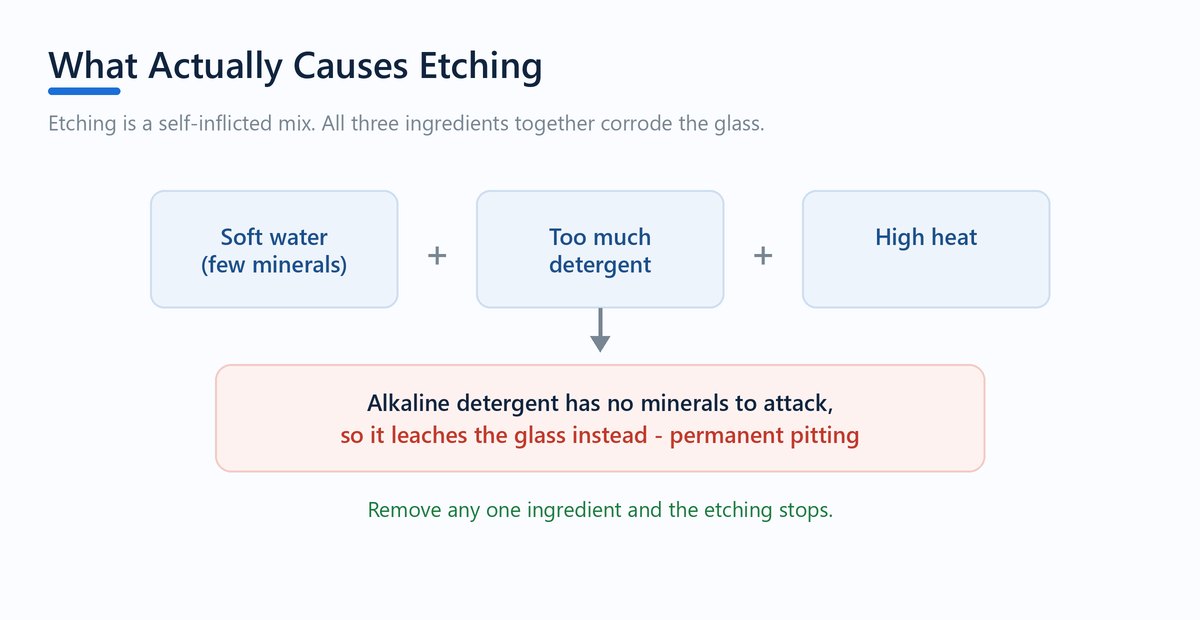
If the vinegar test changed nothing, take a breath, because this is the residue you cannot undo. Etching is corrosion of the glass surface, and no product on earth reverses it. But you can absolutely stop it from spreading to the rest of your glasses, and understanding the cause is oddly reassuring, because it means you were probably trying too hard.
Etching is the strange twin of the hard-water problem. Hard-water film comes from too many minerals. Etching comes from too few. Here is the mechanism. Dishwasher detergent is strongly alkaline, the chemical opposite of acid. In hard water, all those dissolved minerals give the detergent something to react with, which keeps it busy and buffered. But in soft water, or over-softened water, the detergent has nothing to grab. So it turns on the only thing left: the glass. Combine soft water, a heavy dose of detergent, and high heat, and the alkaline solution slowly leaches minerals right out of the glass surface, pitting it microscopically. Do that load after load and the pitting deepens into that permanent frost.
Notice what that means. Etching is almost always a self-inflicted wound from a well-meaning combination: soft water plus a generous scoop of detergent plus the hottest cycle plus rinsing every plate spotless before it goes in. Each of those feels like “cleaning harder.” Together they are a recipe for corroding your glassware. Manufacturers like Whirlpool confirm that etching is permanent and driven by soft water and too much detergent, which is why every real fix below is about doing less, not more.
How to Fix Hard-Water Film for Good
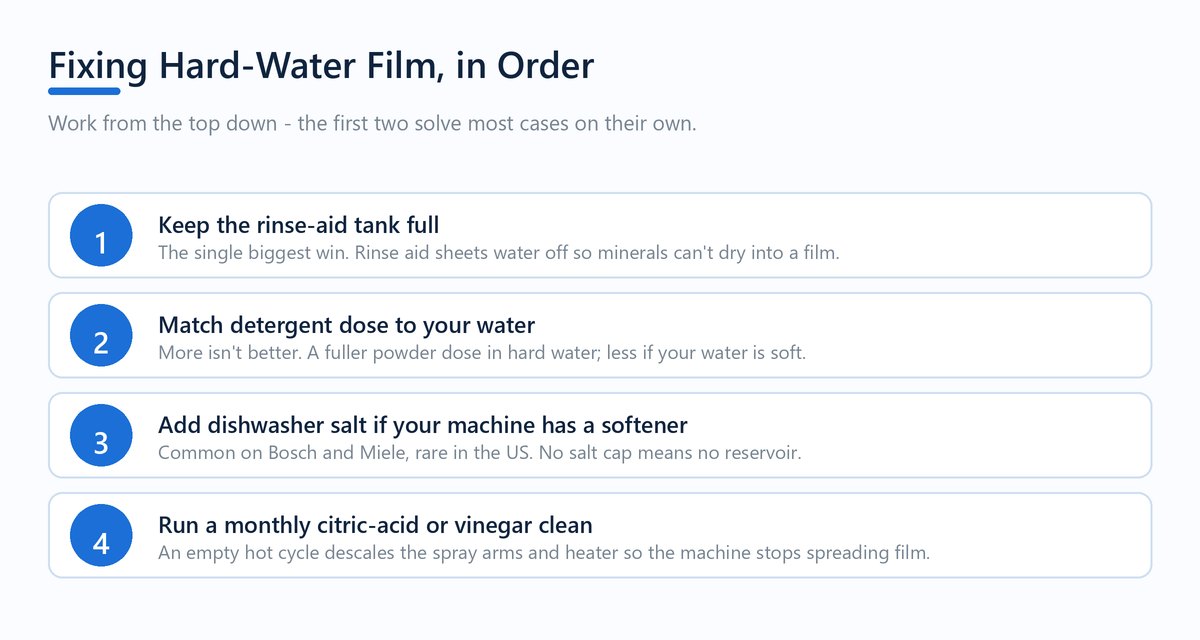
Once you know it is mineral film, the plan is straightforward. You are fighting your water, so every fix either helps the machine deal with minerals or removes the minerals before they can deposit. Work through these in order, because the first two solve most cases on their own.
Keep the Rinse-Aid Tank Full at All Times
Rinse aid is the workhorse, so start here. That little dispenser next to the detergent cup, usually with a clear window or a low-level indicator, holds a liquid surfactant that makes water slide off your dishes instead of clinging in mineral-loaded droplets. Fill it, and set the dosage dial up a notch or two if your machine has one, because factory defaults are tuned for average water, not hard water.
If you would rather not buy branded rinse aid, plain white vinegar works as a budget stand-in for many people, though not all. Do not pour it into the rinse-aid compartment long-term, because vinegar’s acidity can degrade the rubber seals and valves in that dispenser over months. Instead, add a small cup of vinegar to the bottom of the tub at the start of a load, or just buy rinse aid, which is cheap and gentle on the machine.
Match Your Detergent Dose to Your Water
More detergent does not beat hard water; the right amount does. In genuinely hard water you may need a fuller dose or a more powerful powder to keep minerals suspended. But dumping in extra “just in case” leaves its own residue and, if your water is actually soft, pushes you toward etching. The goal is a dose matched to your water, not a maxed-out one.
This is where powder earns its keep. Because you scoop powder yourself, you can use more in hard water and less in soft, tuning the dose to your home. Pods and tablets are fixed-dose by design: convenient, but you cannot dial them up for very hard water or down for soft. If you have hard water and cloudy dishes, switching from a one-size pod to an adjustable powder is one of the most effective changes you can make.
Add Dishwasher Salt If Your Machine Has a Softener
Many dishwashers, especially European brands like Bosch, Miele, and Beko, have a built-in water softener with a salt reservoir in the base of the tub. Coarse dishwasher salt recharges that softener so it can strip minerals out of the water before the wash even starts. If your machine has this feature, keeping the salt topped up is the most thorough hard-water fix there is, because it treats the water instead of just coping with it.
Here is the catch, and it is a big one. Most dishwashers sold in the United States do not have a built-in softener or a salt reservoir at all. If yours doesn’t, there is nowhere to put dishwasher salt, and you should never dump salt loose into the tub hoping it helps. Check your manual or look for a large screw cap in the floor of the dishwasher; no cap means no softener, and your fixes are rinse aid and detergent dose instead.
Run a Monthly Acid Clean With Citric Acid or Vinegar
Over time, limescale builds up inside the machine itself, on the spray arms, the walls, and the heating element, and a scaled-up machine spreads more film onto every load. Once a month, run the dishwasher empty and hot with a descaling agent to dissolve that buildup. Citric acid powder is the appliance-friendly choice: put two or three tablespoons in the detergent cup, or a cup of white vinegar in a bowl on the top rack, and run the hottest cycle with no dishes inside.
Citric acid is gentler on rubber and seals than vinegar, so if you are cleaning monthly, it is the better long-term pick. Keep this cleaning cycle separate from your dishes, and never combine an acid cleaner with detergent in the same run, because the acid neutralizes the alkaline detergent and you get the cleaning power of neither. Our full guide to cleaning a washing machine walks through the same descaling logic for the other appliance that quietly furs up with limescale.
How to Stop Etching Before It Starts
If your problem is etching, remember the theme: the cause is doing too much, so the cure is doing less. You cannot save the glasses that are already frosted, but you can stop the damage cold and protect everything you own from here on. Every step below removes one ingredient from the etching recipe.
Use Less Detergent, Not More
This is the big one. If you have soft water and etched glasses, you are almost certainly using too much detergent, and the fix feels wrong but works: cut the dose. Try halving it, or switch to the smallest amount that still cleans your normal loads. In soft water, a little detergent goes a very long way, and the excess has nothing to clean except your glassware.
If you use pods, this is the moment their fixed dose becomes a liability. A full tablet may be far more than soft water needs, and you cannot make a pod smaller. Switching to a scoopable powder or gel and dialing the amount down is often the single change that stops etching in a soft-water home.
Stop Pre-Rinsing Your Dishes
It feels responsible to scrub every plate clean before loading, but in soft water it backfires. Modern detergents, especially the enzyme-based ones, are built to attack food. If there is no food, the detergent goes looking for something else to work on, and in soft water that something is your glass. A little food residue on the dishes actually buffers the detergent and protects the glassware.
So scrape off the big chunks and load the rest as-is. This also saves water and saves you time, which is why appliance makers and testers have quietly been telling people to stop pre-rinsing for years. If you are worried about smells, run the dishwasher more often rather than rinsing everything first.
Lower the Water Temperature
Heat accelerates the chemistry of etching. The hotter the water, the faster the alkaline detergent leaches minerals out of soft glass. If your problem is etching and your machine or water heater runs very hot, easing back on temperature slows the reaction. Skip the “sanitize” or highest-heat option for everyday loads, and if your water heater is set above 120 degrees Fahrenheit, that is worth checking anyway for safety and energy reasons.
Pair a cooler cycle with the smaller detergent dose and you have removed two of the three etching ingredients at once. The glasses still get clean, because clean is about the detergent doing its job on food, not about scalding your dishes.
Do Not Over-Soften Your Water
If you have a whole-home water softener, it is possible to overshoot. Water that is aggressively softened to near zero hardness is exactly the fuel etching runs on, because the detergent has zero minerals to react with. You do not need to remove your softener, but you may want a plumber to set it to leave a little hardness in the line, or you can lean harder on cutting detergent to compensate. This is the counterintuitive heart of the whole topic: a bit of hardness in your water actually protects your glass.
The Other Culprits Behind a White Film
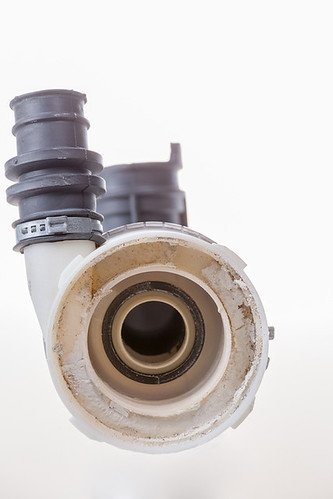
Before you rebuild your whole routine, rule out the boring mechanical stuff. Sometimes a “white residue” is not really about your water or your detergent at all; it is a dirty or under-performing machine redepositing gunk. These are quick to check and often free to fix.
A Clogged Filter Redepositing Food
At the bottom of your dishwasher sits a filter that traps food particles so they do not land back on your dishes. When it clogs, the machine recirculates dirty, food-flecked water, which dries into a grayish-white haze that looks a lot like mineral film. Most modern filters twist out by hand in seconds. Pull yours, rinse it under the tap, scrub it with an old toothbrush, and click it back in.
Make this a monthly habit and you head off two problems at once, because the same clog that dulls your dishes also strains the drain pump. If your dishwasher has ever left standing water, our guide to a dishwasher that won’t drain starts at that very filter and follows the water from there.
Clogged Spray-Arm Holes That Rinse Unevenly
The spray arms are the spinning bars that fire water at your dishes. Their little nozzle holes clog with mineral scale, seeds, and debris, and a clogged arm sprays weakly and unevenly, so parts of the load never get properly rinsed. Slide the arms off, or look closely at the holes, and poke any blocked ones clear with a toothpick or a bent paperclip.
While you are down there, give the arms a spin by hand to make sure nothing is stopping them from rotating. A tall pot or a dangling utensil can block an arm’s swing, leaving a whole section of dishes under-rinsed and hazy. It is a two-second check that explains a surprising number of “only some of my dishes are cloudy” complaints.
An Empty Rinse-Aid Tank
It sounds obvious, but a rinse-aid tank that quietly ran dry is one of the most common reasons spots and film suddenly reappear after months of clear dishes. There is no dramatic warning; the results just slowly get worse. Check the indicator, which is usually a small window that shows dark when full and clear or shows a low-level icon when empty, and top it up.
If you find yourself refilling it constantly, that is not a fault, it is a sign your water is genuinely hard and your machine is working hard to cope. Take it as confirmation you are dealing with mineral film, and lean into the hard-water fixes above.
Old, Caked, or Damp Detergent
Dishwasher detergent does not last forever. Powders and pods absorb moisture from the air, and once they clump or harden, the enzymes and bleaching agents that do the real cleaning start to break down. Stale detergent cleans poorly and can leave its own undissolved white specks on the dishes.
Store detergent somewhere dry, seal the bag or tub tightly, and do not stockpile a year’s supply under a steamy sink. If your box has gone hard or your pods have fused into a brick, that alone can be your culprit, and a fresh package may clear the “residue” instantly.
Powder vs Pods vs Gel in Hard Water
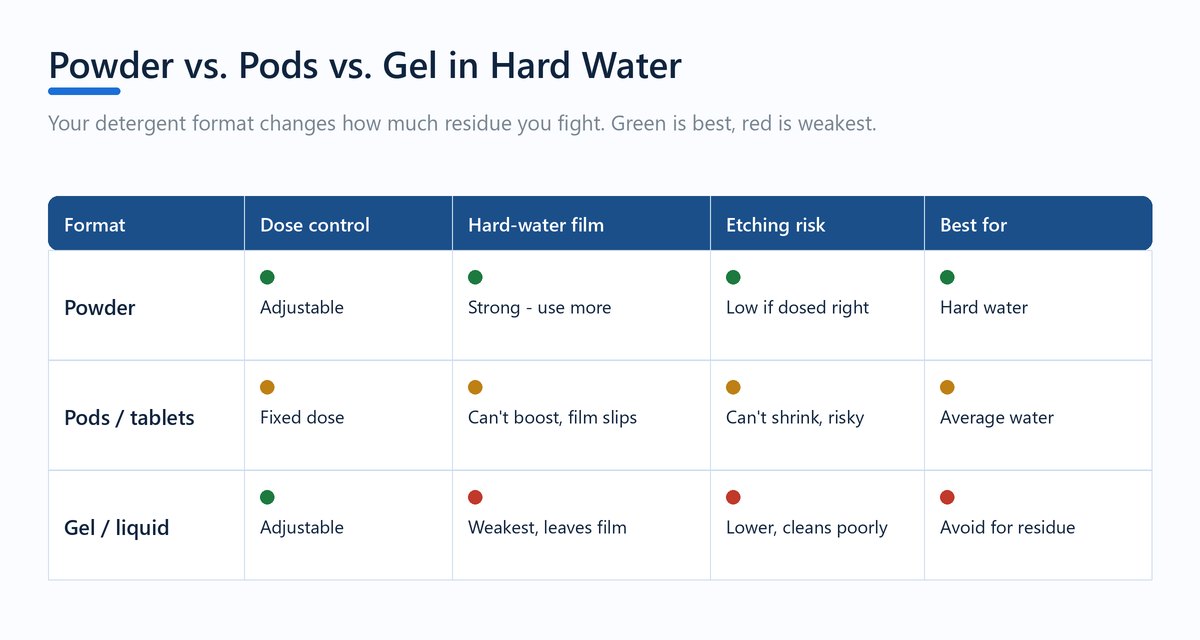
Once you know your water, your choice of detergent format stops being about convenience and starts being about chemistry. Each form behaves differently in hard versus soft water, and picking the right one for your situation quietly solves a lot of residue problems.
Powder is the most flexible and the best friend of a hard-water home. Because you control the scoop, you can use more in hard water to keep minerals suspended and less in soft water to avoid etching. It also tends to hold the most effective mineral-fighting ingredients. The only downside is measuring and the occasional clump if it gets damp.
Pods and tablets are fixed-dose convenience. They pack detergent, rinse aid, and often a water softener into one tidy packet, which is genuinely great for average water. But that fixed dose is their weakness: you cannot boost them for very hard water, so film sneaks through, and you cannot shrink them for soft water, so they encourage etching. If your water is at either extreme, a pod is fighting you.
Gel and liquid detergents are the weakest choice for residue, and worth avoiding if white film is your problem. They generally cannot carry the enzymes and oxygen-bleach agents that powders and pods can, so they clean less aggressively and leave more behind on hard water. Some older gels even contained ingredients that added to cloudiness. If you are on gel and fighting film, switching to powder or a quality tablet is an easy upgrade.
The honest summary: for hard water, adjustable powder plus rinse aid wins. For soft water, a modest dose of powder or a good tablet, kept deliberately small, keeps etching away. Gel is the format most likely to leave you staring at a foggy glass.
It’s the Water, Not the Machine
If you take one idea away from all this, let it be this reframe: a dishwasher leaving white residue is almost never a broken dishwasher. It is a mismatch between your water and your routine. Your machine is faithfully doing what you told it to; the residue is just the visible result of hard minerals, or of detergent with nothing to fight but your glass.
That is genuinely good news, because it means you rarely need a repair or a new appliance. You need to identify your water, run the vinegar test, and then either help your machine handle minerals or ease off on detergent and heat. The same appliance that frustrated you all month can turn out spotless dishes with a filled rinse-aid tank and a dose that fits your water.
So start with the two-minute test. It tells you whether you are fighting film or protecting against etching, and everything else follows from that single answer. Match the fix to the cause, and the fog goes away, or in the case of etching, never spreads to another glass again.
Frequently Asked Questions
Why is my dishwasher suddenly leaving white residue when it never did before?
A sudden change usually points to something that ran out or clogged, not your water, which changes slowly. Check the rinse-aid tank first, because an empty one is the most common cause of film appearing overnight. Then check for a clogged filter or blocked spray arms, and consider whether you recently switched detergents, changed to a hotter cycle, or started a water softener, any of which can flip you from clean dishes to cloudy ones.
Will vinegar remove the white film from my dishes and dishwasher?
Yes, if the residue is hard-water mineral film. Vinegar is a mild acid, and acid dissolves the calcium and magnesium deposits that make up limescale, so a vinegar soak or a vinegar cleaning cycle will clear it. But if the cloudiness is etching, vinegar does nothing, because there is no mineral layer to dissolve, only damaged glass. That is exactly why the vinegar test doubles as both a diagnosis and a cleaning method.
How do I know if my glasses are etched or just have hard-water film?
Run the vinegar test. Rub or soak a cloudy glass with white vinegar; if a clear patch appears, it is hard-water film sitting on top and it will wash off. If nothing changes no matter how long you soak, it is etching, which is corrosion of the glass itself and cannot be reversed. A rainbow or oil-slick shimmer in the cloudiness is another sign of etching rather than film.
Can etched glasses be fixed or restored?
No. Etching is permanent microscopic damage to the glass surface, not a coating, so there is no product or technique that restores an etched glass to clear. Anything abrasive enough to remove the pitted layer would only damage the glass further. The realistic move is to stop the cause, by cutting your detergent dose, not pre-rinsing, and lowering the heat, so your remaining glasses do not join the etched ones.
Do I need dishwasher salt to stop white residue?
Only if your dishwasher has a built-in water softener with a salt reservoir, which is common on European brands like Bosch and Miele and rare on machines sold in the United States. If yours has that reservoir, keeping it filled with dishwasher salt is an excellent hard-water fix. If it does not, salt has nowhere to go and will not help; use rinse aid and match your detergent dose to your water instead.
Is the white residue on my dishes safe, and is it bad for the dishwasher?
The mineral film itself is just calcium and magnesium and is not harmful to eat off, though it looks and feels unpleasant. Over time, though, that same limescale builds up inside the machine on the heating element and spray arms, making it work harder and spread more film, which is why a monthly acid clean matters. Etching is not a safety hazard either, but it permanently ruins the look of your glassware, so it is worth stopping quickly.
About the Author
Elena Brooks
Elena Brooks is the person her group chat texts when something at home stops working or a health trend starts trending. She’s spent years turning that instinct into a job — digging into the research behind everyday questions, calling the experts, and writing up what holds up and what doesn’t. Her beat is wherever curiosity points: kitchens, cars, pets, sleep, money, and the occasional meteor shower.