

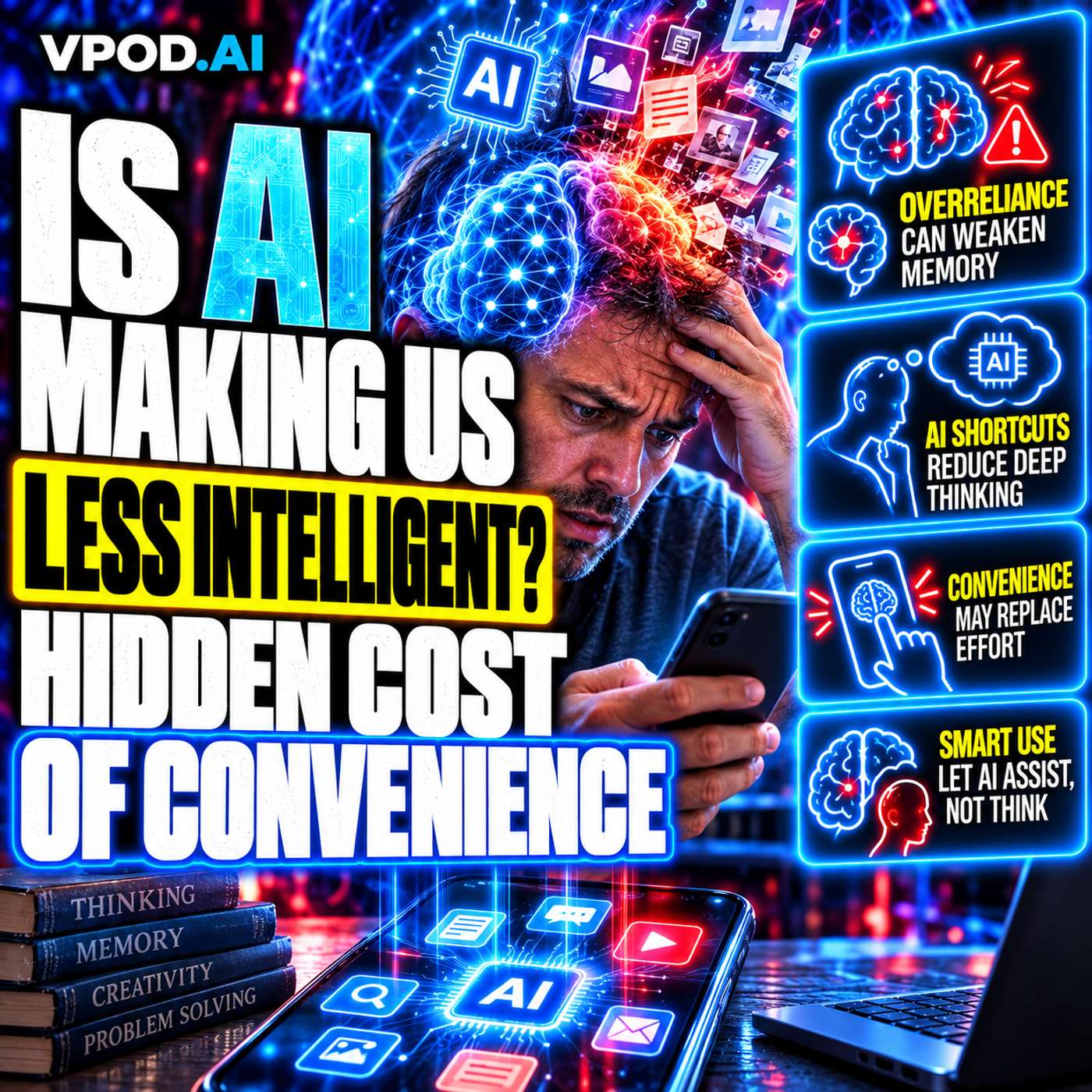





AI is making everyday work faster, easier, and more convenient—but what happens when that convenience starts replacing our ability to think for ourselves?
In this episode, Mike and Susan explore the growing tension between artificial intelligence and human critical thinking. From grammar checks and email writing to coding, research, and problem-solving, AI is becoming embedded in everyday life. The question is no longer whether we will use it, but how we can use it without becoming dependent on it.
The conversation dives into cognitive offloading—the human tendency to hand mental work over to tools—and examines how excessive reliance on AI could weaken the skills we need to evaluate information, solve problems, and make independent decisions.
You’ll hear about:
• Why our brains naturally look for shortcuts that reduce mental effort
• How AI dependence can resemble relying on GPS until you lose your own sense of direction
• Why confident AI responses can still contain incorrect information, fabricated facts, or faulty logic
• How losing foundational knowledge makes it harder to recognize AI mistakes
• Why critical thinking, judgment, emotional intelligence, and human experience remain essential in an AI-powered workplace
• How leading prompts can encourage AI to reinforce your existing assumptions and biases
• Why fact-checking, cross-referencing, and active oversight should be part of every serious AI workflow
• When AI can help remove repetitive busy work without replacing meaningful thinking
• Why difficult learning experiences, creative struggles, and problem-solving challenges should not always be automated
• What increasing AI dependence could mean for students and future generations who are still developing foundational skills
The episode makes the case for treating AI as an assistant rather than a replacement for human thought. Use it to accelerate repetitive work, generate starting points, and support your workflow—but protect the tasks that develop your expertise, creativity, judgment, and independence.
Because if we allow machines to handle every difficult step of learning and problem-solving, we may eventually lose the ability to recognize when those machines are wrong.