






What happens when your laptop screen, keyboard, AI assistant, entertainment system, and even hearing support move into a pair of glasses?
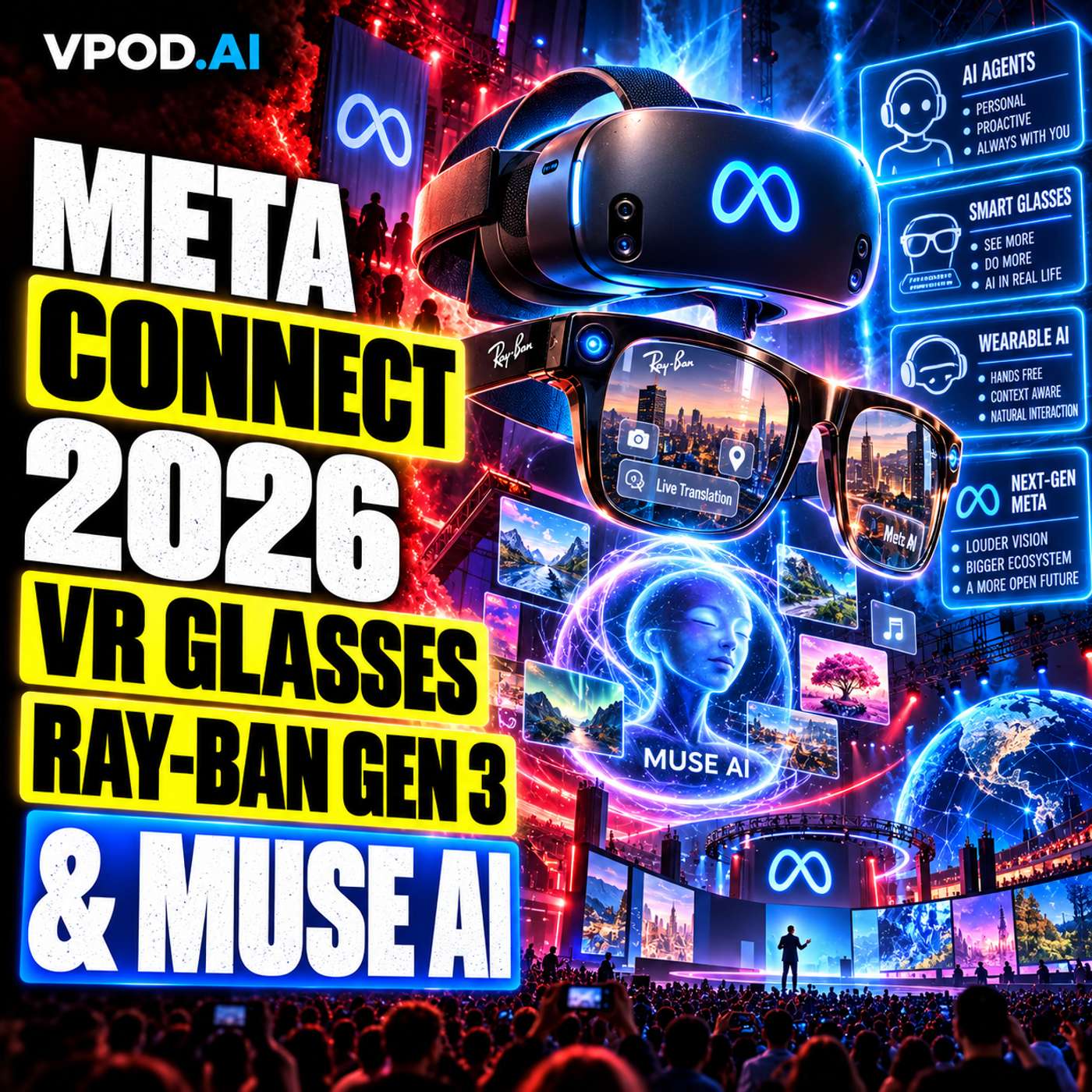
In this episode of Vpod.ai, Mike and Susan explore the vision presented around Meta Connect 2026, including ultralight VR glasses designed for spatial productivity, the Ray-Ban Meta Gen 3 lineup, and the growing role of AI-powered wearable computing.
The conversation begins with Meta’s proposed 100-gram VR glasses and their split-computing design. Instead of placing the processor and battery directly on your face, the system moves much of the hardware into an external pocket-sized pack connected by an optical cable.
You’ll hear about:
• 5K micro-OLED displays and 37 pixels-per-degree visual density
• A Snapdragon Elite-powered external processing pack
• Eye tracking, hand tracking, and controller-free interaction
• Downward-facing cameras that track hands resting naturally on a desk
• A virtual “surface keyboard” that turns ordinary tables into input devices
• DisplayPort support for low-latency PC and console gaming
• IMAX Enhanced, Dolby Vision, and Dolby Atmos entertainment
• 180-degree stereoscopic 8K sports streaming and foveated streaming
• More than 75 games rebuilt around native hand tracking
The episode also explores the Ray-Ban Meta Gen 3 smart glasses, including their 12-megapixel camera, 3K video recording, six-microphone array, open-ear speakers, and AI-driven features.
Mike and Susan examine how the Muse AI agent could use computer vision to translate menus, recognize objects, assist with navigation, suggest recipes, and connect wearable computing with third-party services.
They also discuss a camera-free Ray-Ban Meta Audio model designed around longer battery life, discreet open-ear audio, and reduced privacy concerns.
One of the most significant themes is accessibility. The episode examines hearing-enhancement capabilities described as bringing hearing assistance into fashionable everyday eyewear rather than a traditional dedicated device.
But the bigger question goes beyond specifications.
If wearable displays eventually become as common as smartphones, what happens when two people standing on the same street can experience completely different digitally augmented versions of reality?
Tune in for a detailed look at the hardware, AI, entertainment, productivity, accessibility, privacy, and social questions shaping the next phase of wearable computing.
Subscribe to Vpod.ai and share the episode with anyone following the future of smart glasses, spatial computing, AI wearables, and augmented reality.