
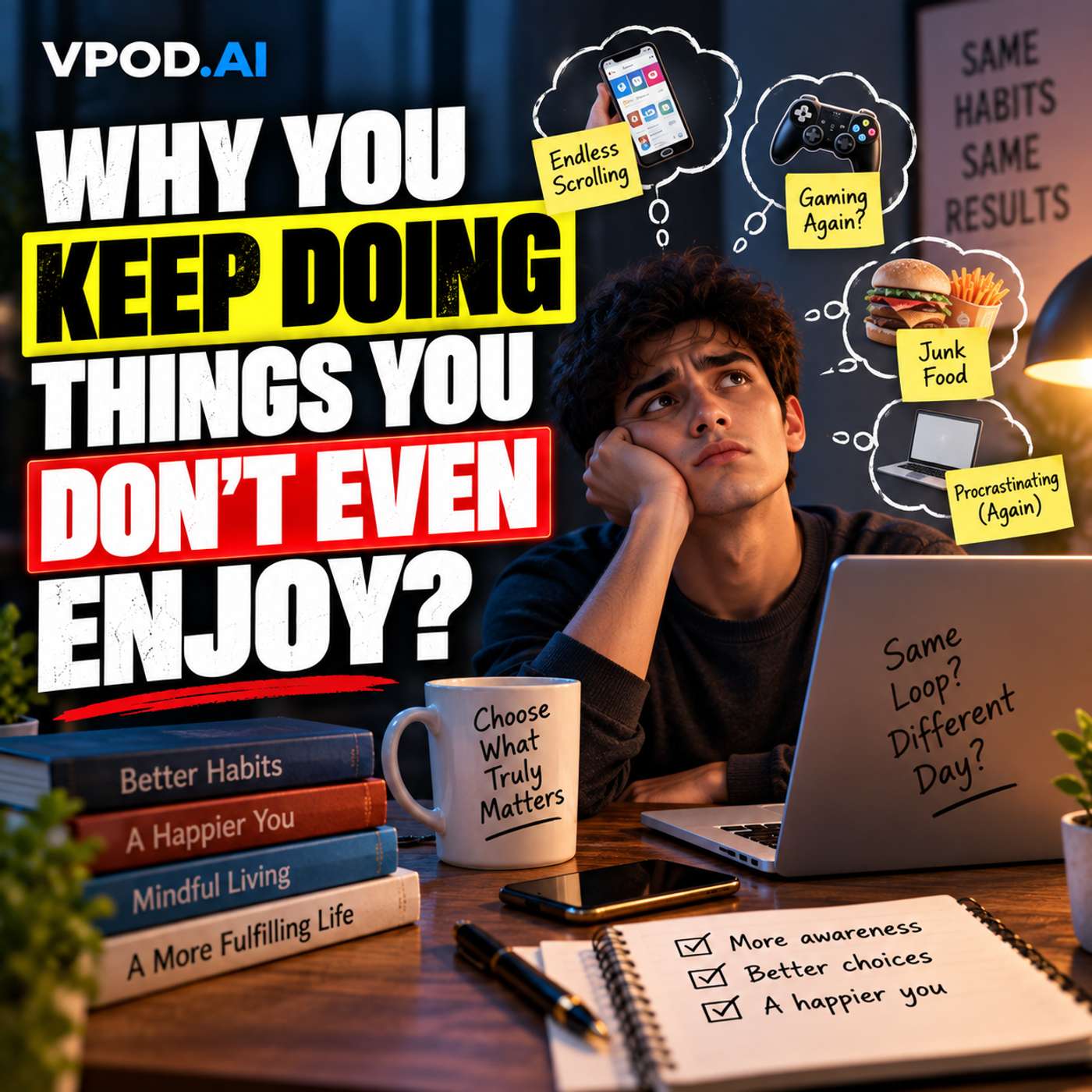





Why do you keep reaching for your phone when you’re not even enjoying what’s on the screen? Why can a craving feel urgent even when you know the reward won’t be worth it?
In this episode of vpod.ai, Mike and Susan explore the biology behind compulsive behavior—and the crucial difference between “wanting” something and actually “liking” it.
The episode examines incentive sensitization theory, dopamine’s role in pursuit and anticipation, environmental triggers, and the neurological loops that can make familiar behaviors feel automatic. Using the memorable “doorbell” analogy, they explain how a cue can become increasingly difficult to ignore even as the reward on the other side becomes less satisfying.
The conversation explores:
- Why dopamine is connected to pursuit rather than simply pleasure
- How “wanting” can grow while genuine enjoyment declines
- What research involving Vietnam veterans suggests about environmental cues
- Four rationalizations that can keep compulsive habits alive
- Why shame and stress can intensify destructive behavioral loops
- Why relying entirely on willpower can become a war of attrition
- How “urge surfing” changes your relationship with cravings
- Why paying close attention to an unwanted habit may expose its real reward
- How adding friction to your environment can interrupt automatic behavior
- Why rebuilding genuine enjoyment through slower rewards matters
The goal isn’t to eliminate every craving. It’s to create a larger gap between the signal and your response—a moment in which you can notice the urge without automatically obeying it.
The episode also includes an important distinction between behavioral compulsions and severe physical dependence on substances, where stopping suddenly can require professional medical support.
If you’ve ever wondered why scrolling, gambling, vaping, junk food, gaming, or another repetitive behavior can keep pulling you back long after the enjoyment fades, this episode offers a different way to think about the loop.
Listen to the full episode, share it with someone who might find it useful, and subscribe to vpod.ai for more explorations into the forces shaping human behavior.